Showing posts with label Defense of Bataan. Show all posts

Thursday, April 10, 2025

National Former POW Recognition Day

Wednesday, April 9, was National Former POW Recognition Day in the United States and 
the Day of Valor (Araw ng Kagitingan) in the Philippines. Both memorialize the 83rd anniversary of the surrender of the Bataan Peninsula to invading Imperial Japanese forces.

Every year, there is a formal ceremony on Mt Samat that features the Philippines' president, cabinet, and foreign dignitaries. President Ferdinand R. Marcos Jr.'s anniversary statementlike last year's, again made no mention of Japan and simply asked Filipinos to follow the example of their country's World War II heroes. 

As you can see from this video, no one, not the president of the Philippine, not the Secretary of the Department of National Defense Gilberto Teodoro, not the Armed Forces of the Philippines chief Gen. Romeo Brawner Jr., nor the deputy chief of mission of the US EmbassyY. Robert Ewing, identified in their remarks who the enemy was during the battle of Bataan. Japan as a perpetrator and invader was missing from all the statements with the exception of the one by the Japanese ambassador

Ambassador Endo Kazuya did not directly say who were the "courageous souls who made the ultimate sacrifice." Instead, he listed the various ways Japan has been helping the Philippines. He only observed that "By facing our history and sincerely reflecting on the deeds and sacrifices during those dark times, we lay the very foundation of our future-oriented partnership – one built upon mutual respect, understanding and trust."  The defenders of the Philippines have faded into their islands' invaders. 

In the U.S. the Philippine Embassy and the Washington Filipino Community held a program at the National WWII Memorial remembering Bataan.  On April 5, the Bataan Legacy Historical Society held a grand commemoration at the San Francisco National Cemetery for the 83rd Anniversary of the Bataan Death March and 80th Anniversary of the end of WWII. On April 4, the 14th Annual Chesapeake Bataan Death March Memorial Walk was held in Chesapeake, Virginia and attended by crew members of the Wasp-class amphibious assault ship USS Bataan (LHD 5)

Neither the House or Senate Veterans Affairs Committees issued statements on April 9. None of the committee members did either. Maybe next year we can organize a letter writing campaign to encourage them to acknowledge National Former POW Recognition Day. Frankly, there is the same silence on National POW/MIA Recognition Day in September. 

By a law, signed by President Ronald Reagan on April 1, 1988, presidents are obligated to issue a proclamation to commemorate National Former POW Recognition Day and the unique service of POWs. This year's proclamation was a bit different from others. It was issued late in the day--proclamations are usually issued the day before--and less focused on POWs. See HERE.

Talking about "Bataan," the Department of Defense removed at least 13 public webpages that mentioned Bataan. This was part of a purge of DOD websites that were believed to display some sort of diversity, inclusion, and equality content. A 59-word list was presented to help identify content for removal. The list included "history," "respect," and "dignity."

This database, put together by Associated Press, identifies 13 webpages removed that mentioned Bataan: 9 about the Bataan Death March Memorial at the Kessler Air Force Base in Biloxi, MS; 3 reporting honoring Bataan Death March victims at the Osan Air Base in South Korea; and one at the Misawa Air Base in Japan reporting on the Osan ceremony.

When I first looked at this database, when the controversy was reported in March, I only found three webpages that mentioned Bataan. They all originated at an air base in New Mexico. Unfortunately, I did not record this. These pages appear to have been reinstated. 

Saturday, October 26, 2019

75th Anniversary of the Arisan Maru Tragedy


A ship similar to the Arisan Maru
October 24th is the 75th Anniversary of the sinking of the hellship Arisan Maru in the Bashi Channel between Formosa and Luzon.

It was the largest naval disaster in American history. In comparison, more than 1,500 perished on the RMS Titanic.

Seven hundred miles south raged the Battle of Leyte Gulf (October 23–27, 1944) to liberate the Philippines.

The Arisan Maru went down with 1,774 mostly American POWs of Japan. It was torpedoed by either the submarines USS Shark (SS-314) or the USS Snook (SS-279). The Shark was attacked and destroyed at the same time, adding 87 more Americans to the missing. The Snook was lost six months in the Luzon Strait later on April 8, 1945 with 60 onboard.

t is said that nearly all the POWs were able to make it into the water. Wearing life belts and clinging to rafts, hatch boards, and any other flotsam and jetsam, the POWs struggled through the night in the rough, cold waters of the South China Sea. The Japanese ships nearby refused to rescue them. By morning, all but nine were dead.

Memorial at the National Pacific War Museum
Dedicated October 24, 1999
Of the nine POWs that survived, four were eventually rescued by the Japanese and taken to Formosa. And five managed to find a life raft, a sail, food, and water. They navigated by the stars 200 miles to the Chinese coast where they were rescued by friendly Chinese and taken to an American base hundreds of miles inland.

Of the four taken to Taiwan, Texan Army Pvt. Charles W. Hughes, a member of the Coast Artillery assigned to the 31st Infantry HQ, died November 9, 1944 at the Shirakawa POW camp on Formosa. 

The remaining three were moved to various camps on Formosa. US Army Air Corps medic and Bataan Death March survivor SSgt. Philip Brodsky was moved among four camps on the Island. Chief Boatswain Martin Binder USN assigned to the USS Pigeon (ASR-6) spent the rest of the war at the Toroku POW Camp. On January 19, 1945, Cpl. Glenn Oliver, who was with the 194th Tank Battalion on Bataan was sent to Japan aboard the Melbourne Maru. He spent the remainder of the war working as a stevedore at Osaka POW Camp #10-B Maibara near Lake Biwa in Shiga Prefecture. 

The story of the survival of the five who sailed to China, is nothing less than mythic. Much of their accomplishment was due to Baltimore native Robert S. Overbeck, who must have been a son of Neptune. Overbeck, a Columbia University graduate, was working as a mine foreman and mine superintendent in the Philippines when the Japanese attacked Pearl Harbor. He joined the Army that day.

He participated in the defense of Bataan and survived the Bataan Death March, Camp O'Donnell, Cabanatuan POW Camp, and Bilibid Prison. After U.S. aerial attacks on Manila September 21-22, 1944 (Overbeck says early October), men were boarded on the Arisan Maru on October 10th. They were kept in the sweltering holds for ten days as the hellship inched toward Palawan and then returned to Manila after more Allied air raids. On October 21, the Arisan Maru departed Manila for the final time, joining convoy MATA-30 heading for Takao, Formosa (Taiwan).

American torpedoes hit the hellship on October 24th breaking it in half. As Overbeck tells the story, he was oddly prepared. He had changed to shorts and had a life vest before he made his way into the water. After being refused rescue by a Japanese destroyer, he spied a life boat and threw off his life vest to swim to it. During the night he acquired four passengers. By morning they could no longer see anyone in the water.

Overbeck found a box with a sail floating near the life boat. Later, a keg of water was found and some hard tack ration was on board. 

1st Sgt. Calvin R. Graef, a member of 200th Coast Artillery from Silver City, New Mexico had, like Overbeck survived battle on Bataan and the Bataan Death March.

Pvt. Avery E. Wilber,  a member of the 60th Coast Artillery (AA), Battery A from Maine had also survived battle on Bataan and the Bataan Death March. 

Cpl. Donald E. Meyer, a member of the US Army Air Corp, 693 Aviation Ordnance Company, 24th Pursuit Group from California had been at Nichols Field when Japan attacked. He had suffered a depressed skull fracture and a dislocated hip during the fighting on Corregidor. Doctors at Bilibid Prison were able to repair both. [looking for links]

Pvt. Anton E. Cichy, a member of H Company of 194th Tank Battalion from Minnesota, had also survived battle on Bataan and the Bataan Death March. 

Overbeck, more civilian than Army, was the only one with sailing experience and automatically took over command. Knowing roughly where they were at the time of the sinking, being able to visualize the coast of China as running approximately north northeast in these latitudes and having a good idea of the wind direction from the rising sun, he thought it "was easy to decide" on a rough course which would take us to China.

They made it the 250 miles in two and one-half days by following the stars. A Chinese junk rescued the and first took them to Kitchioh [Jieshi] a town in  Lufeng, Shanwei Municipality, Guangdong midway between Hong Kong and Shantou [Swatow] and then up the coast to Hoifung.

The journey then continued to the interior to Hingning-a refugee town right out of a Star Wars movie. The former POWs were treated like royalty by the Chinese in every village they entered. For 12 days the five survivors were transported about 600 miles by foot, truck, bicycle and plane to Kunming airfield, base of the 14th Air Force and the former Flying Tigers. On November 28, 1944 they started their flight aboard a C47 back to the USA. 

SEE:
Arisan Maru: America's Worst Naval Tragedy - Paperback – March 18, 2019 by Don Treichler
The Last Voyage of the Arisan Maru - Paperback - June 30, 2008 by Dale Wilber
Ride the Waves to Freedom: Calvin Graef's Survival Story of the Bataan Death March and His Escape From a Sinking Hellship  - Paperback - 1999 by Melissa Masterson

Tuesday, April 09, 2019

National Former POW Recognition Day - April 9

There were two starting points for the Bataan Death March:
the west coast beach town of Bagac and the port town of Mariveles at the tip of Bataan.
The above picture is of the park at Mariveles.

Since 1988, with Public Law 100-269, Congress designated April 9th as "National Former Prisoners of War Recognition Day" and authorized and requested the President to issue a proclamation in observance of this event.

April 9, 2019 is also the 77th Anniversary of the fall of Bataan in the Philippines and the surrender of 78,000 American and Filipino troops to invading Japanese forces. It is the start of the infamous Bataan Death March on which as many as 12,000 died.

On the first permanent National Former Prisoners of War Recognition Day, April 9, 1988, President Ronald Reagan said:

“…It is truly fitting that America observe April 9 in recognition of our former prisoners of war; that date is the 46th anniversary of the day in 1942 when U.S. forces holding out on the Bataan Peninsula in the Philippines were captured. Later, as prisoners of war, these gallant Americans were subjected to the infamous Bataan Death March and to other inhumane treatment that killed thousands of them before they could be liberated. In every conflict, brutality has invariably been meted out to American prisoners of war; on April 9 and every day, we must remember with solemn pride and gratitude that valor and tenacity have ever been our prisoners’ response.”

Never Forget

Tuesday, September 05, 2017

‘I didn’t think I would live this long

World War II veteran and Bataan Death March survivor Eddie Graham turns 100 on September 5th

The Wichita Eagle, September 2, 2017 5:47 PM

BY STAN FINGER

Eddie Graham never expected to see this day.

Not after trudging more than 60 miles through the jungles of the Philippines at gunpoint in what became known as the Bataan Death March in World War II.
c
Or seeing fellow prisoners marched away, never to return. Or subsisting on a cup of rice a day, often less because he would sneak some of his portion to others in poor health.

Or digging a new trench every day to bury those who had died overnight, sometimes stacking the bodies four or five deep.

“No, I didn’t think I would live this long,” Graham said softly as he looked around at the large crowd gathered in north Wichita to celebrate his 100th birthday on Saturday. “But I’m still here. Somebody’s watching over me.”

Graham’s birthday is actually on Tuesday, but celebrating it on Saturday carried significance: it not only meant relatives could converge on Wichita from around the country, it was the same day Japan formally surrendered aboard the U.S.S. Missouri in 1945, ending World War II.

Barely more than 50 survivors of the Bataan Death March are still alive.

“When I was a kid, my aunt — Eddie’s wife — told us not to ask him questions because it would cause him to have nightmares at night,” said Wanda Graham, who lives in Portales, N.M. “So we never talked about it.”

Graham kept those horrific memories tucked away until he was into his 90s, when the brother of his caretaker talked him into speaking to a class at a Maize school. That brother is now the mayor of Wichita.

>>>>>>>>>>>>>>>>>>>>>>>>>>>>>>

Graham voluntarily enlisted in the New Mexico National Guard and was assigned to the 200th Coast Artillery Regiment at an American base in the Philippines two months before the attacks on Pearl Harbor December 1941. He fought in the Battle of Bataan and then with nearly 75,000 American and Filipino troops forced on the 65 mile infamous Bataan Death March to Camp O'Donnell. When the camp closed he was transferred to Camp Cabanatuan to work in the fields. On 20 September 1943 with 850 prisoners he was taken aboard the Taga Maru in Manila, also known as the Coral Maru.Seventy men died during the 15 day voyage to Moji, Japan via Formosa. In Japan, he was taken to Osaka where he became a slave laborer at a steel mill for Nippon Steel in Hirohata Osaka 12-B POW Camp (also known as Harima "O" Camp or Hirohata Divisional Camp). Nippon Steel still exists today as Nippon Steel & Sumitomo Metal Corporation. This company has yet to issue an apology to the hundreds of Allied POW slave laborers it used against the Geneva Convention during the War. Interestingly, former Amb. Ichiro Fujisaki, who arranged for Japan's official apology to the POWs in 2009 and reconciliation trips, is on the company's board.

<<<<<<<<<<<<<<<<<<<<<<<<<<<<<<

The memories have been trickling out since then, friends and relatives say.

He has never considered himself a hero. He credits his survival to faith and good fortune, friends and family say.

Mayor Jeff Longwell said he asked Graham where he found the strength to persevere during those dark days. Prayer, Graham told him.

One of the few personal items Graham was allowed to keep as a prisoner was his rosary. A devout Catholic, he prayed that rosary every day.

There are moments during his time as a prisoner of war for which there is no explanation, relatives said.

One was when the prisoners were separated into two long lines. Graham was in one line, but felt uneasy about it.

“He didn’t know why, but he felt like he needed to get into the other one,” said Janelle Longwell, the sister-in-law of his caretaker.

When the guards moved out of view, Graham slipped into the other line. The line of prisoners he had been in was marched into the jungle — and never returned.

One day in camp, Graham and a few other prisoners were given red ribbons, Wendy Graham said. Filled with another uneasy feeling, Graham hid the ribbon in the dirt when no one was looking.

He then darted over to the prisoners without ribbons. The prisoners with ribbons were never seen again.

After he was finally liberated, Graham returned to the U.S. and settled into civilian life. He married soon after the war and raised a family, working as a carpenter.

He has always laughed easily and forgiven quickly, relatives say. He harbored no bitterness toward his captors or the Japanese soldiers.

“They were just doing their job,” he told family.

He’s almost impossible to beat at cards and his mind is still sharp at 100, his sister-in-law Angie Graham said.

Graham is more than willing to go serve his country again if called, Longwell said, though he admits that at 100 he doesn’t move as fast as he once did.

“A few years ago, I asked him, ‘What’s the best thing that’s happened to you? What’s the best thing that you’ve experienced?’ ” Wendy Graham said. “And he said, ‘Life.’

“He realized that was the most valuable thing that he had.”

Sunday, April 02, 2017

Obligation and the Bataan Death March Memorial

99-year-old Ben Skardon completes 10th walk in Bataan Memorial Death March 


Skardon, a newly minted captain in 1941, led Company A of the 92nd Infantry Regiment PA (Philippine Army), a battalion of Filipino Army recruits on the Bataan Peninsula. Skardon started out with 120 men in his command, and ended in April, 1942, with 60 men left. He himself was in hospital for malaria when the surrender came, but was ambulatory and forced to make the Death March. He earned two Silver Stars and four Bronze Stars for valor. He also survived 3 years in POW camps on the Philippines, the bombing and sinking of two unmarked hell ships by US planes as he was shipped to China. He survived to become a professor of English literature at Clemson University.
March 30, 2017

WHITE SANDS MISSILE RANGE, New Mexico — The 75th anniversary of World War II’s infamous Bataan Death March was commemorated by 7,200 participants who gathered in the wee morning hours for the 28th Bataan Memorial Death March, Sunday, March 19.

 Once again, Clemson University alumnus and professor emeritus Ben Skardon, 99 years young, was the oldest participant and the only survivor of the real Bataan Death March who walked in the event. 

He walked eight and a half miles through the unforgiving New Mexico desert, with temperatures reaching 90 degrees, and refused to stop until he matched his distance from the previous nine years. Skardon is a Clemson institution, so Clemson orange was the color of choice for the 64 members of “Ben’s Brigade” — the die-hard support group made up of friends, family, former students and relatives of his fellow prisoners of war — who accompanied him. The swarm of orange T-shirts was only given competition as Skardon crossed through several bright yellow fields of blooming California poppies between the four- and six-mile markers.

Skardon stopped at each mile marker to address his Brigade, usually with a joke or the cry “Oosh!” which is the command he says his Japanese captors gave to keep moving.

As the temperature rose, members of Ben’s Brigade took turns holding an American flag at angles that would shade him. He moved at his normal pace of two miles an hour, but stopped to rest or talk to people several times between each mile marker — something he hadn’t done in years past. Spirits rose as they reached one mile marker after another, but there was concern he might not make it the whole way this year. He had just recovered from a bout of the flu weeks earlier, and the temperatures were 10 degrees hotter than in previous years. It would take nothing away from him if he couldn’t go his traditional 8.5 miles again — if he only walked a mile it would still be an astounding feat — but nobody could question the power of his will either. He never mentioned quitting.

At mile marker six, he left the road to sit on a folding chair and rest in the shade of one of the support tents. The members of Ben’s Brigade, themselves sweaty and tired at this point, gratefully accepted water and gatorade from the volunteers who had waited for them. Somebody put a wet handkerchief around Skardon’s neck and handed him an orange slice to suck on. The two Army medics assigned to him took his vital signs and suggested he should take it easy on himself this year.

“Four minutes,” he said.

Four minutes later, he stood up and walked on.

At mile marker eight, Ben’s Brigade gathered around him one more time.

“Our destiny is right here,” he told them. “What I want to say is ‘thank you,’ and if I haven’t already shaken hands with you, please shake my hand after this. I can’t tell you, personally, how much this has meant to me, especially the new people who come out here for 8.5 miles. A few of you still go out and do more and that’s more power to you, [but] the power in my feet has gone! I have two very stalwart gentleman [the Army medics] who are actually dragging me through to the finish line. It touches me every time I look around and see you. So goodbye to a lot of you. This is the last point we’ll all be together today. Once we get to the finish line, they take me to an air-conditioned tent. You’ll all have to sweat it out!”

At that point nobody in Ben’s Brigade doubted he would reach his goal of 8.5 miles again. They weren’t wrong. He crossed the finish line less fifteen minutes later.

The Bataan Memorial Death March honors a special group of World War II heroes responsible for the defense of the islands of Luzon, Corregidor and the harbor defense forts of the Philippines. On April 9, 1942, tens of thousands of American and Filipino Soldiers were forced to surrender to Japanese forces. The Americans were Army, Army Air Corps, Navy and Marines. Among those seized were large numbers of the 200th Coast Artillery, New Mexico National Guard — the reason the memorial march is held in New Mexico.

Often overlooked are the four months of fierce fighting that took place before the American and Filipino forces surrendered. For instance, Skardon earned two Silver Stars and four Bronze stars during that short time span.

This was Skardon’s 10th time walking in the march, which he considers a personal pilgrimage. He says it’s his sacred responsibility to attend every year and walk with the thousands of others who come to honor those who didn’t survive the real Bataan Death March or the years of confinement in prisoner of war camps that followed.

“Coming here is an obligation,” he said. “I ought to do something, and the best way I know, physically, is to walk every time I get a chance in their memory.”

He says nothing he does now, even at 99, can compare to the ultimate sacrifice of his brothers-in-arms who didn’t return from the war.


“The word ‘hero’ does not apply to me at all,” he insists, quoting the Bible verse John 15:13: “‘Greater love has no man than this, than to lay down his life for his friends.'”

Tuesday, December 20, 2016

Buy the 75th Anniversary mug commenorating the Defense of the Philippines

Please support our research and remembrance of the American POW experience with Imperial Japan by purchasing our commemorate mug of this year's 75th Anniversary of Defense of the Philippines.

For tax-deductible donations of $35 or more we will send you this statement mug. CLICK HERE TO ORDER. Please remember to include your address.Thank you

Saturday, May 14, 2016

Obama must memorialize more than Hiroshima

memorial to American POWs
who died in Hiroshima
On May 27th, U.S. President Barack Obama and Prime Minister Shinzo Abe will together visit together the Hiroshima Peace Memorial.

There has been much commentary on this, most to create a climate of acceptance of this historic visit. Few give the perspective of the American POW. Many assume it will be negative. This is not necessarily true.

Below is an op ed that appeared on May 11th in The Wall Street Journal Online by Dr. Lester Tenney. He tries to give some nuance to how a Pacific War veteran may view the visit.

For the POWs, who have so often have been abandoned by the White House, this is an opportunity to insist that they must be remembered.

To this end, a memorial needs to be erected at the Port of Moji on Kyushu that is part of a UNESCO World Heritage site; Japan’s new UNESCO World Industrial Heritage sites must note that American and Allied POWs were slave laborers at these sites; and that the POW visitation program must be turned into a permanent program of remembrance, reconciliation, and education.

On May 12th, National Security Advisor Susan Rice held a meeting with veterans organizations to review the President’s upcoming trip to Vietnam and Japan. The American Defenders of Bataan and Corregidor Memorial Society was not invited. Rice said the President’s decision to visit Hiroshima, Japan was “to honor the memory of all who lost their lives during World War II.” We shall see.

Remembering More Than Hiroshima
We must not forget the lives lost and trauma incurred by Allied forces during the Pacific War.

By LESTER TENNEY
Wall Street Journal, May 11, 2016 12:15 p.m. ET

A black man was the first American soldier to die in World War II. An unexploded bomb from a Mitsubishi “Betty” split U.S. Army Pvt. Robert Brooks in two on December 8, 1941, as he ran to the machine gun on his half-track at Clark Field in the Philippines. Like me, he was a member of the 192nd Tank Battalion preparing to fight the invading Imperial Japanese forces. It is fitting that our first black president will soon stand at Hiroshima, where the Pacific War began its end.

Pvt. Brooks’s sacrifice and those of thousands of American and Allied forces who fought and died for freedom in the Pacific must never be forgotten. What Hiroshima represents is more than the effects of a nuclear weapon. It is the culmination of a war started by Imperial Japan and conducted with gross inhumanity, a war in which more civilians died than combatants.

It would be wrong for the president to pivot away from this history and use his visit solely to discuss aspirations for a world without nuclear weapons. Hiroshima highlights mankind’s tragic ability to wreak terrible destruction, and this destruction was not caused exclusively by atomic bombs. Sand-filled bamboo sticks, bayonets, plague-inflected fleas, starvation and rape—methods of warfare used by Japan—are also destructive.

When President Harry Truman announced the bombing of Nagasaki, which ended the war, he recognized “the tragic significance of the atomic bomb.” However, he went on to explain “we have used it against those who attacked us without warning at Pearl Harbor, against those who have starved, beaten and executed American prisoners of war, against those who have abandoned all pretense of obeying international laws of warfare. We have used it in order to shorten the agony of war, in order to save the lives of thousands and thousands of young Americans.”

As a former American POW of Japan, I am particularly sensitive to these words. Truman was looking out for me and more than 27,000 other American POWs in Asia. Until then, we felt forgotten and ignored. The “Europe first” policy of Franklin Roosevelt and Winston Churchill abandoned us to fight without resupply or reinforcement on the Philippines at the start of World War II. We became POWs for more than three bitter years.

We endured four unforgiving months of tank warfare in the tropical heat on Bataan against an enemy with superior training, equipment and provisions. Surrendered by our commanders, nearly 80,000 of us American and Filipino troops were forced on the Bataan Death March. The surviving 68,000 arrived at Camp O’Donnell, a prison camp that saw up to 300 die daily.
The camp commandant ranted at us that we were lower than dogs and better off dead, as we would always be enemies of Japan. I must say that many times I had to agree.

After a period in the camp, many of us went by “hell ship” to Japan to become slave laborers. In my case, it was in a dilapidated Mitsui coal mine. My friend from Janesville, Wis., Capt. Fred Bruni, had a different experience. He and 150 men from the camp were sent to Palawan Island to build an airfield. Upon completion, all the men were set afire and machine-gunned by the Kempeitai.

We POWs have tried to preserve this history despite U.S. and Japanese government efforts to suppress it. Upon liberation, most of us were forced to sign gag orders not to discuss the horrors of our imprisonment. The U.S. government’s policy was to pacify Japan in part by curbing memories of its war atrocities. Central to the 1952 San Francisco Peace Treaty is an article foreclosing any further compensation of victims, thus again preventing the recall of Imperial Japan’s past crimes and abuses.

At home, an underfunded Veterans Administration refused to give us full disability and ignored or misunderstood the aftereffects of vitamin deficiency, tropical diseases and trauma. It took two acts of Congress before we received any compensation for our imprisonment and only at a rate of $1.50 per day for lost meals.

The U.S. government abandoned the Pacific War’s history. This has made efforts to hold Japanese companies accountable for their brutal use of POW slaves nearly impossible. It is taboo to associate high-speed rails, luxury automobiles or Washington’s metro cars with companies that once abused Americans. Among the nearly 60 well-known companies such as Mitsui, Mitsubishi, Sumitomo, Kawasaki and Nippon Sharyo, only the Mitsubishi Materials Company, which used POWs in four of its mines, has apologized.

In recent years the Japanese government has finally begun to make amends to American POWs. They offered an official apology in 2009. At the Obama administration’s urging, they established in 2010 a reconciliation program for former POWs to visit Japan. Unfortunately the program will end this year without any follow-up for descendants or the public.

But history is critical to how we understand ourselves. No one knew Pvt. Brooks’s race until the Army wanted to honor him. When news of his death reached Fort Knox, the chief of the armored force, Gen. Jacob Devers, decided that a parade ground should be named in his memory, because the first American tanker to die in World War II should not be forgotten.

When it was discovered that Pvt. Brooks’s parents were black tenant farmers from Sadieville, Ky., the general was asked if he wanted to reconsider. “No,” he answered, “it did not matter whether or not Robert was black, what mattered was that he had given his life for his country.” As Gen. Devers said at the Brooks Field dedication ceremony, “In death there is no grade or rank. And in this greatest democracy the world has ever known, neither riches nor poverty, neither creed nor race, draws a line of demarcation in this hour of national crisis.”

Mr. Obama wants to use his visit to Hiroshima to highlight the perils of nuclear war. But this is not the only lesson. Our service as veterans of the Pacific War needs to be remembered and not abandoned to some tumid oratory. The president’s visit to Hiroshima will be hollow, a gesture without motion, if the Pacific War’s full history is not maintained. Hiroshima does not and cannot exist outside the context of the Asia-Pacific War and all its dead.

Mr. Tenney, 95, was a member of the 192nd Tank Battalion, Company B that defended the Philippines in World War II. He lives in San Diego.

Saturday, April 09, 2016

April 9 - Remember Bataan

Presidential Proclamation -- National Former Prisoner of War Recognition Day, 2016

NATIONAL FORMER PRISONER OF WAR RECOGNITION DAY, 2016
- - - - - - -
BY THE PRESIDENT OF THE UNITED STATES OF AMERICA

A PROCLAMATION


Under the flag of the United States, generations of women and men, united in a common cause greater than themselves, have served to defend the ideals that bind us together as a Nation and that preserve our country as a beacon of hope and freedom around the world. On National Former Prisoner of War Recognition Day, we salute the selfless service members throughout our history who gave of their own liberty to ensure ours, and we renew our commitment to remaining a Nation worthy of their extraordinary sacrifices.

In wars and engagements since America's founding, brave patriots have experienced indescribable suffering as prisoners of war. Often physically and mentally tortured, starved, and put through the worst most of us could imagine, these heroes are owed a debt we can never fully repay, and their families -- who exhibited tremendous fortitude in the face of grueling uncertainty -- are worthy of our profound gratitude. The values of honor, courage, and selflessness that drive our Armed Forces are particularly acute in those who have been taken as prisoners of war, sustaining them through days, weeks, and sometimes years of profound hardship endured for the sake of securing the blessings of liberty for all.

America's former prisoners of war -- and all who don our uniform to keep us safe -- have helped make our Nation the strongest and most prosperous in the history of the world. Our eternal obligation is to care for them and uphold our everlasting promise to never leave our men and women on the battlefield behind. Let us reaffirm our adherence to these ideals and honor our former prisoners of war by paying them the gratitude and respect they deserve.

NOW, THEREFORE, I, BARACK OBAMA, President of the United States of America, by virtue of the authority vested in me by the Constitution and the laws of the United States, do hereby proclaim April 9, 2016, as National Former Prisoner of War Recognition Day. I call upon all Americans to observe this day of remembrance by honoring all American prisoners of war, our service members, and our veterans. I also call upon Federal, State, and local government officials and organizations to observe this day with appropriate ceremonies and activities.

IN WITNESS WHEREOF, I have hereunto set my hand this eighth day of April, in the year of our Lord two thousand sixteen, and of the Independence of the United States of America the two hundred and fortieth.

Sunday, April 05, 2015

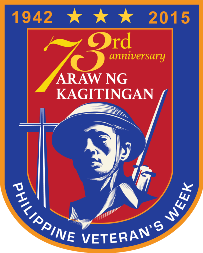
73rd anniversary of the Fall of Bataan April 9, 2015


Today, March 5th, the start of Philippine Veterans Week.

The Philippines and Filipinos throughout the US will observe the 73rd anniversary of the Fall of Bataan this coming Thursday, April 9th.

The day, also referred to as “Araw ng Kagitingan” (Day of Valor) is a legal holiday nationwide as stipulated in Republic Act 3022 which President Carlos P. Garcia signed in 1961. Read the full text of RA 3022 in this link.

The law calls on all Filipinos particularly their public officials to observe a one-minute silence at 4:30 o’clock in the afternoon of April 9 and to hold appropriate rites in honor of the veterans of the Fall of Bataan in particular and World War II in general.

The Fall of Bataan happened in April 9, 1942, when Filipino and American fighters isolated for months in Bataan surrendered to the Japanese Imperial Army under General Masaharu Homma.

This came after Major General Edward P. King of the United States Armed Forces in the Far East (USAFFE) came to the conclusion that further attempts to stop the Japanese from advancing would be useless. Most of the survivors of the Japanese offensive were then forced to march from Mariveles, Bataan all the way to San Fernando, Pampanga before traveling in tiny box cars via train to Camp O’Donnell in Tarlac.

The 65-BATAAN DEATH MARCH killed approximately 8,000 Filipino and 600 American troops.  At Camp O'Donnell thousands died. During the first 4 months 300 POWs died a day.

In Washington, a memorial will be held on April 9th at the World War II Memorial on the Mall and Embassy of the Philippines.

SCHEDULE PART I – WREATH LAYING CEREMONY
VENUE: WWII MEMORIAL, National Mall 
TIME: 4:45 – 5:30 PM

PARTICIPANTS

* VFW Washington Department Color Guard (Color Guard Commander – Jay Cabacar)
* Taps to be performed by James Cruzada Alleva
* Philippine Embassy Personnel
* FIL-AM Community of Metro DC
* Other Guests

SEQUENCE

* 4:45 – 5:15 PM : Assembly
* 5:15 – 5:30 PM : Wreath Laying Ceremony
HON. PATRICK CHUASOTO Chargé d’ Affaire, Philippine Embassy
* 5:30 PM : End of Ceremony
* 5:30 – 6:00 PM – DEPARTURE & PROCEED TO ROMULO HALL, PHILIPPINE EMBASSY

PART II – COMMEMORATION PROGRAM

VENUE: ROMULO HALL, PHILIPPINE EMBASSY 
TIME: 6:30 – 8:30 PM

* Philippine & US National Anthem (James Cruzada Alleva- Trumpet)
* Invocation – (WW2 Veteran)
* Recognition of WW2 Veterans and families present
* Welcome Remarks & Introduction of the Speaker - MGen Delfin N. Lorenzana AFP(Ret)
* Remarks: HON. PATRICK CHUASOTO
Chargé d’ Affaire, Philippine Embassy
Dinner/Refreshment
* Video/Film Clips Showing:
*Death March Recollection – by a veteran
*26th Annual Bataan Memorial March (3/22/2015)

Contact:
Office of Veterans Affairs
Embassy of the Philippines
Tel: 202-467-9427; 202-467-9410

Wednesday, January 28, 2015

The day we knew - Japan's war atrocities


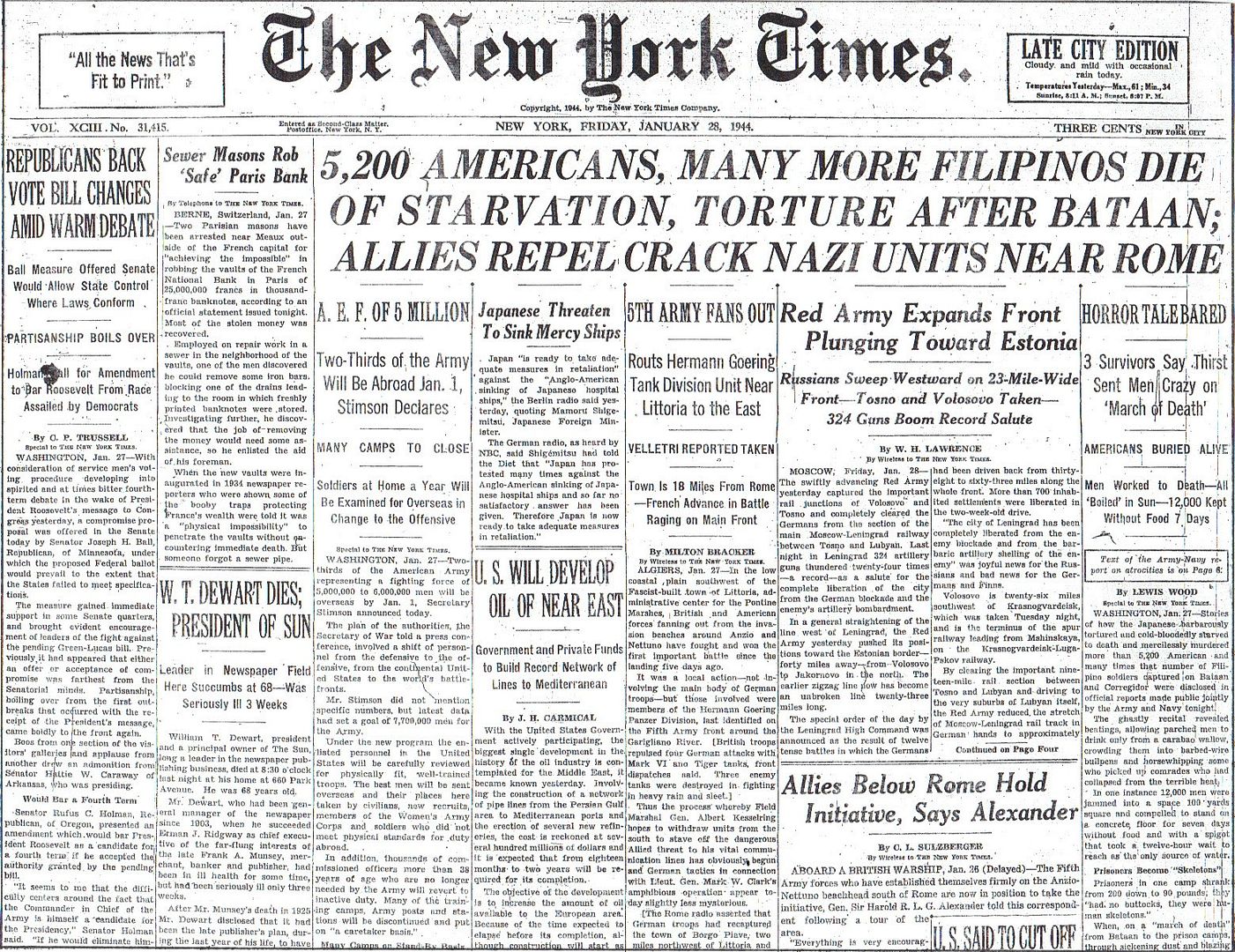
Seventy-one years ago today, the headlines across the United States screamed of the brutality of Imperial Japan. Prisoners, civilians, women, children had been tortured, starved, and slaughtered in the Philippines. The rumors of unimaginable savagery toward its captive peoples had all proved true.

On January 28, 1944, the world first learned about the Bataan Death March (April 1942) and the horrors endured by the American and Filipino POWs of Japan. Invading Japanese forces showed no mercy, allowing their prisoners to die by the thousands from savagery, starvation, and disease.

click to order
Newspapers and newsreels told the stories of three American escapees from a Japanese POW camp in the Philippines who had survived the Death March the Davao Prison Camp. Never before had the public been allowed to hear of the extent of Japanese atrocities and the inhumanity of their regime. Washington had kept the story from the public, fearing that the Japanese would use it as an excuse to end efforts to aid the POWs or worse.

Congressman and editors cursed Churchill and Roosevelt for advocating a Europe First strategy that put aside the war in Asia in favor of focusing on Hitler in the West. The result was the smashing of American air and sea power in Asia, the largest defeat in US military history, and the unfathomable deaths of thousands of Americans both military and civilian in the Pacific.

The truth aroused such fury in the American public that the government’s Europe First policy was imperiled. On January 29th at the Brooklyn Navy Yard, Margaret Truman, Missouri senator Harry Truman’s daughter, expressed the feelings of her fellow Americans when she said as she christened the battleship USS Missouri, “May this great ship be an avenger to the barbarians who wantonly slaughtered the heroes of Bataan.” *

click to order
More war bonds were sold in January and February 1944 than in any period of the war. The graphic description of the Death March and the POW camps was serialized by the Chicago Tribune and made into a book. The hero of the story, Texas native and US Army Air Corps William Dyess who organized the escape, unfortunately died December 1943 in a plane crash barely a month before the public release of his story.

The public learned that American and Filipino forces fought from an untenable position until formally surrendering to the Japanese on April 9. The Japanese immediately began to march some 76,000 prisoners (12,000 Americans, the remainder Filipinos) northward into captivity along a 65-mile route of death.

Japanese butchery, disease, exposure to the blazing sun, lack of food, and lack of water took the lives of approximately 5,200 Americans and Filipinos along the way. Many prisoners were bayoneted, shot, beheaded or just left to die on the side of the road. "A Japanese soldier took my canteen, gave the water to a horse, and threw the canteen away," reported one escapee. "The stronger were not permitted to help the weaker. We then would hear shots behind us." The Japanese forced the prisoners to sit for hours in the hot sun without water. "Many of us went crazy and several died."

The ordeal lasted five days for some and up to twelve days for others. Although the Japanese were unprepared for the large number of prisoners in their care, the root of the brutality lay in the Japanese attitude that a soldier should die before surrender. A warrior's surrender meant the forfeiture of all rights to treatment as a human being.

This was the "first murder" Captain William Dyess said he witnessed:
"The victim, an air force captain, was being searched by a three-star private. Standing by was a Jap commissioned officer, hand on sword hilt. These men were nothing like the toothy, bespectacled runts whose photographs are familiar to most newspaper readers. They were cruel of face, stalwart, and tall. 
'The private a little squirt, was going through the captain's pockets. All at once he stopped and sucked in his breath with a hissing sound. He had found some Jap yen.' 
'He held these out, ducking his head and sucking in his breath to attract notice. The big Jap looked at the money. Without a word he grabbed the captain by the shoulder and shoved him down to his knees. He pulled the sword out of the scabbard and raised it high over his head, holding it with both hands. The private skipped to one side.' 
'Before we could grasp what was happening, the black-faced giant had swung his sword. I remember how the sun flashed on it. There was a swish and a kind of chopping thud, like a cleaver going through beef'. 
'The captain's head seemed to jump off his 'shoulders. It hit the ground in front of him and went rolling crazily from side to side between the lines of prisoners.' 
'The body fell forward. I have seen wounds, but never such a gush of. blood as this. The heart continued to pump for a few seconds and at each beat there was another great spurt of blood. The white dust around our feet was turned into crimson mud. I saw the hands were opening and closing spasmodically. Then I looked away.' 
'When I looked again the big Jap had put up his sword and was strolling off. The runt who had found the yen was putting them into his pocket. He helped himself to the captain's possessions.'
You can read here THE DYESS STORY: The Eye-Witness Account of the DEATH MARCH FROM BATAAN and the Narrative of Experiences in Japanese Prison Camps and of Eventual Escape