Showing posts with label Kempeitai. Show all posts

Monday, November 13, 2017

Orphans complete their fathers' journey

Unique to the 9th POW Delegation to Japan, is the presence of two orphans of POWs, Joseph Brown and John Whitehurst who never knew their fathers who were imprisoned in the Philippines and died in the sinking of the Hellship Arisan Maru on October 11, 1944.

While in Japan, both men joined with members of the delegation to speak to students at Temple University in Tokyo on October 5, 2017. Below is a video of the presentation as well as profiles of their fathers. Never forgotten.


CHARLES D. BROWN
Joseph Brown, 75, the youngest son of the late Charles D. Brown lives in Temecula, California. He was born in Manila on March 3, 1942 in the midst of the Japanese invasion of the Philippines. He is a Vietnam veteran with a career in law enforcement who has participated 13 times in the White Sands, New Mexico Bataan Memorial Death March and attended this year’s 75th anniversary ceremonies in the Philippines for the Bataan Death March. He carries with him a bracelet his father crafted for his first birthday while in POW camp on the Philippines.

Charles D. Brown was born June 6, 1903 in Monterey, Mexico while his father was a doctor for the Mexican National Railway. The family returned to Brownsville, Texas where he attended high school and worked in a number of clerical positions before enlisting in the U.S. Army in 1932. Sent to the Philippines, Brown was assigned to the 31st Infantry Regiment, stationed at Fort Santiago with the regimental headquarters in Manila. By 1941, the 25th anniversary of the regiment, he was a Staff Sergeant and a member of the Color Guard.

In April 1937, he married Lolita Penabella, a Spanish citizen whose family were residents of Manila. They had four children with the youngest, Joseph, born three months after the war started. Brown last saw his pregnant wife and three children—Loretta, Charles and Elizabeth—on December 26, 1941. At the war’s start, he was promoted to Warrant Officer and was part of the 31st Infantry’s planned defense of U.S. forces’ withdrawal into the Bataan Peninsula.

On April 9, 1942, Major General Edward King surrendered the peninsula to Japanese forces. This was the start of the 65-mile Bataan Death March of over 75,000 sick and starving American and Filipino POWs up from the tip of Bataan to the train junction at San Fernando. In the words of Colonel Harold W. Glattly, the chief Luzon Force surgeon, the men were “patients rather than prisoners.” This ordeal compounded by the guards withholding water, food, and rest while randomly beating, stabbing, and murdering the men extended the transfer north from days into weeks.

At San Fernando, the survivors received a bowl of rice each and some water, before being jammed standing into unventilated boxcars for a 24-mile journey into the Tarlac Province. From the station, the dazed men walked another 3.5 miles to Camp O’Donnell. Including the men, who died in the boxcars, as many as 650 Americans and 5,000 to 10,000 Filipinos perished on the March. Camp O’Donnell was a half-completed training camp for Philippine Army recruits. Its bamboo and nipa structures had unfinished roofs and unconnected water pipes. No utilities had been installed, and the septic system was only partially complete. Situated in the barren piedmont of the Zambales Mountains, the camp was surrounded by a heavy growth of mosquito-infested cogon grass. Here the over 10,000 American and 50,000 Filipino survivors of the Death March endured days of burning sun without adequate food, water, or medicine. It is estimated that 1,550 Americans and 22,000 Filipinos died at Camp O’Donnell, the overwhelming majority within the first eight weeks.

After most Americans were moved from Camp O’Donnell to Camp Cabanatuan in June 1942, Brown he and others did agricultural slave labor. On his son’s first birthday, he crafted him a bracelet from an aluminum scrap that he inscribed, “J.W. Brown, Daddy 3-3-43.” He gave it to Fr. Theodore (Padre Doro) Buttenbruch SVD, the first priest of The Sacred Heart of Jesus Parish, who was working with his wife to smuggle money, tobacco, and medicine to the POWs. The bracelet was successfully delivered. Fr. Buttenbruch, however, was eventually caught by the Kempeitai and executed.

On October 11, 1944, he and 1,781 other prisoners were loaded into two holds of the Mitsui-built “Hell ship” Arisan Maru. To avoid air raids, the freighter first sailed south from Manila to Palawan and then back. The Arisan Maru left Manila October 21 in convoy of seven ships for Formosa and Japan. On October 24th, some 225 miles from Formosa in the Bashi Strait, the convoy was attacked by three submarine wolfpacks. It is believed that the Arisan Maru was torpedoed and sunk by either the USS Shark II (SS-314) or the USS Snook (SS-279). The Japanese guards cut the rope ladders to the holds. The abandoned men eventually found their way to the deck only to drown in the choppy, cold water. Sailors from nearby Japanese destroyers clubbed and machine-gunned American survivors in the water and the ships deliberately pulled away from the men struggling to reach them. In all, there were 1,773 POW casualties. A Japanese freighter later picked up four survivors. Another five managed to find an abandoned lifeboat, a sail, a water barrel, and a box of hardtack. Miraculously, they navigated to China and Chinese guerrillas who brought them to American forces in Kunming.

Brown’s wife and four children were considered Spanish citizens, and thus, never interned during the war. They survived the Battle of Manila and sailed to the United States in September 1945 aboard the USS Admiral E. W. Eberle (AP-123) to Tacoma, Washington. Following Charles Brown’s wishes, the family went to Horton, Kansas to live with his sister Bessie.

A memorial marker to Warrant Officer Brown is in the Miramar National Cemetery, San Diego California. His name is also engraved upon the Walls of the Missing at the Manila American Cemetery.

Philippines POW#: 1-7548
Congressman: Duncan Hunter (R-CA 50th)


COLLIN B. WHITEHURST, Jr., 
John Collin Whitehurst, 76, the only child of the late Collin B. Whitehurst, was born October 28, 1940 in Manila. His mother Rose and he were evacuated from the Philippines with other military families on May 5, 1941 and he has lived mostly in Texas since 1942. He worked as an accountant before finding his true passion in social work. He has attended American Defenders of Bataan and Corregidor Memorial Society conventions since 2002 and is currently on their Board of Directors. He has returned to the Philippines twice, in 2002 and in January 2006 when he attended the dedication of the Hell Ship Memorial at Subic Bay.

Collin B. Whitehurst, Jr. was born on February 3, 1914 in Richmond, Virginia. He grew up in Cincinnati, Ohio graduating from Hughes High School in 1932. He attended the University of Cincinnati, but in 1934 received an appointment to the U. S. Military Academy at West Point. At the Academy, he was in the Chapel Choir all four years, the Glee Club for one year, Manager of Goat Football for two years, and a Pistol Marksman. He enjoyed West Point and graduated 300 out of 301. His first assignment after graduation in 1938 was to Fort Thomas, Kentucky, with Headquarters Company, 10th Infantry Regiment. In December 1939, he married an officer’s daughter, Rose Eva Knuebel, daughter of Colonel and Mrs. John H. Knuebel. They sailed for the Philippines in June 1940.

First stationed at Fort McKinley near Manila, he was assigned to 45th Infantry Regiment, Philippine Scouts. At the end of August 1941, Whitehurst was sent temporarily to the 81st Infantry Regiment, Philippine Army, as an instructor on Bohol, an island province of the Philippines located in the Central Visayas. Later that fall, he was with the Ninth Military District on Leyte supervising inter-island shipping. Promoted to Major on December 19, 1941, after the war began, he was assigned to the staff of the Commanding General of the Visayan-Mindanao Force, Major General William F. Sharp on Mindanao.

General Sharp, with great reluctance and under the threat of a massacre of all the POWs on Corregidor, surrendered his forces on Mindanao on May 10, 1942. Upon surrender, Whitehurst entrusted his West Point ring to Rev. J. E. Haggerty who was the Headquarters Chaplain. Haggerty reverted to civilian status and served as chaplain to recognized guerilla forces under the legendary Colonel Wendell W. Fertig. Haggerty returned the ring to Whitehurst’s widow after the war.

Whitehurst and the POWs on Mindanao were first kept at Camp Casisang south of Malaybalay and then to the Davao Penal Colony #502 (DAPECOL). During the 21 months Whitehurst was imprisoned at Davao, he became close friends with the acting Episcopalian chaplain, Capt. John J. Morrett (d. 2011). Together, they organized and trained a choir for religious services that helped lift the spirits of the camp.

In June 1944, some 1,200 of the Davao Penal Colony POWs were moved to Manila for dispersal to other work sites on Luzon or in Japan. Whitehurst was briefly held at Bilibid Prison and then at Cabanatuan where he was again doing agriculture labor. On October 11, 1944, he and 1,781 prisoners were loaded into two holds of the Mitsui-built “Hell ship” Arisan Maru. The holds, with one holding some coal, were so small that the men first had to stand. Room was created by the deaths of men from heat and disease. To avoid air raids, the freighter first sailed south from Manila to Palawan and then back. The Arisan Maru finally left Manila on October 21 in a convoy of seven ships for Formosa and Japan. On October 24, some 225 miles from Formosa in the Bashi Strait the convoy was attacked by three American submarine wolfpacks. It is believed that the Arisan Maru was torpedoed and sunk possibly by either the USS Shark II (SS-314) or the USS Snook (SS-279). The Japanese guards cut the rope ladders to the holds. The abandoned men eventually found their way to the deck only to drown in the choppy, cold water. Sailors from nearby Japanese destroyers clubbed and machine-gunned American survivors in the water and the ships deliberately pulled away from the men struggling to reach them. In all, there were 1,773 POW casualties and only nine survivors.

Following his liberation, Major General William F. Sharp, commander, Visayan-Mindanao Force, wrote to Whitehurst’s parents: “Your son was a fine, loyal officer who did excellent work while serving with my Command. He was always cheerful and willing; he made a lasting impression on all with whom he came into contact. Collin’s spirit never wavered during the long months of his imprisonment. We few still living who knew him cherish his memory.”

The Whitehurst family on October 25, 2004, 60 years and a day after Major Collin Whitehurst’s death on the Arisan Maru, dedicated a memorial marker in Fort Sam Houston National Cemetery commemorating his life and service. His name is also engraved on the Walls of the Missing in the Manila American Cemetery.

Philippines POW#: 2-0235s
Congressman: Joaquin Castro (D-TX 20th) 

Thursday, December 24, 2015

Former POW returns to Japan at country's request

Omori POW Camp on Aug. 29, 1945Scott Downing, at right
Amarillo Globe News story by Mark Beilue, December 19, 2015 [corrections by APP]

Stu Downing was walking to one of the many events the Japanese government had for his father, Scott Downing, and four other prisoners of war from World War II when he was handed an envelope. It was a letter signed by four Japanese high school girls.

“Dear Mr. Scott Dawning,

Good evening, everyone. Thank you for coming to Japan. We are students of Toin Gauken High School in Yokohama.

I’m so glad to participate in this meeting, but I am a little nervous too. We examined cruelty by Japanese this summer.

We found through our study what prisoners of war (POW) had to go through during the war. We pray from the bottom of my heart that your comrades’ soul may rest in peace. We wonder how you feel about your experience now. We were shocked to find out how little we knew about the past. We are now aware of what kind of damage ignorance can cause...”


This was Scott Downing’s fifth trip to Japan. The first was awful — three months as a beaten and abused prisoner of war 70 years ago. The second was somewhat redemptive — testifying at a war crimes trial of Japanese military officers two years later.

The third and fourth were sightseeing trips — in 1984 with wife Bitsy and in 1996 with Stu. This one, from Dec. 5 to 14, was one of healing.

“I feel great about the people,” said Downing, 96.

“They’re not bad people. It’s the soldiers I didn’t like.”

The trip was at the invitation of the Ministry of Foreign Affairs in Japan. It was in conjunction with the U.S. State Department and the American Defenders of Bataan and Corregidor (ADBC) Memorial Society.

There were four other former American POWs on the trip, which the Japanese government periodically [since 2010, this is the 7th] hosts for American prisoners. The goodwill trips are presented as one of reconciliation.

“It’s to heal any old wounds,” Stu said. “We’d like to think that time heals those wounds. I think all these men, including my dad, have forgiven, but they haven’t forgotten.”

“Seventy years,” said Scott, “is a long time.”

Shot down  over Japan
Indeed, 70 years ago, First Lt. Downing, 26, was an experienced bombardier on a B-29. He was part of an 11-man crew on its 20th mission from the Tinian Islands to Japan.

This one was May 25, 1945. The objective was an industrial complex four miles southeast of the Imperial Palace in Tokyo. A Japanese Zero fired on the B-29, setting fire to the right engine.

The crew of 11 tried to bail out. Three could not get out of plane. Downing did, landing 15 miles southeast of Tokyo. Villagers tied him to a tree for two hours, and beat him with sticks, shovels and rakes until the military arrived.

Thus began three months of imprisonment. He was first at the Kempeitai prison in Tokyo, home of the secret police where 19 prisoners were crammed into 8-by-12-foot horse stalls. If they talked to each other, they were beaten.

In fact, one of the former POWs on the trip, Donald Ryan of Florida, was among the 19 in the same stall as Downing. They didn’t remember each other because no communication was allowed.

They were given a rice ball the size of a golf ball three times a day and a cup of water. In July, they went three days without water.

Downing was interrogated by Japanese officers, blindfolded and threatened. He was beaten with a bamboo pole, threatened with decapitation with a sword at his neck, and had an officer repeatedly click a rifle bolt at his head.

Atomic bombs at Hiroshima and Nagasaki on Aug. 6 and 9 had B-29 pilots at other camps beheaded. Downing and others were set for execution when it was announced Japan surrendered Aug. 15.

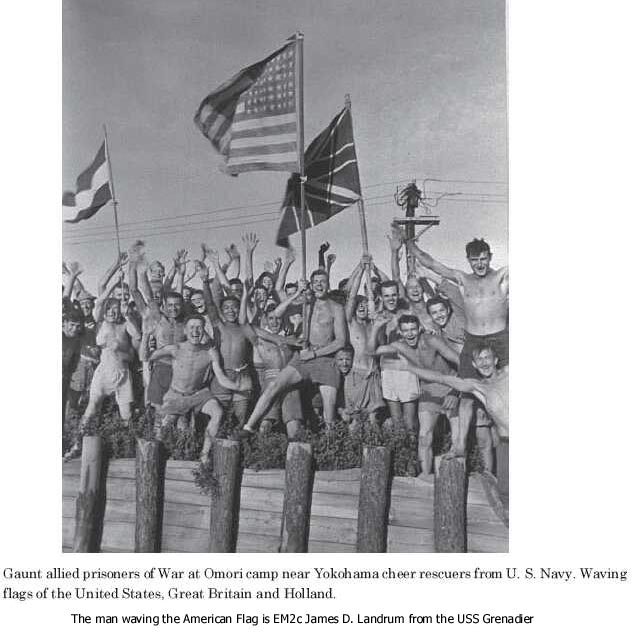
Downing and others were take to Omori prison camp on Tokyo Bay, where conditions were only slightly better. Two weeks later, on Aug. 29, a U.S. minesweeper and a cruiser came into the bay to load up the anxious prisoners.

Returning to the B-29 crash site
On this trip 70 years later, Downing, who became a building contractor in Canyon and Amarillo after the war, visited the sites of the camps and the crash site where three crewmen died. Nothing clicked. So much has changed since 1945.

Downing did meet Hideo Onuki, 83, who as a 13-year-old boy witnessed the crash of the B-29.

“When I saw the crash, I thought, ‘Serves you right,’” Onuki told The Associated Press. “But now I feel that it was good for Downing to survive. I never thought I would actually get to meet him.”

The former POWs were asked questions by a Christian college class, and met for 1½ hours with Caroline Kennedy, the U.S. ambassador to Japan and daughter of the former president. [And met with Japan's Foreign Minister Kishida.]

“She was absolutely great with all the men,” Stu said.

The contingent was feted by the Japanese government at almost every turn with dinners and events. Only once did it turn awkward when an aide to the foreign minister suggested it was wrong for the U.S. to go on firebomb raids and drop the two atomic bombs.

Fiske Hanley, 95, of Fort Worth, one of the five POWs on the trip, took exception and mildly offered a retort.

“In a nicely worded way, he said had we not done that, the Japanese invasion was going to happen, and then 2 to 5 million would have died,” Stu said.

But that was only one uneasy moment in nine days of hospitality that was covered extensively by the Japanese press. Downing even got to experience a heated toilet seat in a Kyoto hotel.

“First time in 96 years,” he said.

And a far cry from his first trip. The return confirmed what he knew — that in war, evil most often lies with government and ideologies, and not with people. And time can change a lot.

“I’m glad I went,” Downing said. “I have a better feeling about the country. They’re more like we are. They think more like we do.”

Thursday, December 03, 2015

PROFILES AMERICAN SPECIAL PRISONERS OF JAPAN

click to order
7TH POW JAPAN TRIP, DECEMBER 5-14, 2015

The following five American veterans, members of the U.S. Army Air Corps and U.S. Navy, travel to Japan on a Japanese government-funded program of remembrance and reconciliation. They will visit the sites of their capture, torture, and rescue as well as several Japanese cultural properties.

These men were “special prisoners” who were afforded no rights or even minimal care. One of the trip’s participants, Fiske Hanley, wrote a book, Accused American War Criminal on the horrors he and other flyers endured. Two of the men, Navy aviators Charles Brown and William Connell, were mentioned at length in James Bradley’s Fly Boys. Connell is believed to be the last American to leave Chichijima alive (others were beheaded and cannibalized).


click to order
They will visit the location of the Kempeitai Tokyo Regional Headquarters where the US Army Air Corps aviators were tortured and held in the infamous horse stalls. The site is now the municipal building for the Chiyoda ward of Tokyo. The Kempeitai HQ for the Empire was located at today’s Palace Hotel. They will also visit the man-made island (by American POWs) that was the Omori POW Camp, where they were all held the final days of the war. It was the first POW camp liberated on the mainland. This site is now a motor boat racing venue and called Heiwajima or Peace Island. They also plan to visit the site of Ofuna, the Imperial Navy’s interrogation center in Kamakura where the two Navy aviators were held as well as Pappy Boyington and Louis Zamperini.

The men will include a visit to the Center of the Tokyo Raids and War Damage and the memorial to the Raids in Yokomamicho Park. The Foreign Ministry will host a reception for them.

---

click to order
CHARLES H. BROWN, 91, resides in Kingwood, West Virginia where he was born and raised. Upon graduating high school in the spring of 1942, he enlisted in the V-5 program (Naval Aviation Cadet) of the U.S. Navy. In the period 1942 to 1945, the Navy produced 61,658 pilots - more than 2.5 times the number of pilots as the Imperial Japanese Navy. After a semester at Potomac State College in Keyser, West Virginia, he traveled to Washington, DC to impress upon the Office of Naval Personnel that he was ready to enlist. He entered active duty February 10, 1943 and took Navy pre-flight training at the University of Georgia at Athens. After advanced training in Kansas and Texas, he was commissioned an Ensign on April 1, 1944. After training to fly a Douglas SBD Dauntless (divebomber) at the Naval Air Station in Deland, Florida, he was sent to the Naval Air Station Glenview, Illinois for carrier training and then to the Naval Air Station Astoria, Oregon to learn to fly a SB2C Curtiss Helldiver. He left San Francisco on January 20, 1945, aboard the USS Randolph CV15 assigned to the VB-12 of Carrier Air Group 12 known as “Crommelin’s Thunderbirds” after their legendary Commander Charles Crommelin. They were engaged in the first carrier strikes against Japan. Barely 26 days at sea and on his first mission, Brown was shot down on February 16, 1945 by anti-aircraft fire while bombing a factory. He made a water landing on Lake Kasumigaura, Japan’s second-largest lake, which is about 35 miles northeast of Tokyo. Villagers from Kamiotsu (today’s Tsuchiura in Ibaraki Prefecture) captured him and his gunner. They paraded the men to authorities with their hands tied behind their backs, blindfolded, and subject to local women hitting them with their geta (wooden shores). At the train station, Brown was briefly positioned for what he thought was to be a beheading. Instead, he was jerked to his feet and put on a train to Tokyo and the Kempeitai’s Regional Headquarters. There he was subject to continual, ruthless interrogation and kept in a filthy horse stall with a Japanese civilian, who was possibly an informer, and a Korean civilian, who taught him how to use chopsticks. Brown was not considered a POW; he was a criminal, a “special prisoner” outside any protections of military custom. After two weeks he was then taken from Tokyo to the notorious Ofuna Naval Interrogation Center in the historic seaside town of Kamakura. After a month of solitary confinement in a 6’ x 8’ cell, he was permitted to mix with other prisoners, but not to speak. At Ofuna, there was continual mental and physical torture on top of starvation and minimal sanitation. The Ofuna interpreter told the prisoners that there was a standing order that if the Japanese homeland was invaded, all prisoners were to be executed. While at Ofuna, he witnessed a “delivery” of young comfort women to the guards, which temporarily displaced the prisoners from their cells for the guards’ “recreation.” Sometime near July 1, 1945, the survivors were transferred to the Omori POW Camp Tokyo #1, an island in Tokyo Bay built by POWs. Finally, the prisoners were permitted to talk to each other and have their wounds treated. However, the special prisoners were kept in a separate barracks surrounded by barbwire and not allowed to associate with the other POWs. By late July, physically and mentally fading, he was confronted by another prisoner, flying ace Major Gregory “Pappy” Boyington who cajoled him to “hang in there.” And he did. On August 15th, the Emperor’s address to the nation telling his people to stop fighting was broadcast throughout the camp. Much to Brown’s surprise the ‘kill all order” was not given and, instead, each special prisoner was given an envelope of Japanese currency for their “time” at Ofuna. Suffering from severe malnutrition, Brown barely remembers the next two weeks. On August 28, 1945, weighing 97 pounds, he was taken aboard the U.S. hospital ship Benevolence and soon flown back to the United States to recuperate from the after effects of beriberi, dysentery, avitaminosis, and beatings. After leaving the Navy in January 1946, he returned home and enrolled in West Virginia University where he received his AB and LLB in 1950. Brown became an attorney and practiced real estate and banking law for 50 years. He did not receive help for his Post Traumatic Stress Disorder (PTSD) from the Veterans Administration (VA) until 1997, but he credits the VA counseling service with helping rid him of his persistent nightmares. He has been married to Betty for 67 years. They had three children. Some of Mr. Brown’s experiences as a POW are included in James Bradley’s 2004 best-selling history, Fly Boys: A True Story of Courage and Roy W. Bruce’s 1994 Crommelin's Thunderbirds: Air Group 12 Strikes the Heart of Japan. Mr. Brown’s POW memoir and oral history can be found at the Library of Congress’ Veterans History Project.

click to order
WILLIAM L. CONNELL, 91, lives in Edina, Minnesota. Born in Bakersfield, California, he grew up in Seattle, Washington. At 17, after graduating high school, he enlisted August 29, 1942 in the U.S. Navy and was sent to Yakima, Washington to join the Civil Air Patrol (CAP) to learn to fly. The Yakima Composite Squadron is one the few remaining original CAP Charter Squadrons. In January 1943, he began his Naval Aviation Cadet training at the University of Iowa, Iowa City. In April, he was sent to flight school at Naval Air Station Olathe, Gardner Kansas where they trained on the N3N Yellow Peril bi-plane for two months. Next was the Pensacola Naval Air Station to learn to fly a variety modern aircraft. He graduated in December 1943 becoming an Ensign and Naval Aviator. He spent the next three months in Douglas SBD Dauntless (divebomber) training at the Deland Naval Air Station in Florida and then six weeks at the Naval Air Station Glenview, Illinois for carrier training on Lake Michigan. Next was training on the new SB2C Curtiss Helldiver at Naval Air Station Barbers Point, Connell was assigned as a replacement pilot to Air Group 2 aboard the USS Hornet (CV-12), which he joined on June 29, 1944 at the Enewetak Atoll in the Marshall Islands. Enewetak, captured in February 1944, was a major forward base for the U.S. Navy during the rest of the war. After the war, the atoll was used for nuclear testing as part of the Pacific Proving Grounds. Forty-three nuclear tests were fired at Enewetak from 1948 to 1958. Connell’s first and last mission was July 4, 1944. After a predawn takeoff, Connell and his gunner, Ben Wolf, approached the small volcanic island of Chichijima in the Bonins, known today as the Ogasawara Islands. Their squadron was to bomb one of the heavily-garrisoned island's two radio bunkers, but as they approached their objective, they spotted two Japanese freighters entering the harbor. They decided to attack them as targets of opportunity. But before Connell had a chance to drop his bombs, an anti-aircraft shell exploded beside his airplane, tearing off the tail section. Although Connell was able to parachute out safely, his gunner did not. He landed in the waters near Chichijima and was captured. His first day was spent strapped to a tree in an excruciatingly painful position that prevented him from sitting. In the week that followed, he was either tied to the tree or being interrogated. While he was on the island, eight American aviators were captured, beheaded, and partially cannibalized for dinners by the General Staff. Five Japanese officers were eventually hanged for these crimes that were chronicled by Chester G. Hearn in his 2003 Sorties into Hell: The Hidden War on Chichi Jima. Connell has the distinction of being the last American to leave the island alive. He was taken to Japan to the Ofuna Naval Interrogation Center in Kamakura, about 30 miles southwest of Tokyo. He spent nearly ten months there enduring isolation, brutal interrogation, and starvation. In April 1945, he was transferred to the Omori POW Camp Tokyo #1, an island in Tokyo Bay built by POWs. Today, the island is Heiwajima, a motorboat racing venue. Considered a “special prisoner” he and other aviators were kept in a separate barracks away from the other POWs on the island. They were considered criminals, not captives. Those who could work were sent out into the firebombed Tokyo to clear the rubble and salvage building materials. Daily, they were threatened with execution if Japan lost the war. Fellow prisoner, the Marine Corps flying ace Major Gregory “Pappy” Boyington organized Connell and other to fight back if the Japanese tried to enact this plan. In the end, this was not necessary and their Japanese captors disappeared soon after the Emperor’s speech ending hostilities on August 15, 1945. After liberation at the end of August, he was flown back to the United States to recuperate at the Naval Air Station, Sandpoint, Seattle Washington hospital. Despite his ordeals, he remained in the Navy and retired in 1964 as a Lieutenant Commander. He spent the next 23 years as a State Farm Insurance agent. After his second retirement, he worked for the next 11 years in various positions at the Minnesota Valley Country Club in Bloomington, Minnesota. Connell has since turned his attention toward educating children about the history of World War II and mentoring them through golf and tennis. In 2012, he took his second parachute jump, but this time under much more controlled circumstances in Minnesota. He has also returned to Chichijima several times--once with President George H.W. Bush, who was also shot down near the island. Twice married, Connell is the father of four children. He is mentioned prominently in James Bradley’s 2004 best-selling history, Fly Boys: A True Story of Courage. His oral history has been recorded by the POW Oral History Project, based at Concordia University, St Paul as well as by the Library of Congress’ Veterans History Project.

SCOTT M. DOWNING, JR, 96, resides in Amarillo, Texas. He was working for Boeing Aircraft making B-17s in Seattle, Washington when he enlisted in the Army Air Corps in September 1942. He was not called to active duty until February 15, 1943 and he began his basic training at Buckley Field, Denver, Colorado (today’s Buckley AFB). He was then sent to Fort Hays State College in Kansas for Cadet Training and then to Bombardier School at Big Spring, Texas. In June 1944, he was commissioned a Second Lieutenant and sent to Harvard Army Airfield, Nebraska (today’s Harvard State Airport) and the 505th Bombardment Group for B-29 training. In mid-December 1944, he reported to Grand Island Army Airfield, Nebraska (today’s Central Nebraska Regional Airport) to pick up a new B-29 plane and was sent to Tinian to join the 482 BS, 313 Wing, 505 Bombardment Group, 20th Air Force in the Mariana Islands, arriving December 27th. Raids against Japan from Tinian had started November 24, 1944. His crew’s bombing and mining missions began on January 29, 1945. On their 20th mission over Tokyo on May 25/26, 1945, his B-29 was shot down near Musai, about 15 miles northeast of Tokyo in Chiba Prefecture. He bailed out of the burning plane and was captured almost immediately by civilians who turned him over to military personnel. The next day he and three other members of his crew were trucked through bombed-out downtown Tokyo to the Kempeitai Tokyo Regional Headquarters. After initial interrogations and beatings, he was thrown in a cell that was about 8’ x 12’. These were converted horse stalls that often held 19 men per cell including some that were critically burned and injured. For roughly three months, Downing subsisted on a baseball-sized ball of rice each day, and his weight fell from 165 to 120 pounds. These months were marked by a horrible monotony of fear and homesickness, occasionally interrupted by guard-administered beatings and sadistic interrogations. The men were not allowed to talk, wash, shave, or receive medical care. Conditions were so tight that when everyone would lie down to sleep, the only way to turn over was to stand in place, turn, and then lie back down. Throughout the day and night, they listened to fellow POWs–some of whom had been severely burned–scream in pain or insanity and struggle to take one more breath before their breathing stopped altogether. It is estimated that 250 American flyers were brought the Kempeitai Tokyo Regional Headquarters, but only 160 survived. On August 15, 1945, Downing and his fellow prisoners were moved to a barbed wire-surrounded barracks on a five-acre man-made island between Tokyo and Yokohama called Omori POW Camp Tokyo #1. This move was part of an agreement between the United States and Japan in anticipation of the end of the war. It was a tough camp but a relief from the Kempeitai horse stalls. On Omori, the prisoners had more freedom and could talk, bathe and exercise. On August 29, 1945, the over 500 POWs including 155 B-29 flyers on Omori became the first liberated by American forces. After the war he was in and out of Madigan General Hospital (today’s Madigan Army Medical Center) at Fort Lewis, Washington. He remained in the service and was assigned duty in the spring of 1946 at Clinton County Air Base in Ohio. In April 1947, he was ordered to Japan and was sent to the 611th Aircraft Control and Warning Squadron at Shiroi Air Base (today’s Shimofusa Japan Maritime Self Defense Forces Air Base) located northeast of Tokyo. Downing was soon asked to help investigate the atrocities committed by the Tokyo Kempeitai for war crimes prosecution in Yokohama. Working in the Investigation Division of the Legal Section of General Headquarters, Japan, he helped interrogate Japanese defendants and assisted the prosecutor by preparing the witnesses. He also testified concerning conditions and the treatment of the prisoners at the Tokyo regional Kempeitai Headquarters. Discharged from the Air Force while in Japan, he concluded his part of the investigation in early fall of 1948 and returned to the United States and Canyon, Texas. He then entered the construction business with his two brothers. Downing has been married to Bitsy for 64 years and they have one son. He enjoys fishing and watching college sports. His oral history is held by the Veterans History Project of the Library of Congress.

FISKE HANLEY II, 95, lives in Fort Worth, Texas where he grew up. Always fascinated with aviation, he earned an AS in Aero Engineering from North Texas Agricultural College (today’s University of Texas at Arlington) and in 1943 a BS in Mechanical Engineering from Texas Technology College (today’s Texas Tech University). In his junior year, he was accepted into the Army Air Corps Aviation Cadet Program. Immediately after graduation, he was sent to the Boca Raton Army Airfield, Florida for cadet training for engineering, meteorological, and communications. The base was created from appropriated land of Japanese-Americans. In September 1943, he was sent to Yale University for specialized technical training and graduated in February 1944 with a second lieutenant’s commission. With only 20 members of his Yale class, Hanley was sent to B-29 flight engineering school at the Seattle Boeing factory. Graduating in August, he was assigned to the 504th Bombardment Group training as a flight engineer at Fairmont Army Air Field, Nebraska. In January, his air crew commanded by 2nd. Lt. John A Brown made their way to Tinian. They flew 16 missions, seven considered combat, which included the March 10, 1945 bombing of Tokyo. Hanley’s plane was shot down on March 27, 1945 while mining the Strait of Shimonoseki. One of only two crew members who survived the plane’s destruction, he parachuted into a rice paddy near Ueki, southwest of Yawata, near the steel mills of Kokura on Kyushu Island [today the mills have become UNESCO World Industrial Heritage sites]. His first eight days were spent in or near Kokura at a police station and a military facility. He had his wounds treated twice and he believes he was questioned by a high level Combined Fleet Command about his mission to mine Shimonoseki Straits. In early April, Hanley and 12 other B-29 captured crew members were taken north over 600 miles by train to Tokyo. On April 6th, the group arrived in Tokyo. Before reaching the Kempeitai Tokyo Regional Headquarters, the prisoners’ guards took the time to reward themselves by visiting a Comfort Station, or military brothel. The American flyers were taken to filthy, basement 4’11’ x 9’10” dungeons or “pig boxes” [buta bako] and told that they would either die of their wounds in or be executed. They were “special prisoners,” considered criminals who murdered women and children and lower than the vermin that would infest their cells and bodies. Eight men, a mixture of B-29 crewmen and Japanese political prisoners, were crammed into these cells. Except for one light bulb that burned 24 hours a day in the corridor, these cells were continually shrouded in gloom. Eventually he was sent to a cell holding 19 other men in an 8’ x 12’ horse stall in the back of Kempeitai Tokyo Regional headquarters. Many mortally wounded men were thrown into these cells. Hanley still has nightmares of their groans and screams of agony as they slowly succumbed to their injuries. Subject to constant beatings and brutal interrogations, Hanley and the other POWs were quickly fading from starvation, torture, untreated wounds, unsanitary conditions, and misery. One tormentor, the English-speaking Yasuo Kobayashi particularly stands out for his cruelty. He seemed to thrive on the prisoners’ agony and enjoy their suffering. He was directly responsible for the deaths of many prisoners and the continual torment of the rest. Although sentenced postwar to 40 years hard labor, he was released in 1952 and settled into a peaceful and successful life in Hawaii. On August 15th, the surviving POWs were taken to Omori POW Camp Tokyo #1 a prison camp island constructed by American POWs. Still “special prisoners” they were separated from the other POWs, but allowed more freedom, given medical attention, and could talk, bathe and exercise. On August 29, 1945, the over 500 POWs including 155 B-29 flyers on Omori became the first liberated by American forces. Camp Omori also housed Olympian Louis Zamperini, a WWII hero at the center of Unbroken, a film by Angelina Jolie based on the best-selling book by Laura Hillenbrand. Hanley was a “source for Unbroken” and he was invited to the movie’s Hollywood premiere in 2014. After liberation and medical care on the U.S. hospital ship Benevolence, he was flown back to the United States. He was treated at Letterman Army Hospital and then went home to Texas on leave. He was discharged from the Army Air Corps and married to Betty, an American Airlines stewardess, in June 1946. He went to work as an engineer for Consolidated-Vultee Aircraft in Fort Worth, which became Convair, then General Dynamics, and now today’s Lockheed Martin. He worked on developing new bombers and fighters as well as NASA’s Saturn V moon rocket. He retired in 1989 and wrote The History of the 504th Bomb Group in World War II and then his autobiography, Accused American War Criminal: One of Few Survivors of Japanese Kempei Tai Military Police Brutality. Married to Betty for 23 years they had three children.


DONALD E. RYAN, 93, lives in Sebring, Florida. He grew up in Kalamazoo, Michigan and enlisted in the U.S. Army Air Corps on November 16, 1942. He did his basic training at the Big Spring Army Air Force Bombardier School in Texas. In January 1943, he was sent to the Gulfport Army Air Field in Mississippi for aircraft training on P-39/P-40s and other older planes. He then trained at Boeing’s B-29 flight engineering school in Renton, Washington. In August 1943, he was assigned to the 794-468th Bombardment Group; 58th Wing, 20th Air Force at the Smoky Hill Army Airfield Salina, Kansas with the first group to train on the B-29 Superfortress. In January 1944, the 468th Bombardment Group shipped out to the Kalaikunda Air Force Station in Kharagpur, West Bengal, India. It was one of four B-29 bases established by the U.S. in India. Ryan flew as a tail gunner in the 16 missions they had in India which included flying gasoline and bombs over the “hump” (the Himalayan Mountains) to China; bombing railyards and docks in Bangkok, Singapore, and Sumatra. The crew also participated in the bombing the steel mills at Yawata on Kyushu (today an UNESCO World Industrial Heritage site). In April 1945, they were reassigned to Tinian in the Mariana Islands. On their second mission, May 25-26, 1945 to bomb Tokyo, his plane was attacked and hit by fighter planes and those that could, bailed out. Ryan landed on a farmer’s fence near today’s Misato in Saitama prefecture close to Tokyo. The local Kempeitai official, who identified himself as having attended the University of Michigan, questioned him while “playing” Russian roulette on him. This intimidation was reinforced by taking Ryan to a saw mill and alternatively trying to stuff him into a casket or pushing him toward the buzz saw. He was soon turned over to military authorities in Tokyo and told he was a “special prisoner,” undeserving of care or POW status. He was taken to the Kempeitai Tokyo Regional Headquarters near the Imperial Palace. He was put in an 8’ x 10’ cell that was once a horse stall with 16 other men. Flies and lice soon turned his and his cellmates’ skin into unending open boils and infections. Continual beatings, starvation, darkness, filth, random cruelty by the guards, and dehydration wore on his humanity and morale. He endured the slow deaths of two badly burned fliers who were added to his cell. On August 15th, the horse stalls were emptied and the prisoners were taken to Tokyo Bay to wash in the surf and then to Omori POW Camp Tokyo #1. Still “special prisoners,” the men were held in barracks separate from the other POWs on this man-made island outside Tokyo. It was a tough camp but the prisoners had more freedom and could talk, bathe and exercise. On August 29, 1945, the over 500 POWs including 155 B-29 flyers on Omori became the first liberated by American forces. Ryan was evacuated to the USS Benevolence and soon flown to Hawaii to take a ship back to the United States. He spent at least six months in the Edward Hines, Jr., Veterans Administration Hospital outside Chicago and was discharged from the Army Air Corps in mid-1946. Ryan returned home to Kalamazoo where he worked with his brother in a truck leasing business and for a number of years owned the Otsego Inn. He has five children from his first marriage. He enjoys dancing and married his fourth wife in 2013.

Wednesday, October 17, 2012

Ten Days in October

FM Gemba with American former POWs of Japan
For the third time in as many years, seven nonagenarian veterans of World War II become "guests of Emperor." These men were tortured, starved, beaten, and forced to work in dangerous conditions by Imperial Japan as prisoners of war. Unlike their first trip to Japan, which was by Hell Ship or parachute, they traveled by a first class ticket on a Japanese airline.

For the third time, Japan's Foreign Minister faced the American POWs and apologized for his government for their suffering under Imperial Japan (photo above). The men and their caregivers are touring Japan and visiting the sites of their incarceration and slave labor. They slaved for well-know Japanese firms such as Hitachi, Mitsubishi, Nippon Express, Rinko, and Ube Industries.

Initiated in 2010, the visitation program for American former POWs of Japan is a model for Japanese government war apologies. There is a formal presentation of an apology and a concerted act of contrition. It is unfortunate, however, that the Japanese Government does not publicize this successful program and has not pushed the Japanese companies that were complicit in the torture and abuse of the POWs to also acknowledge and apologize. Indeed, the companies have been largely silent and some have refused to allow these elderly men to revisit the sites of their first stay in Japan.

Here are brief biographies of the men in Japan from October 12 to 21.

>Randall S. Edwards, 95, lives in Lakeland, Florida. Born in Wyoming, he grew up in Nebraska and enlisted in the U.S. Navy in 1935 after high school to see the world. He was sent to the Philippines in 1940 and assigned as a Radioman 1ST Class to the submarine tender, the USS Canopus, which had been ordered to stay in Manila Bay after the bombing of Pearl Harbor in December 1941. Bombed and strafed continually, the ship was finally scuttled in Mariveles Bay on April 8, 1942 with the crew escaping to the fortress island of Corregidor in the mouth of Manila Bay. On Corregidor, the crew served in beach defense with the Fourth Marines. He was a POW at Cabanatuan 3 and shipped to Mukden, China (today’s Shenyang) in October 1942 on Mitsubishi’s Hellship Tottori Maru via Formosa and Korea to Manchukuo (Manchuria). Edwards was a slave laborer at MKK (Manshu Kosaku Kikai, which some researchers believe was owned by Mitsubishi and known as Manchuria Mitsubishi Machine Tool Company, Ltd.). He worked on multiple machines from grinders to lathes, carefully sabotaging each task. Toward the end, he was made to haul pig iron to the company’s foundry. He believes that the multiple shots and blood tests that he received while at Mukden were part of human medical experiments conducted by the Imperial Army’s 731st Biological Warfare Unit. After the war, Edwards remained in the Navy where he received over 40 medals during his service and retired in 1955 as a Warrant Officer. From 1948-1950, he was with U.S. Occupation Forces in Yokosuka, Japan in charge of the Base’s radio station. He found there that the Japanese were “not all demons.” After the Navy, he received his BS in Electrical Engineering from the University of Florida, Gainesville and went to work as a research engineer on fusion energy at the Oak Ridge National Laboratory in Oak Ridge, Tennessee. After retiring in 1982, he became a National Service officer for American Defenders of Bataan and Corregidor and American Ex-Prisoners of War to help his fellow veterans with their VA claims. He enjoys golf and international travel with his wife Rose Mary.
POW# 104
Member of: DAV, American Defenders of Bataan & Corregidor, American Ex-Prisoners of War

>Robert W. Ehrhart, 89, lives in Carmichael, California. He grew up in Oakland, California and enlisted in the Marine Corps Reserve during high school. His unit was activated November 6, 1940 and sent to the Philippines in April 1941 to join the Marine Detachment at Cavite.  On May 1, the 1st Separate Marine Battalion, unique in that it trained to function either as infantry or antiaircraft artillery, was activated. Relocated fall 1941 to the Olongapo Navy Yard near Subic Bay, the unit was moved during December 1941 to Corregidor Island. On January 1, 1942 they were redesignated the Third Battalion, Fourth Marines and joined the Battle of Corregidor through surrender on May 6, 1942. Ehrhart was sent to the Cabanatuan POW Camp where he was on a burial detail, burying as many as forty men a day. He remembers that the “bodies were like skeletons and when you lifted them onto the window shutters, which were used for litters, their skin would peel back and stick to your hands.” To bolster his morale and that of his fellow POWs, he started to draw cartoons, risking severe punishment if discovered. He had a pencil, but paper was almost impossible to obtain. He bartered for whatever writing material anyone had with the rare Carnation Milk can label his greatest canvas. In September 1943, Ehrhart was transferred to Japan aboard the Hellship Taga Maru (aka Coral Maru). He was sent to Osaka 4-D Sakurajima were he was a slave laborer at Hitachi Zosen’s Sakurajima Shipyard (today’s Universal Shipping Corporation). He worked as a riveter helping build military ships and oil tankers. Today, the site of this POW camp is the Universal Studios Japan theme park. After the camp was bombed in May 1945, he was sent to Osaka 6-B, Akenobe, POW Camp where he was a slave laborer working as a stope driller in a copper mine for Mitsubishi Mining (today’s Mitsubishi Materials Corporation). When the POWs realized that the war had ended, they pieced together an American flag to fly on the camp flagpole, which they believe was the first postwar U.S. symbol in Japan. After recuperating in military hospitals from vitamin deficiency, malnutrition, and various tropic diseases, he was discharged April 29 1946. He then studied Mechanical Engineering at the University of California, Berkeley. After graduation, he worked for the Navy and eventually joined the State of California’s Department of Water Resources as a hydroelectric engineer. Since retiring in 1983, he has pursued his passions of travel and fine photography. The Veteran’s History Project of the U.S. Library of Congress holds a recording of his oral history.
POW# 221
Member of DAV, VFW, American Defenders of Bataan & Corregidor, American Ex-Prisoners of War

>David G. Farquhar, Jr., 90, resides among orange groves in Redlands, California where he has lived all his life. He joined the U.S. Army Air Force in 1942. He trained in Nebraska and was assigned as a Technical Sergeant to General Curtis LeMay’s 20th Air Force, 24th Squadron, 313th Bomb Wing, 6th bomb group, Crew #2404. He was sent with the 6th Bomb Group to Tinian in the Northern Marianas in January 1945. Farquhar participated in 18 missions over the Pacific and Mainland Japan. On May 23, 1945, he was a turret gunner when his B-29 was shot down over Tokyo by flak and fighter planes. He and his 11 crewmates all bailed out safely and were captured. They were taken to the infamous horse stalls outside of the Kempeitai (military police of the Imperial Army) Headquarters in Tokyo near the Emperor’s palace. They were not considered POWs but “special prisoners” who were war criminals. Beaten, starved, and tortured, they were denied clothes, basic hygiene, and medical treatment. On August 15th, the day Japan surrendered, he was transferred to a cell at Tokyo Base Camp #1 Omori where he was liberated August 28, 1945. Omori was the first POW camp liberated. After a series of hospital stays he was discharged in 1946 and returned to San Diego State College (today’s San Diego State University) for a BA in Engineering. He then obtained an MA in Education from the University of Redlands. From 1950 to 1993, Farquhar taught both junior high and high school mathematics and science. He has been married to Jacqueline for nearly 66 years. He currently tends his orange grove, serves on various boards, and participates in community activities.
POW# Not known to “special prisoners” 
Member of American Ex-Prisoners of War 

>Douglas Northam, 93, lives in Reno, Nevada. Born in Morris County, Texas, he grew up in nearby Naples, Texas. After graduating from high school in 1937, he enlisted in the Civilian Conservation Corps and in 1940 in the U.S. Navy. He was transferred to China in February of 1941 and assigned to the USS Oahu (PR-6), a Yangtze River Patrol boat ported in Shanghai. The USS Oahu, never designed for open sea operations, was sent to Manila Bay in November 1941, arriving two days before the Japanese attack on Pearl Harbor. The gunboat operated in and around Manila Bay and Cavite Navy Yard on inshore patrol and in support of U.S.-Filipino forces on Bataan until after its fall April 8, 1942 and then continued to operate about the island fortress of Corregidor until sunk by enemy gunfire May 5th. Northam was then assigned to an artillery group on Corregidor, which was surrendered on May 7th when Corregidor fell. As a POW of Japan he was sent to Bilibid POW Camp in Manila and then moved to Cabanatuan 1 and 2. In November 1942, he was sent to Japan aboard Mitsubishi’s Hellship the Nagato Maru. He worked for Nippon Express as a slave stevedore in the freight yards in and around the city of Osaka at Umeda Bunsho Camp in Osaka (Osaka 2-D UMEDA). In March 1945, after his POW camp was firebombed, he was transferred to Osaka POW Camp 5-B TSURUGA were he was a slave stevedore again for Nippon Express and Tsuruga Transportation Company. After the war, Northam utilized the GI Bill to study geology at the University of California, Berkley. He joined Shell Oil Company in 1951 as a laboratory technician and retired 1977 as research technician. He has been married to Hazel for 64 years. In retirement he was a volunteer at a local elementary school and the VA Hospital. His hobbies include gardening, horse racing, and cooking.
POW# 117
Member of DAV, American Defenders of Bataan & Corregidor, American Ex-Prisoners of War, AMVETS 

>John Leroy Mims, 90, lives in Aberdeen, North Carolina. Born in Ashburn, Georgia, he grew up in Florida and enlisted in the Army at age 16 in 1938, but was discharged a year later after it was discovered that he was underage. Still hungry and jobless, he re-enlisted February 15, 1941 and was assigned to Company B, 1st Battalion of the famous 31st Infantry Regiment sometimes referred to as the “American Foreign Legion.” In April 1941, he was sent to the Philippines aboard the USAT Republic and stationed at Cuartel de España in Manila. He fought in the Battle for Bataan and as a POW forced on the Bataan Death March. During the war, his Filipino fiancée Juanita worked as a secretary for a Japanese general and bravely aided the resistance by sending shortwave radio messages to Allied forces in the Pacific. As a POW, the Japanese repeatedly beat and tortured Mims . Although they were able to break his body, they could never come close to breaking his spirit. During his captivity, the Japanese broke his back, neck and both of his legs and shattered many of the bones in his face. The beatings briefly left him a paraplegic on two separate occasions and he retains a limp. Mims lost over 120 pounds as a POW dropping from 190 pounds to 67 pounds. Of the 1,600 soldiers in the 31st Infantry Regiment who surrendered, less than half survived Japanese captivity. In September 1944, he was sent to Japan on board Mitsubishi’s Nippon Yusen Kaisha (NYK) Hellship Sekiho Maru (Canadian Inventor [the Mati Mati Maru or slow slow ship]). Mims became a slave laborer mining coal for Ube Kosan’s Sanyo Muen Kogyo Sho (Ube Industries’ Sanyo Smokeless Coal Work, which is still known today as Ube Industries Ltd.) at Hiroshima #6B - Omine (Sanyo) POW Camp in Omine-machi, Yamaguchi Prefecture. After the war, Mims remained in the Army for the next 27 years, attaining the rank of Sergeant First Class. He returned to Japan from 1952-54 to be in charge of the Tokyo Quartermaster Depot. He retired in 1963 and involved himself in real estate, construction, and mining. He and Juanita were married 59 years until her death in 2004. They are parents of three biological and 22 adopted children. He remarried in 2009 to another beautiful Filipina, Nena Sabal. His hobbies include reading and recounting his history story as a POW of Japan, especially on how he survived the infamous Bataan Death March. The Veteran’s History Project of the U.S. Library of Congress holds a recording of his oral history.
POW# 429
Member of DAV, VFW, American Legion, Military Order of the Purple Heart, and National Order of the Trench Rats, American Defenders of Bataan & Corregidor

>John Real, 90, lives in Ventura, California. A California native he enlisted in the US Army Air Corps after graduating from high school in 1940. He was sent to the Philippines in April 1941 and assigned to aerial reconnaissance at Clark Field with the 2nd Observation Squadron, 27th Bombardment Group, V Bomber Command, 20th Air Force. Real and his unit manned an observation tower on top of Mt. Mariveles, Bataan during Japan’s invasion of the Philippines where he tracked Japanese ship movement around the Olongapo Navy Yard. He walked down the mountain to surrender on April 9, 1942 and was stripped of all his belongings before being forced on the Bataan Death March. At the start of the march, he and others were used as human shields by being forced to walk in front of seized American 155mm calibre field guns (Long Toms) that the Japanese were firing at Corregidor. He was a POW at both Camp O’Donnell and Cabanatuan 1. He avoided a certain death at O’Donnell by volunteering for a work detail on Bataan. In September 1943, he was sent to Moji, Japan aboard the Hellship Taga Maru (aka Coral Maru) via Formosa. At Tokyo 5-B POW Camp in Niigata he was a slave laborer unloading coal ships for Niigata Kairiku Unso, now part of the Rinko Corporation (however, POWs remember Rinko as their “employer”). After the war, Real received a BA in Business Administration from the University of California, Santa Barbara and a MA from the Thunderbird School of Global Management in Arizona, where he met his wife with whom he had three children and was married to for 49 years until she passed away in 2006. After graduation, he pursued a career in pharmaceutical sales with various companies, retiring with Berlex Labs, at the time a division of Schering AG. In retirement, he has been an active member of the Museum of Ventura County and the J. Paul Getty Museum at the Getty Villa in Malibu.
POW# 514 
Member of DAV, VFW, American Legion, American Ex-Prisoners of War, American Defenders of Bataan & Corregidor, AMVETS 

>George R. Summers, 90, lives in Riverside, California. Born in the Philippines, he grew up in California where he joined the Marine Corps Reserve in February 1941. Activated in June 1941, his unit was sent to Guam, an American territory, in September 1941. Japan invaded the island on December 8, 1941 and he was taken prisoner upon the surrender of the island on the 10th--the first American territory to fall. Summers was on the first transport of Allied POWs to Japan, the Argentina Maru with 420 American POWs from Guam to Tadotsu on the north coast of Shikoku. After arriving in Japan on January 16, 1942, the POWs were transported to Zentsuji (Hiroshima Branch #1), a POW camp about eight kilometers from Tadotsu. He spent six months there clearing a mountainside to plant apple trees. He was then transferred to Tanagawa Osaka Area POW Command #4B Camp. At Tanagawa, he helped to manually tear down a mountainside building a breakwater for a primitive dry-dock and submarine base. This camp was noted for its severe malnutrition and extreme death rate. Six months later, he was sent to Umeda Bunsho Camp in Osaka (Osaka 2-D UMEDA), Japan where he worked for Nippon Express as a slave stevedore. He was transferred to a total of six POW camps due to American bombings. His last camp was the Nagoya 10-B Fushiki Camp, where he worked as a stevedore slave unloading soybeans from Korea for Fushiki Kairiku Unso until Japan’s surrender. After his release, he was hospitalized for six months at the Long Beach Naval Hospital. Like many veterans, he then shifted between various odd jobs and classes. In 1947, he joined the U.S. Merchant Marine. From 1955 to 1968 he worked for General Telephone Company, which later became GTE and is today’s Verizon. After GTE, he served as a financial clerk for the City of Anaheim from 1968 to 1978. Married to Juanita Louise Summers since 1970, he has two children from his first marriage. In retirement, he has focused on real estate investment and his hobbies of collecting Koi fish and exotic birds.
POW# 347 
Member of DAV, American Ex-Prisoners of War, Military Order of the Purple Heart