American POWs of Japan is a research project of Asia Policy Point, a Washington, DC-based nonprofit that studies the US policy relationship with Japan and Northeast Asia. The project aims to educate Americans on the history of the POW experience both during and after World War II and its effect on the U.S.-Japan Alliance.
Showing posts with label Defense POW/MIA Accounting Agency. Show all posts
Showing posts with label Defense POW/MIA Accounting Agency. Show all posts
TOMB OF THE UNKNOWN SOLDIER - UNIQUE PUBLIC ACCESS
For the first time in nearly 100 years, and as part of the Tomb of the Unknown Soldier Centennial Commemoration, the public will be able to walk on the Tomb of the Unknown Soldier Plaza and lay flowers in front of the Tomb on Nov. 9 and 10, 2021, 9 a.m. to 4 p.m.
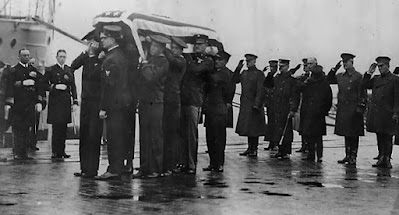
On Veterans Day the public is invited to observe a joint full honors procession, meant to replicate elements of the World War I Unknown Soldier’s 1921 funeral procession followed by a flyover with aircraft from all the armed services branches.
Of the more than 72,000 American service men and women are still missing from World War II, 65 percent or more than 47,000 are missing in the Indo-Pacific. Most are presumed lost at sea, many dying as POWs in Japanese hellships.
The hearing will help inform the public about the Defense POW/MIA Accounting Agency’s (DPAA) accounting efforts and allow the Subcommittee to conduct oversight of DPAA’s performance. The hearing will also examine whether DPAA has the necessary resources to carry out its mission, as well as whether it has used these resources effectively since its formation in 2015.
In fiscal year 2019, the DPAA recorded 218 identifications, the highest yearly total reached by the agency or its predecessor organizations, bringing important closure to family and loved ones.
In 1946, nine
remains were recovered from Cabanatuan Grave #110, Cabanatuan Cemetery #1 and
moved to Manila Cemetery #2. A year later, they were once again moved to
the Manila Mausoleum at Nichols Field for the purpose of analyzing and
identifying the remains.
Of the nine men listed only Pfc Kokitas
was identified. The analysts unsuccessfully attempted to associate these eight
remains with the eight unresolved individuals believed to have been buried in
Grave 110.
After a second attempt
to identify the remains in 1949, the CIP analysts from HQ, AGRS PHILCOM ZONE
recommended that these remains be classified as unidentifiable. In 1950,
the AGRS interred these eight unknowns in the Manila American Cemetery.
Researchers at the
Defense POW/MIA Accounting Agency (DPAA) have collected documents and assessed
historical evidence concerning Cabanatuan POW Camp cases for many years.
DPAA is engaged in a long-term project to fully account for the Cabanatuan
missing. This will involve a comprehensive review of all files associated
with Cabanatuan, including the collection of genealogical data and DNA
reference samples from the prisoners’ next of kin.
Currently, DPAA must
have DNA samples of 60% or Family Reference Samples (FRS) on file for each
grave before the U.S. government will consider approving a disinterment for the
purpose of identification. As of 31 October 2016, the Armed Forces
DNA Identification Laboratory (AFDIL) has no FRSs on file for Grave 110.
If you are a next of kin
of one of the men listed below and you wish for the DPAA to try to identify
their remains, please contact Fred Baldassarre.
Individuals
Recorded as Buried in Grave 110, Cabanatuan Cemetery #1