Showing posts with label Davao. Show all posts

Saturday, August 01, 2020

Remembering a POW legend, Ed Jackfert

Ed Jackert with Senator Barbara Boxer
With sadness, I report that on July 24th, Sgt Edward Jackfert, 98, of Wellsburg, West Virginia and Tampa, Florida passed away. 


His funeral was Saturday, August 1, 2020. The West Virginia (WV) Patriot Guard Riders escorted the WWII hero from the Chambers Funeral Home to a public graveside service at Franklin Cemetery, Wellsburg, WV, held with Military Honors by the WV Army National Guard. Ed was with the U.S. Army Air Corps in the Philippines where he was surrendered to become a POW of Japan for more than three years. He was liberated in Japan 75 years ago this August. You can leave a note, send flowers or plant a tree HERE.


Ed graduated in 1939 from Wellsburg High School and enlisted in the United States Army Air Corps on September 11, 1940. He was sent to aircraft engineers’ school, and then to the Philippine Islands, arriving in June 1941. He was assigned to the 28th Bomb Squadron which later became a part of the 19th Bombardment Group.  The unit was based at Clark Field as the bomber command of the Far East Air Force.


Ed was a mechanic at Clark Field when Imperial Japanese Navy planes attacked on December 8, 1941. The airfield was destroyed in less than an hour. Clark Field as a tactical base was virtually destroyed. The casualties were very high, about 100 wounded and 55 dead. Survivors were evacuated on December 24th to the Bataan Peninsula and Mindanao island.


Ed fought as part of a provisional infantry formed on Mindanao. First, he was assigned to guard Carmen Ferry near Davao and the newly constructed Del Monte Air Field. In mid-April 1942, he was sent to the new Maramag Field in central Mindanao to help put up a last-ditch offense, known as the Royce Mission. Mindanao was surrendered to the Japanese on May 10th. (Mother’s Day 1942. The POWs captured on Mindanao were consolidated at Camp Casisang, about five kilometers southwest of Malaybalay, Mindanao. They were miles away from Bataan and the infamous Bataan Death March.


On October 3, 1942, he and 268 POWs at Camp Casisang were transported by the hellship Tamohoko Maru from Bugu, Mindanao to Manila.  They were loaded aboard the hellship Tottori Maru for a month-long trip via Formosa (Taiwan) and Chosen (Korea) to Japan arriving November 11, 1942.


In October 1942, he was transported to Japan aboard the hellship Tottori Mari arriving November 11, 1942. He was primarily a slave laborer at Tokyo-2B-Kawasaki POW Camp (Mitsui Wharf Co., Ltd. known as “Mitsui Madhouse” for its brutal and chaotic conditions as well the language problems created by the many nationalities at the camp). There he was used as stevedore and day laborer for the Mitsui Senpaku KK [today’s Mitsui OSK Lines Ltd], Mitsubishi’s NYK Line (name unchanged today), Nisshin Flour (today’s Nisshin Seifu Group), Kawasaki Railroad Electric Power Plant, KYK Brick Factory (Kojima or Kawasaki Yogyo Co., Ltd., today’s Shinagawa Refactory), and Nippon Steel (name unchanged today). He was also traded around the Kawasaki, Kanagawa area spending time as a slave laborer for Nisshin Flour Milling (Tokyo 24-D)Showa Denko Chemical (Tokyo-16-B- Niigata [Kanosetoday’s Showa Denko K.K.where he mixed chemicals for ammunitionand Japan Steel Pipe [Japan Kokantoday’s JFE Holdings] (Tokyo 5D Kawasaki). Starting in January 1945, the camps came under constant air attack from American bombing raids. On July 25, 1945, Tokyo-2B was destroyed and 22 POWs were killed.


The camp was liberated on August 30, 1945. Among the 139 POWs in the camp, there were 59 Americans, 25 British, 6 Australians, 44 Italians and 5 Norwegians. He was evacuated to the hospital ship USS Benevolence (AH-13) for processing and then eventually on to a plane to Manila. There, on September 18, they boarded a troop transport and arrived in Los Angeles [possibly] on October 3.


Ed returned home to West Virginia to heal and reconstitute his life. He went to Bethany College and received a degree in economics. From there he joined the Internal Revenue Service as a Criminal Investigator and worked primarily in the field of organized crime and corruption of public officials. He retired from the government in February 1977.


Ed was a valiant and tireless advocate for the American POWs of Japan. He was one of five POWs who testified in person on June 28, 2000 to the U.S. Senate Judiciary Committee on how the 1951 San Francisco Peace Treaty with Japan abrogated the right of former POWs of Japan to sue Japanese companies for compensation for their forced labor or on how the POWs were mistreated by their Japanese capturers in violation of the Geneva Convention.


In September 2010, he participated in the first delegation of American POWs on a “friendship” trip to Japan. There he met with Japan’s Foreign Minister Katsuya Okada who offered an official apology to the POWs of Japan. This apology appeared as a Cabinet Decision in February 2009 making it one of only four official Japanese government apologies.


He was twice elected National Commander of the American Defenders of Bataan and Corregidor (ADBC, today the ADBC Memorial Society), in 1984 and 1999. His passion has been to ensure the legacy of the POWs by creating the ADBC Museum, Education & Research Center in Wellsburg, WV to preserve the history of the defense of the Philippines and to teach the lessons of war. 


The Museum received in 2015 the only atonement payment from a Japanese company, Mitsubishi Materials Corporation, for the company’s wartime abuse of POW slave laborers in its mines. You have to dig deep into the company's 2016 social responsibility report on page 70 to find mention of the apology on the Mitsubishi Materials website. There is one sentence. It mentions an "apology made to former US prisoners who were forced to work." In other words, the apology is not "offered" as reconciliation experts suggest; non-US POWs are not included (British, Australian, South African, Irish); and the rightwing euphemism "forced to work" is used. 


Ed wrote a memoir of his time as a POW called, Service to my Country

POW#246


Requiescat in pace

Saturday, April 28, 2018

Bataan Survivor--A book talk May 5


click to order
Dr. Frank Blazich, curator for the Division of Armed Forces History at the National Museum of American History (Smithsonian), will discuss a POW memoir that he edited for publication, Bataan Survivor: A POWs Account of Japanese Captivity in WWII in a talk entitled,  Dapecol: the Davao Penal Colony as Experienced by Col. David L. Hardee on May 5, 2018 at the annual convention of the American Defenders of Bataan and Corregidor Memorial Society in Albuquerque, New Mexico.

2:30pm - Hotel Albuquerque Old Town in Albuquerque, New Mexico, Franciscan Ballroom

Colonel David L. Hardee, drafted his memoir at sea aboard the SS Cape Meares (C1-B) from April-May 1945 following his liberation from Japanese captivity. A career infantry officer, Hardee fought during the Battle of Bataan as executive officer of the Provisional Air Corps Regiment. Surrendered on April 9, 1942, a wounded Hardee survived the Bataan Death March and proceeded to endure a series of squalid prison camps on the Philippines. 

He spent most of his time at "Dapecol"-- an abbreviation for the Davao Penal Colony, a POW farm labor camp on Mindanao. In June 1944, he was sent to Mania to be imprisoned in Bilibid where he was liberated on February 4, 1945.

A debilitating hernia left Hardee too ill to travel to Japan during 1944 with most of the remaining POW officers on the Philippines. He was one of the few lieutenant colonels to remain in the Philippines and subsequently survive the war.

As a primary account written almost immediately after his liberation, Hardee’s memoir is fresh, vivid, and devoid of decades of faded memories or contemporary influences associated with memoirs written years after an experience. This once-forgotten memoir has been carefully edited, illustrated and annotated to unlock the true depths of Hardee’s experience as a soldier, prisoner, and liberated survivor of the Pacific War.

In April 2018, Dr. Blazich made a podcast on the book for the MacArthur Memorial. You can hear it here.

Monday, January 09, 2017

Library of Congress posts POW of Japan diaries

2 POWs, 2 World War II diaries tell a story of friendship, suffering and death

In a World War II prisoner diary acquired by the Library of Congress, George Washington Pearcy kept lists of the foods he ate and the things he wanted to do when he got back to the U.S. 


By Michael E. Ruane, Washington Post,  January 8,  2017

In September 1944, after two years of suffering in POW camps in the Philippines, U.S. Army Lt. George Washington Pearcy was being transferred to one of Japan’s “hell ships,” bound for captivity in the enemy’s home islands.

Before he left, he entrusted his diary to a fellow prisoner who was staying behind. Pearcy had written the diary on the backs of tin-can labels and other scraps of paper, and he wanted to make sure it survived him.

He gave it to Lt. Robert F. Augur, a friend who had lost a leg in the fighting at Corregidor in 1942 and who kept a small journal of his own.

Pearcy, 29, was killed a few weeks later when the prison [Hell ship] ship Arisan Maru was torpedoed by an American submarine. Augur, 34, survived the war, made his way home, and brought his friend’s diary with him.

Now, almost 75 years later, the Library of Congress has acquired both men’s writings and posted them online, along with family correspondence.


Photographs of Army Lt. Robert F. Augur, of Portland, Ore., top and bottom left, and Army Lt. George Washington Pearcy of St. Louis, a set of four at right, at the Library of Congress. (Ricky Carioti/The Washington Post)

See Here for Pearcy's WWII diary, papers, that recall POW suffering, death and survival.

The acquisitions tell a grim story of World War II prison life, the anguish of families back home and the determination of two men to preserve for history what they experienced.

Pearcy described fellow POWs, thin as skeletons, eating frogs and snails, and clad in rags, or in nothing at all. He noted the diseases he had — including malaria, chronic diarrhea, and beriberi, the debilitating result of vitamin B1 deficiency.

His life was filled with flies, lice, mosquitoes and death, as he was shuttled among prisoner-of-war camps and prison ships. He made toothpaste out of charcoal and powdered salt. He wore shoes that had no soles. He bathed in the rain and shaved with a knife.

Yet he tried to avoid foul language, read the Bible and made plans for the future.

To pass the time, he kept lists — of people he met, foods he ate, expressions he heard and things he wanted to do when he got home.

“Buy record player and start collection,” he wrote. “Buy complete set of pocket books to read in idle moments and going to and from work . . . Talk to Pop about buying farm . . . Write officers of Bataan Corregidor campaign and ask them to write back experiences — humorous, pathetic, realistic, and must be true.”

When George Washington Pearcy was a POW at a Japanese prison camp in the Philippines, he wrote his diary on the backs of can labels and other discarded paper. (Ricky Carioti/The Washington Post)

Japan attacked U.S. forces in the Philippines at the same time it attacked Pearl Harbor in December 1941. Most American and Filipino soldiers held out until the bastion of Corregidor fell in spring 1942 and its defenders, including Pearcy and Augur, were captured.

In June 1942, Pearcy recorded that he was in Cabanatuan Prison Camp No. 1, north of Manila, and stayed there until Oct. 25.

The detailed pages of his diary begin in October.

“I have run an intermittent fever for the last four days,” he wrote on the 17th. “And it has been coupled with [diarrhea] . . . My legs both of them are stiffening up again — my feet are swelling in the insteps.”

The next day, a Sunday, he wrote: “It is peculiar to walk right by the church area while the service [is underway] and go either to the urinal or the latrine box and . . . stand or sit and relieve yourself while you listen to the sermon.”

“The principal thing around here is the constant battle for weight,” he wrote. “You get sick for a few days and drop 10-15-20 pounds . . . that you can little afford to lose. It takes a long time to gain weight and only a short time to lose it.”

Pearcy was a diligent letter writer before the war broke out, and the acquisitions include numerous letters to his parents from the Philippines. The son of a prominent St. Louis attorney, he had a law degree from Washington University in St. Louis, according to the Library of Congress.

The library’s Veterans History Project received the Pearcy papers in December 2015 from relatives, the project’s senior reference specialist, Megan Harris, said. It was then the library’s only original POW diary from the Pacific theater, she said.

“By itself, it’s an extraordinary artifact,” she said recently.

When the project produced a blog post about the gift last February and mentioned Augur’s role, Augur’s family heard about it, recognized the connection, and offered his papers, too.

Harris immediately accepted, and the papers of both men were posted this fall.

Before his capture, Augur had been decorated for heroism in the fighting that cost him his left leg. In captivity, he jotted down in a small black book the names and home addresses of comrades, and in some cases their fates.

Next to Pearcy’s name, he penciled “J-abt 9/44,” denoting when Pearcy was shipped out for Japan.

Pearcy, for his part, used a pencil and wrote in tiny script on material that included labels of cans that had contained pork and beans, chili con carne or mackerel.

“I have just come back from the [camp] hospital,” he wrote at one point. “It is still a depressing place. The whole area is so contaminated that it smells. And the smell of death is everywhere.”

“There are human skeletons and people you know are going to die,” he wrote. “There are little shower houses. . . . These are the ‘death houses’ or ‘St. Mary’s wards’ where people are put to die.”

Later in October, he was transferred to Bilibid prison, outside Manila, and from there began a harrowing, 11-day journey by ship to the Davao Penal Colony in the southern Philippines.

“All Americans getting filthy,” he wrote during the trip. “B.O. terrific. Can’t wash . . . Perspire . . . Men run around bare footed. Make themselves more prone to infection. Legs puff up. General infections and sores on body get worse.”

Aboard the boat on Halloween 1942, he noted:

“An officer (Lt. Fitzgerald) died in our lower bay today from heat exhaustion and general exhaustion . . . the men sat around and watched him die . . . Japs drop a small platform . . . through hatch and lift body out. All American troops stood at attention and saluted.”

He drew a picture of the ship, the Erie Maru, on the back of a letter he had received from his mother. “We have had no word from you since the war started,” she had written. “We are anxious to have you back and that day cannot come soon enough.”

Upon arrival at the penal colony, Pearcy worried about the delivery of his meager belongings: “I am afraid that some light handed person will get my musette bag which has my diaries in it, which I have spent so much time on.”

Pearcy did not report the kind of Japanese brutality that appears in other POW accounts. He found some guards to be reasonable, although a few were “regular sadists, and seem to get pleasure out of making the men as miserable as possible.”

He guessed the same kind of men could be found in the American army.

He remained at Davao through 1942 and 1943, and into 1944, much of the time hospitalized with malaria, bronchitis and dysentery. He appears to have returned to Bilibid prison in 1944.

In March 1945, after Augur was freed, he sent the diary to Pearcy’s parents, Frances and Claude Pearcy, in St. Louis.

He and Pearcy had been buddies, Augur wrote them. Before Pearcy was to board the ship to Japan, “George left a few of his papers with me and asked that I try to get them out for him.”

Augur warned Pearcy’s parents that, reading the diaries, they would see that “George has had a pretty rough time of it.”

He “was in poor condition at the time and should never have made the trip,” Augur wrote. But the enemy forced him, and many others, to go.

Augur thought Pearcy could make it.

“I do hope and pray that you have either already had word from him . . . or will soon have a message telling of his safe arrival,” Augur wrote.

Neither Augur nor Pearcy’s parents knew it, but Pearcy had been dead for five months.

The American submarine crew did not know that the Japanese vessel being targeted had 1,775 POWs, including Pearcy, on board when they sank the ship Oct. 24, 1944, in the South China Sea. Only a handful of men survived.

The Pearcys would not learn their son’s fate for seven months.

They continued to write to him via the authorities and send photos, hoping something might get through. They sent a snapshot of their house and a photo of his father smoking a pipe.

On May 25, 1945, Frances Pearcy filled out an official postcard to her son:

“We have heard of you from Augur [and others]. All assure us you have what it takes. Keep your chin up. Much love. Mother.”

Four weeks later, the War Department wrote the Pearcys that George had been killed “by submarine action” in the sinking of the ship.

“It is with deep regret that I must notify you of this unhappy culmination of the long period of anxiety and suffering you have experienced,” the Army’s adjutant general wrote.

George Pearcy’s body was never found.

But in October 1945, two months after World War II ended in the Pacific and a year after their son had perished, the Pearcys received a delayed “Imperial Japanese Army” postcard from a Philippine prison camp.

“Love to both of you,” it said. “Birthday greetings to ‘Pop.’ ”

It was signed, “George W. Pearcy.”

Wednesday, January 28, 2015

The day we knew - Japan's war atrocities


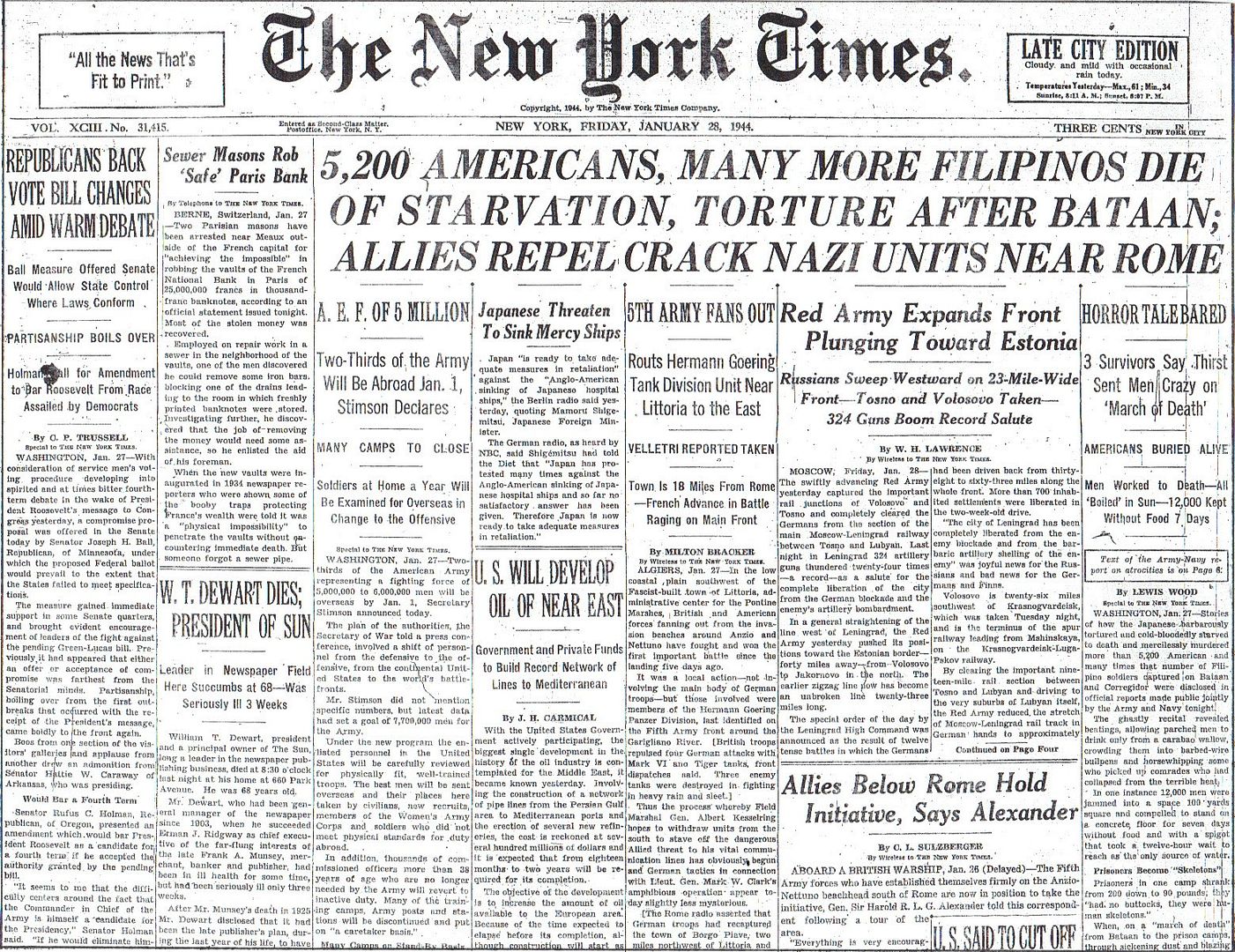
Seventy-one years ago today, the headlines across the United States screamed of the brutality of Imperial Japan. Prisoners, civilians, women, children had been tortured, starved, and slaughtered in the Philippines. The rumors of unimaginable savagery toward its captive peoples had all proved true.

On January 28, 1944, the world first learned about the Bataan Death March (April 1942) and the horrors endured by the American and Filipino POWs of Japan. Invading Japanese forces showed no mercy, allowing their prisoners to die by the thousands from savagery, starvation, and disease.

click to order
Newspapers and newsreels told the stories of three American escapees from a Japanese POW camp in the Philippines who had survived the Death March the Davao Prison Camp. Never before had the public been allowed to hear of the extent of Japanese atrocities and the inhumanity of their regime. Washington had kept the story from the public, fearing that the Japanese would use it as an excuse to end efforts to aid the POWs or worse.

Congressman and editors cursed Churchill and Roosevelt for advocating a Europe First strategy that put aside the war in Asia in favor of focusing on Hitler in the West. The result was the smashing of American air and sea power in Asia, the largest defeat in US military history, and the unfathomable deaths of thousands of Americans both military and civilian in the Pacific.

The truth aroused such fury in the American public that the government’s Europe First policy was imperiled. On January 29th at the Brooklyn Navy Yard, Margaret Truman, Missouri senator Harry Truman’s daughter, expressed the feelings of her fellow Americans when she said as she christened the battleship USS Missouri, “May this great ship be an avenger to the barbarians who wantonly slaughtered the heroes of Bataan.” *

click to order
More war bonds were sold in January and February 1944 than in any period of the war. The graphic description of the Death March and the POW camps was serialized by the Chicago Tribune and made into a book. The hero of the story, Texas native and US Army Air Corps William Dyess who organized the escape, unfortunately died December 1943 in a plane crash barely a month before the public release of his story.

The public learned that American and Filipino forces fought from an untenable position until formally surrendering to the Japanese on April 9. The Japanese immediately began to march some 76,000 prisoners (12,000 Americans, the remainder Filipinos) northward into captivity along a 65-mile route of death.

Japanese butchery, disease, exposure to the blazing sun, lack of food, and lack of water took the lives of approximately 5,200 Americans and Filipinos along the way. Many prisoners were bayoneted, shot, beheaded or just left to die on the side of the road. "A Japanese soldier took my canteen, gave the water to a horse, and threw the canteen away," reported one escapee. "The stronger were not permitted to help the weaker. We then would hear shots behind us." The Japanese forced the prisoners to sit for hours in the hot sun without water. "Many of us went crazy and several died."

The ordeal lasted five days for some and up to twelve days for others. Although the Japanese were unprepared for the large number of prisoners in their care, the root of the brutality lay in the Japanese attitude that a soldier should die before surrender. A warrior's surrender meant the forfeiture of all rights to treatment as a human being.

This was the "first murder" Captain William Dyess said he witnessed:
"The victim, an air force captain, was being searched by a three-star private. Standing by was a Jap commissioned officer, hand on sword hilt. These men were nothing like the toothy, bespectacled runts whose photographs are familiar to most newspaper readers. They were cruel of face, stalwart, and tall. 
'The private a little squirt, was going through the captain's pockets. All at once he stopped and sucked in his breath with a hissing sound. He had found some Jap yen.' 
'He held these out, ducking his head and sucking in his breath to attract notice. The big Jap looked at the money. Without a word he grabbed the captain by the shoulder and shoved him down to his knees. He pulled the sword out of the scabbard and raised it high over his head, holding it with both hands. The private skipped to one side.' 
'Before we could grasp what was happening, the black-faced giant had swung his sword. I remember how the sun flashed on it. There was a swish and a kind of chopping thud, like a cleaver going through beef'. 
'The captain's head seemed to jump off his 'shoulders. It hit the ground in front of him and went rolling crazily from side to side between the lines of prisoners.' 
'The body fell forward. I have seen wounds, but never such a gush of. blood as this. The heart continued to pump for a few seconds and at each beat there was another great spurt of blood. The white dust around our feet was turned into crimson mud. I saw the hands were opening and closing spasmodically. Then I looked away.' 
'When I looked again the big Jap had put up his sword and was strolling off. The runt who had found the yen was putting them into his pocket. He helped himself to the captain's possessions.'
You can read here THE DYESS STORY: The Eye-Witness Account of the DEATH MARCH FROM BATAAN and the Narrative of Experiences in Japanese Prison Camps and of Eventual Escape