Showing posts with label Lecture. Show all posts

Thursday, March 14, 2013

Lousi Zamperini and Resilience


Resilience guides former Olympian, prisoner of war

By YASMEEN SERHAN · Daily Trojan, March 13, 2013

Olympian distance runner, World War II  hero and celebrated Alumnus Louis Zamperini spoke to a maximum capacity audience about the power of resiliance.
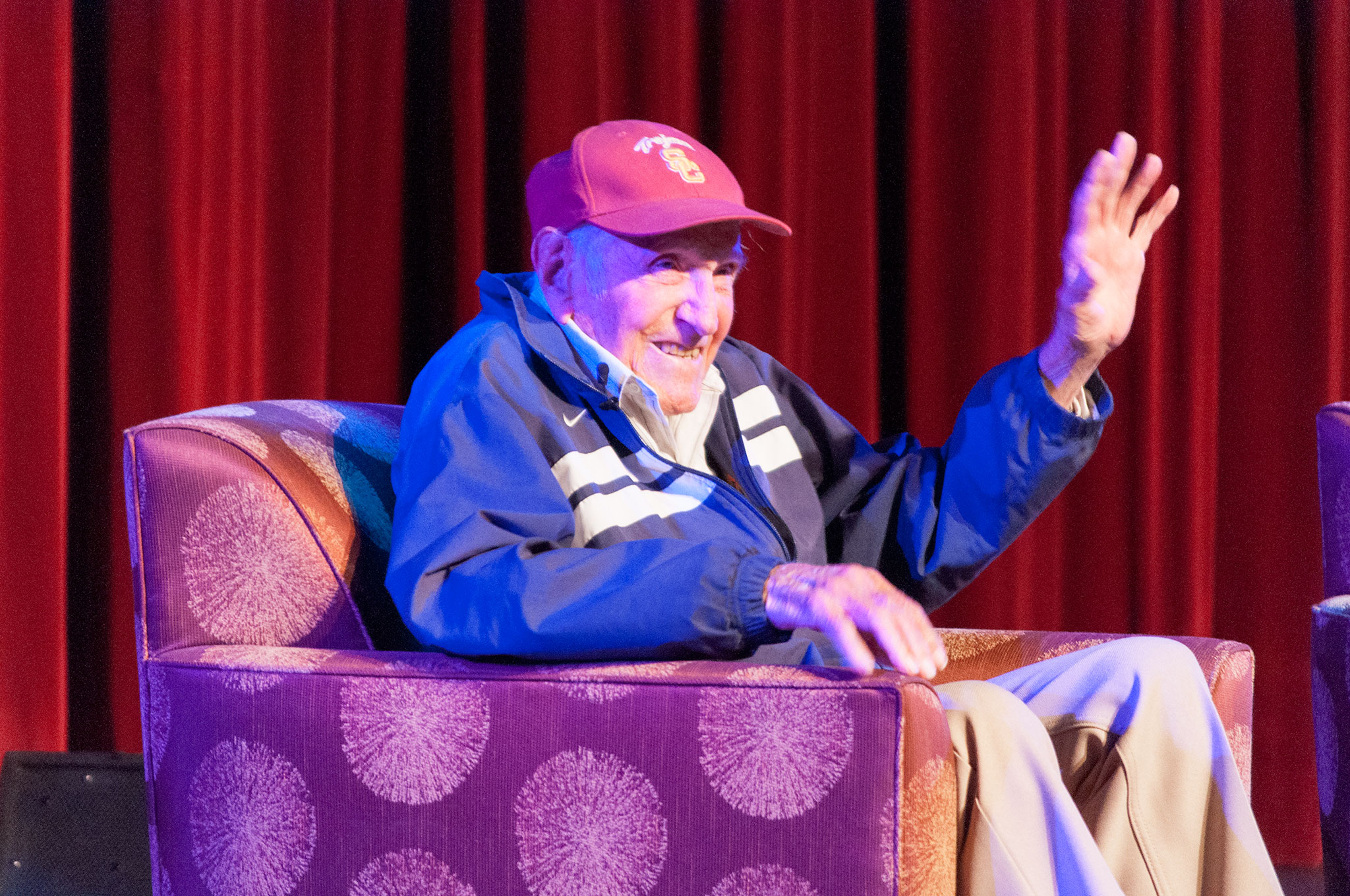
Courage ยท USC alum Louis Zamperini speaks Wednesday at Bovard Auditorium about how his Olympic and POW experiences shaped his life. - Priyanka Patel | Daily Trojan
Courage · USC alum Louis Zamperini speaks Wednesday at Bovard Auditorium about how his Olympic and POW experiences shaped his life. — Priyanka Patel | Daily Trojan
The event, entitled “The Great Zamperini: USC Trojan, Olympian and War Hero,”  was hosted by the Undergraduate Student Government, USC Spectrum and Program Board in conjuction with the Sol Price School of Public Policy, the Kappa Sigma Fraternity and the Student Alumni Society.
The second event of the Student Alumni Society’s 5 Traits of a Trojan Speaker Series focused on the Trojan trait of courage, and also included a performance by the Sol Price School of Public Policy color guard and a video introduction by Zamperini’s son, Luke.
Zamperini, who greeted the crowd of students, faculty and alumni sporting a cardinal and gold hat with his hands poised in the ‘fight on’ sign, spent the remainder of the evening sharing stories of his life, notably his 8th-place performance in the 1936 Berlin Olympics, his experience being stranded for 47 days after his aircraft crashed into the Japanese-controlled waters of the Pacific Ocean s and his survival as a Japanese prisoner of war during World War II.
Throughout the tales of his time in the Japanese prison camps, Zamperini described his two and a half year survival as a time of little hope.
“Every morning I woke up and expected that this was the day,” Zamperini said. ‘This is the day they’re going to kill us.”
Despite the serious tales of his life as a prisoner of war and his eventual rescue, Zamperini was not without humor.
“The mayor asked me if any good came out of being a prisoner of war in Japan,” Zamperini said. “I said, ‘Yeah, it prepared me for 55 years of married life.”
Zamperini recounted his post-war memories, from his assimilation to life after the war to his religious revitalization after listening to a talk by Christian evangelist Billy Graham. It was these same experiences that Zamperini recollected to encourage students to always be resilient.
“Life is full of problems,” Zamperini said. “Sometimes the problems are difficult, but you have to be resolute.”
When asked about how he survived his experiences in war, Zamperini recounted lessons his track coach taught him.
“You have to take the bull by the horns and fight ‘til the finish,” Zamperini said.
In closing, Zamperini reaffirmed his lifelong membership in the Trojan Family.
“I was in this room when I just got back from the war,” Zamperini said of Bovard Auditorium. “Wherever I go, people see my hat. I’m a Trojan though and through.”
Many students said the event reaffirmed their faith in the strength of the Trojan Family.
“Zamperini embodied every aspect about what I hope I will achieve in this lifetime,” said Kenneth Mang, a sophomore majoring in business administration. “This was an extraordinary opportunity, and I hope to have the chance to see him again.”
Jaideep Chadha, a junior majoring in business administration, said Zamperini’s return to the university at the age of 96 represents the strength and timelessness of the Trojan Family.
“His story is not only inspirational, but it shows how important the Trojan Family is and how much these connections matter,” Chadha said.
Student Alumni Society Co-Director Maheen Sahoo said Zamperini is a great example for Trojans everywhere.
“Louis Zamperini truly embodies what it means to be a Trojan and what it means to be one of the five traits — courageous,” Sahoo said. “I think we’re really lucky to have him here on our campus.”

Tuesday, March 12, 2013

Desperate Defense of the Philippines


A Book Discussion With Author

John Gordon
The winner of the NYMAS 2011
Arthur Goodzeit Book Award


Friday, March 15, 2013
7 pm to 8:45 pm

The Soldiers Sailors Club
283 Lexington Avenue 
(between 36th and 37th Streets)
New York City

Free and open to the public

As the only single-volume work to offer a full account of Navy and Marine Corps actions in the Philippines during World War II, this book provides a unique source of information on the early part of the war. It is filled with never-before-published details about the fighting, based on a rich collection of American and newly discovered Japanese sources, and includes a revealing discussion of the buildup of tensions between Gen. Douglas MacArthur and the Navy that continued for the remainder of the war. U.S. Army veteran and defense analyst John Gordon describes in considerable detail the unusual missions of the Navy and Marine Corps in the largely Army campaign, where sailors fought as infantrymen alongside their Marine comrades at Bataan and Corregidor, crews of Navy ships manned the Army's heavy coastal artillery weapons, and Navy submarines desperately tried to supply the men with food and ammunition. He also chronicles the last stand of the Navy's colorful China gunboats at Manila Bay.

The book gives the most detailed account ever published of the Japanese bombing of the Cavite Navy Yard outside Manila on the third day of the war, which was the worst damage inflicted on a U.S. Navy installation since the British burned the Washington Navy Yard in 1814. It also closely examines the surrender of the 4th Marines at Corregidor, the only time in history that the U.S. Marine Corps lost a regiment in combat. To provide readers with a Japanese perspective of the fighting, Gordon draws on the recently discovered diary of a leader of the Japanese amphibious assault force that fought against the Navy's provisional infantry battalion on southern Bataan, and he also makes full use of the U.S. ship logs and the 4th Marine unit diary that were evacuated from Manila Bay shortly before the U.S. forces surrendered.

John Gordon, a retired lieutenant colonel in the U.S. Army with a PhD in public policy, is a senior defense analyst at a defense think tank, and has written widely on military subjects. A resident of Gainesville, VA, he also serves as an adjunct professor at George Mason University and Georgetown University.

~ Peek Inside the Book ~

SUNK IN KULA GULF


Book Discussion with Author

click to order book
John Domagalski

Thursday, March 14, 2013
Noon-1:30pm 

Navy Memorial
701 Pennsylvania Avenue NW
Naval Heritage Center
Washington, DC

The early morning hours of July 6, 1943, found the USS Helena off the Solomon Islands in what would later be known as the Battle of Kula Gulf. But the ship’s participation in the battle came to a swift end when three Japanese torpedoes suddenly struck. One hundred and sixty-eight sailors went down with the ship, many never surviving the initial torpedo hits. As the last of the Helena disappeared below the ocean’s surface, the remaining crewmen’s struggle for survival had only just begun.

Sunk in Kula Gulf tells the epic story of the Helena’s survivors. Two destroyers plucked more than seven hundred from the sea in a night rescue operation as the battle continued to rage. A second group of eighty-eight sailors —clustered into three lifeboats—made it to a nearby island and was rescued the next day. A third group of survivors, spread over a wide area, was missed entirely. Clinging to life rafts or debris, the weary men were pushed away from the area of the sinking by a strong current. After enduring days at sea under the hot tropical sun, they finally found land. It was, however, the Japanese-held island of Vella Lavella and deep behind the front lines. The survivors organized and disappeared into the island’s interior jungle. Living a meager existence, the group evaded the Japanese for eight days until the Marines and U.S. Navy evacuated the shipwrecked sailors in a daring rescue operation.

Using a wide variety of sources, including previously unpublished firsthand accounts, John J. Domagalski brings to life this amazing, little-known story from World War II.

Monday, February 20, 2012

Wake Island Lecture

Temple University
March 6, 2012
 7:30 PM

Lincroft Main Campus 

  Warner Student Life Center
765 Newman Springs Road
Lincroft, New Jersey

 $12 General Admission, $5 Students
Brookdale Students Free


Pre-registration for the program is appreciated and may be made by calling (732) 224-2315. The course code is XWWTS 256 PR. More information regarding the content of the program is available from WWII  Center director Professor Paul Zigo at (732) 224-2029 or e-mail.

Dr. Urwin’s lecture will be based on his current book Victory in Defeat: The Wake Island Defenders in Captivity, which relates in vivid detail the story of the defenders of Wake Island following their surrender to the Japanese on December 23, 1941.

A highly regarded military historian, Professor Urwin spent decades researching what happened after the surrender of Wake Island and will offer a revealing look at the U.S. Marines, sailors, soldiers, and civilian contractors in captivity. In addition to exhaustive archival research, he interviewed dozens of POWs and even some of their Japanese captors.

Dr. Urwin also had access to diaries secretly kept by the prisoners. This information has allowed him to provide a nuanced look at the Japanese guards and how the Americans survived three-and-a-half years in captivity

Dr. Urwin is the author of eight books including Facing Fearful Odds: The Siege of Wake Island which won the Gen. Wallace M. Greene Jr. Award from the Marine Corps Heritage Foundation.   He currently is Vice President of the Military History Society (MHS).