Showing posts with label Brooks Robert. Show all posts

Thursday, December 09, 2021

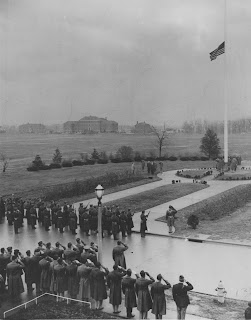
Brooks Field dedicated in 1942 to a heroic
African American tanker


IN RECOGNITION OF PRIVATE ROBERT H. BROOKS AND THE 80TH ANNIVERSARY OF THE ATTACK ON PEARL HARBOR 
 ______ 
 of kentucky 
 in the house of representatives 
 Tuesday, December 7, 2021

 Mr. GUTHRIE. Madam Speaker, today, on the 80th anniversary of the attacks on U.S. naval forces at Pearl Harbor, we remember poignantly the courage and sacrifice of America's Greatest Generation. That legacy of service is rich in Kentucky's Second District, exemplified by the seemingly insurmountable challenges faced by Company D of the 192nd Tank Battalion, which included the Harrodsburg Tankers. 

On December 8th, across the international dateline and just hours after the attack on Pearl Harbor, Japanese bombers descended on Company D and other U.S. forces who were stationed in the Philippines at Clark Field. A young private and Kentuckian by the name of Robert H. Brooks attempted to sprint to his station to fight back against Japanese forces. Sadly, he lost his life during his heroic action. He was the first casualty of the U.S. Armored Forces in World War II. The fighting in the Philippines was relentless for the U.S. service members and Company D. All of the remaining 66 Mercer County natives-- known today as the Harrodsburg Tankers--survived the initial conflict. However, 29 soldiers were lost to the unimaginable conditions during the three years they were held at prisoner-of-war camps. 

 At Fort Knox there is a parade field named after Private Brooks, called Brooks Field, and we will never forget him and those brave soldiers. The bravery of Private Brooks, Company D, and its tankers from Harrodsburg are an indelible reminder of the price of freedom for all that we must never forget.


👉This is the text that was submitted to Congressman Brett Guthrie's (R-KY) office to use. It is interesting to see what history was cut out by the congressman.

Madam Speaker, I rise today to remember the life and sacrifice of Private Robert H. Brooks, an American hero from Kentucky, who gave his life defending liberty on December 7, 1941. He did not perish at Pearl Harbor in Hawaii, but during a same-day attack by Imperial Japan on the American territory of the Philippines. Brooks, 26, was the first American tank battalion member to be killed in World War II and possibly the first African American.

We cannot forget that on December 7, 1941, December 8th across the international dateline, Japan descended upon not only Pearl Harbor but also upon the Philippine Islands, Guam, Wake Island, Howland Island, Midway, Malaya, Singapore, Thailand, Hong Kong, and Shanghai. Whereas the attack on Pearl Harbor was to discourage U.S. action in Asia, the other strikes served as preludes to full-scale invasions and brutal military occupation.

Pvt. Brooks was a member of the 192nd Tank Battalion, Company D, which originated as the 38th Divisional Tank Company of the Kentucky National Guard from Harrodsburg, Kentucky. The 192nd arrived in the Philippines in late November 1941 and was sent immediately to guard Clark Field at Fort Stotsenburg. Soon after Japan’s Pearl Harbor attack, waves of Japanese bombers appeared over the air fields in the Philippines.

Brooks was killed running to his M3 Half-track hoping to man its .50 caliber machine gun. When the news of Pvt. Robert H. Brooks, the first battle casualty of the Armored Force, reached Fort Knox, the Commanding General, Jacob Devers, ordered that the main parade ground at the base from that day on be named after the young tanker.

In inviting Brooks’ parents to the naming ceremony, it was discovered that they were Black tenant farmers from rural Kentucky. At the time, the Army’s Armored Force was segregated.

When this was reported back to General Devers, he said, “It does not matter whether or not Robert was Black, what mattered was that he had given his life for his country.” At the dedication of Brooks Field on December 23, Major General Devers said “In death, there is no grade or rank. And in this greatest democracy the world has ever known, neither riches nor poverty, neither creed nor race, draws a line of demarcation in this hour of national crisis.”

Pvt. Brooks was not alone in his determination and dedication to service. His Company D and 192nd Tank Battalion held out in the Battle of Bataan with dwindling supplies, rampant disease, and little rest until they were surrendered by their commanders on April 9, 1942. Rescue did not come nor was it planned. What followed was the infamous Bataan Death March, capricious abuse, starvation, hellships, and slave labor in Japan. By war’s end, barely half of the men and women surrendered on Bataan had survived. Only 37 or the 66 men from Harrodsburg returned home.

So today, I ask you to remember the bravery of both Pvt. Brooks and General Devers who defied convention to do what was right to advance democracy and equality. I invite you to visit Brooks Field at Fort Knox in my district to pay your respects to them. And I ask you not to forget the brave men of the 192nd Tank Battalion who withstood fascism in battle and in captivity, half of whom did not return home.

Tuesday, December 07, 2021

Eighty Years Ago, Japan Assaulted More Than Pearl Harbor

Kota Bharu

On December 7, 1941, Japan expanded its war on the Asian mainland south and eastward into the Pacific.

by Mindy L. Kotler

National Interest, Dec 7, 2021

Eighty years ago today, December 7, 1941, critical airfields and ports across Southeast Asia and the Pacific were ablaze and in ruin. In just seven hours, Imperial Japan’s surprise attacks cripled British and American forces in the Far East, exposed the Dutch East Indies to invasion, and pushed Thailand into submission. The bombing of Pearl Harbor was but one of many that day. Casualties of the “Associated Powers,” likely exceeded those in Hawaii. One result of these unprovoked attacks was the creation of alliances that endure to this day.

Japan coordinated attacks on the U.S. territories of Philippines, Guam, Wake Island, Howland Island, and Midway and the British Empire in Malaya, Singapore, and Hong Kong. Japanese forces invaded and bombed Thailand’s airfields. In Shanghai, Japan took control of the International Settlement after blowing up the last two British and American gunboats on the Yangtze, the HMS Peterel and the USS Wake.  

The first attack, 70 minutes before Pearl Harbor, was on British-Indian forces at Kota Bharu, on the eastern side of Malaya. Hours before, a British flying boat was shot down by Japanese aircraft while monitoring the progress of the Japanese fleet. The British Royal Air Force crew and their Royal Australian Air Force observer became the first Allied casualties of the war. The ensuing defense of northeastern Malaya was fierce and savage with high casualties on both sides. 

Soon after, Bangkok was bombed and Japanese troops landed to its south and at various points along the Kra Peninsula on the southeastern coast of Thailand. Again, the invaders met with stiff resistance. Despite determined Thai forces, the fighting lasted only five hours. Prime Minister Plaek Phibunsongkhram agreed to a ceasefire and formed an alliance with Japan. The Kota Bharu landings were a prelude to the drive down the eastern side of the Malay peninsula, while the Japanese troops landed in Thailand advanced with Thai soldiers down the western side to seize Singapore and its naval base--the cornerstone of British power in the Indo-Pacific. Japanese planes bombed Singapore that day in warning.

Japan’s early morning attack on Pearl Harbor on Hawaii’s Oahu, was followed by the bombardments of the American airfields on Midway and Howland Island in the equatorial Pacific. Two of the four Hawaii settlers on Howland were killed. For his selfless defense of Midway, First Lieutenant George H. Cannon became the first U.S. Marine in World War II to receive the Medal of Honor.

Guam was shelled, bombed, and invaded. The American territory fell two days later. Of the nearly 500 American military personnel taken to Japan from Guam as prisoners of war, five were female nurses. Japanese troops occupied Batan Island above Northern Luzon in the Philippines before mounting a full-scale invasion. This approach on Aparri on the coast of Cagayan Valley, believed by American war planners as impractical, caught the defenders off-guard and unprepared. The success of the surprise assault was played out just this past fall when U.S., Filipino, and Japanese forces held their first joint amphibious exercises near this Northern Luzon town.

Six hours after the Pearl Harbor attack, the Japanese bombed Hong Kong’s Kai Tak Airport and pushed the defending British and Commonwealth troops to the defensive Gin Drinkers Line. The territory, however, was long regarded as indefensible. Nevertheless British, Indian, Canadian  units along with the Auxiliary Defence Units and Hong Kong Volunteer Defence Corps (HKVDC) held out for two weeks against a Japanese force twice its size.

The Japanese attacked Wake Island about the same time as they bombed Hong Kong. The Americans on Wake Island were composed of 400 Marines, a handful of soldiers and sailors, 45 Chamorro Pan Am employees,  and 1,146 unarmed civilian contractors building an airfield. They proceeded to do what had never been done before or after, hold off an Armada for nearly two weeks. They did not surrender until December 23rd.

The last Japanese actions on December 7th were the bombing of the Iba and Clark airfields in southern Luzon, the Philippines. As in Hawaii, the Japanese caught the American planes on the ground and the defense weak. The guns of neither the ageing artillery batteries nor tank battalions defending the fields could reach the high flying Japanese planes. Whereas the attack on Pearl Harbor damaged the Pacific Fleet, the attack on the Philippines and other U.S. territories destroyed the Far East Air Force. 

The first battle casualty of the Armored Force in World War II, Pvt. Robert Brooks of Kentucky’s Company D, 192nd Tank Battalion, took place on Clark Field. Back at Fort Knox, the home of the newly formed Armored Force, the Commanding General Jacob Devers responded to the news by ordering that the main parade ground at the base be named after the young tanker. This distinction was particularly significant as Brooks turned out to be African American.

On December 7, 1941, Japan expanded its war on the Asian mainland south and eastward into the Pacific. The primary objective was to knock out American and British opposition to its advance into Southeast Asia. The ultimate goal was occupation of the Indo-Pacific, control over  its valuable natural resources, and supremacy over the region's seas. As the sun set, Japan's success seemed possible.

Instead, the day’s debacles forged alliances with a resolve to fight fascist expansionism East and West. The “Associated Powers” (Britain, the Netherlands, and the United States) became the Allies and expanded to include India, Canada, Australia, New Zealand, and free forces from Japan’s occupied territories. The shared bitter experience of Imperial Japan’s wanton brutality and deceits provided the emotional bond to this warfighting coalition. Ironically, these very alliances are what Japan today looks to in defending its homeland. 

Friday, September 25, 2020

Gold Star Families Remembrance Week

This week, September 20th – 26th, is Gold Star Families Remembrance Week, which honors the families of fallen service members and recognizes the sacrifices made by the family members of veterans who died in the line of duty.

The first tanker to die in WWII was a son of African American Kentucky sharecroppers. Pvt. Robert Brooks of the 192nd Tank Battalion was killed by a Japanese bomb on December 8, 1941 at Clark Field.

Cleveland Wright (b. 1931, d. 1992), U.S. Air Force,
“We Regret To Inform You,” 1979. Oil on Canvas.
Collection of the National Veterans Art Museum.
All rights reserved.

Saturday, May 14, 2016

Obama must memorialize more than Hiroshima

memorial to American POWs
who died in Hiroshima
On May 27th, U.S. President Barack Obama and Prime Minister Shinzo Abe will together visit together the Hiroshima Peace Memorial.

There has been much commentary on this, most to create a climate of acceptance of this historic visit. Few give the perspective of the American POW. Many assume it will be negative. This is not necessarily true.

Below is an op ed that appeared on May 11th in The Wall Street Journal Online by Dr. Lester Tenney. He tries to give some nuance to how a Pacific War veteran may view the visit.

For the POWs, who have so often have been abandoned by the White House, this is an opportunity to insist that they must be remembered.

To this end, a memorial needs to be erected at the Port of Moji on Kyushu that is part of a UNESCO World Heritage site; Japan’s new UNESCO World Industrial Heritage sites must note that American and Allied POWs were slave laborers at these sites; and that the POW visitation program must be turned into a permanent program of remembrance, reconciliation, and education.

On May 12th, National Security Advisor Susan Rice held a meeting with veterans organizations to review the President’s upcoming trip to Vietnam and Japan. The American Defenders of Bataan and Corregidor Memorial Society was not invited. Rice said the President’s decision to visit Hiroshima, Japan was “to honor the memory of all who lost their lives during World War II.” We shall see.

Remembering More Than Hiroshima
We must not forget the lives lost and trauma incurred by Allied forces during the Pacific War.

By LESTER TENNEY
Wall Street Journal, May 11, 2016 12:15 p.m. ET

A black man was the first American soldier to die in World War II. An unexploded bomb from a Mitsubishi “Betty” split U.S. Army Pvt. Robert Brooks in two on December 8, 1941, as he ran to the machine gun on his half-track at Clark Field in the Philippines. Like me, he was a member of the 192nd Tank Battalion preparing to fight the invading Imperial Japanese forces. It is fitting that our first black president will soon stand at Hiroshima, where the Pacific War began its end.

Pvt. Brooks’s sacrifice and those of thousands of American and Allied forces who fought and died for freedom in the Pacific must never be forgotten. What Hiroshima represents is more than the effects of a nuclear weapon. It is the culmination of a war started by Imperial Japan and conducted with gross inhumanity, a war in which more civilians died than combatants.

It would be wrong for the president to pivot away from this history and use his visit solely to discuss aspirations for a world without nuclear weapons. Hiroshima highlights mankind’s tragic ability to wreak terrible destruction, and this destruction was not caused exclusively by atomic bombs. Sand-filled bamboo sticks, bayonets, plague-inflected fleas, starvation and rape—methods of warfare used by Japan—are also destructive.

When President Harry Truman announced the bombing of Nagasaki, which ended the war, he recognized “the tragic significance of the atomic bomb.” However, he went on to explain “we have used it against those who attacked us without warning at Pearl Harbor, against those who have starved, beaten and executed American prisoners of war, against those who have abandoned all pretense of obeying international laws of warfare. We have used it in order to shorten the agony of war, in order to save the lives of thousands and thousands of young Americans.”

As a former American POW of Japan, I am particularly sensitive to these words. Truman was looking out for me and more than 27,000 other American POWs in Asia. Until then, we felt forgotten and ignored. The “Europe first” policy of Franklin Roosevelt and Winston Churchill abandoned us to fight without resupply or reinforcement on the Philippines at the start of World War II. We became POWs for more than three bitter years.

We endured four unforgiving months of tank warfare in the tropical heat on Bataan against an enemy with superior training, equipment and provisions. Surrendered by our commanders, nearly 80,000 of us American and Filipino troops were forced on the Bataan Death March. The surviving 68,000 arrived at Camp O’Donnell, a prison camp that saw up to 300 die daily.
The camp commandant ranted at us that we were lower than dogs and better off dead, as we would always be enemies of Japan. I must say that many times I had to agree.

After a period in the camp, many of us went by “hell ship” to Japan to become slave laborers. In my case, it was in a dilapidated Mitsui coal mine. My friend from Janesville, Wis., Capt. Fred Bruni, had a different experience. He and 150 men from the camp were sent to Palawan Island to build an airfield. Upon completion, all the men were set afire and machine-gunned by the Kempeitai.

We POWs have tried to preserve this history despite U.S. and Japanese government efforts to suppress it. Upon liberation, most of us were forced to sign gag orders not to discuss the horrors of our imprisonment. The U.S. government’s policy was to pacify Japan in part by curbing memories of its war atrocities. Central to the 1952 San Francisco Peace Treaty is an article foreclosing any further compensation of victims, thus again preventing the recall of Imperial Japan’s past crimes and abuses.

At home, an underfunded Veterans Administration refused to give us full disability and ignored or misunderstood the aftereffects of vitamin deficiency, tropical diseases and trauma. It took two acts of Congress before we received any compensation for our imprisonment and only at a rate of $1.50 per day for lost meals.

The U.S. government abandoned the Pacific War’s history. This has made efforts to hold Japanese companies accountable for their brutal use of POW slaves nearly impossible. It is taboo to associate high-speed rails, luxury automobiles or Washington’s metro cars with companies that once abused Americans. Among the nearly 60 well-known companies such as Mitsui, Mitsubishi, Sumitomo, Kawasaki and Nippon Sharyo, only the Mitsubishi Materials Company, which used POWs in four of its mines, has apologized.

In recent years the Japanese government has finally begun to make amends to American POWs. They offered an official apology in 2009. At the Obama administration’s urging, they established in 2010 a reconciliation program for former POWs to visit Japan. Unfortunately the program will end this year without any follow-up for descendants or the public.

But history is critical to how we understand ourselves. No one knew Pvt. Brooks’s race until the Army wanted to honor him. When news of his death reached Fort Knox, the chief of the armored force, Gen. Jacob Devers, decided that a parade ground should be named in his memory, because the first American tanker to die in World War II should not be forgotten.

When it was discovered that Pvt. Brooks’s parents were black tenant farmers from Sadieville, Ky., the general was asked if he wanted to reconsider. “No,” he answered, “it did not matter whether or not Robert was black, what mattered was that he had given his life for his country.” As Gen. Devers said at the Brooks Field dedication ceremony, “In death there is no grade or rank. And in this greatest democracy the world has ever known, neither riches nor poverty, neither creed nor race, draws a line of demarcation in this hour of national crisis.”

Mr. Obama wants to use his visit to Hiroshima to highlight the perils of nuclear war. But this is not the only lesson. Our service as veterans of the Pacific War needs to be remembered and not abandoned to some tumid oratory. The president’s visit to Hiroshima will be hollow, a gesture without motion, if the Pacific War’s full history is not maintained. Hiroshima does not and cannot exist outside the context of the Asia-Pacific War and all its dead.

Mr. Tenney, 95, was a member of the 192nd Tank Battalion, Company B that defended the Philippines in World War II. He lives in San Diego.

Friday, September 06, 2013

71ST ANNUAL MAYWOOD BATAAN DAY - SEPTEMBER 8TH

Sunday, September 8th
3:00 PM
Corner of 1st Avenue and Oak Street
Maywood, Illinois

In October of 1941, 89 men from Maywood, Illinois left the United States for the Philippine Islands with Company “B” of the Army’s 192nd Tank Battalion.

Only 43 would return from the War.

They had arrived in Philippine Islands on November 20, 1941 — Thanksgiving Day—and were stationed at Clark Field on Luzon, 60 miles to the north of Manila. On December 7, 1941, Japan attacked Pearl Harbor in Hawaii and Clark Field in the Philippines.

At Clark Field, Robert Brooks, of D Company became the first American “tanker” killed in WWII. He is likely also the first African-American killed in the War. Brooks Field at Fort Knox, Kentucky is named in his honor.

The 192nd Tank Battalion fought for four desperate months against the invading Japanese. Exhausted, sick, starving, and out of ammunition, they were surrendered by their commanding officers on April 9, 1942. On the infamous 65-mile Bataan Death March, the soldiers of Maywood made up the largest number of POWs from a single American town.

>Maywood’s Bataan Day has been held every year since 1942, on the Second Sunday in September<

As POWs of Japan, the Maywood men endured indescribable deprivation, abuse, and degradation. Many became slave laborers for prominent Japanese companies. One that used American POW slave labor was Nippon Sharyo, which manufactured the engines for the Thai-Burma Death Railway. The company still manufactures rolling stock on the same site that it did during the War. Nippon Sharyo passenger cars now cast daily shadows on the Maywood Veterans Memorial Park. A METRA (Chicago area) commuter rail track runs on one edge of the Park. METRA is a major client of Nippon Sharyo. American tax incentives and METRA contracts were used to encourage Nippon Sharyo to build manufacturing facilities in Illinois. The company is planning to benefit from upcoming high-speed rail contracts.

Nippon Sharyo has never acknowledged nor apologized to the POWs it used as slave labor.

Click here for more information on the memorial events and celebration.

Contact Information:
Col. Richard A. McMahon, Jr. (USA, Ret.), President
Phone: (708) 366-8761
Email: Ramcmahon1@aol.com
Website URL: http://mbdo.org