Showing posts with label Congress. Show all posts

Monday, April 06, 2026

80th Anniversary of the End of WWII

September 2, 2025

O
n June 18, 1945, Marine Private Marion Rounds, Jr. of Company "L", Third Battalion, Twenty Second Marines, Sixth Marine Division was killed in action on Okinawa somewhere near Kunishi Ridge. His brother's son, Senator Mike Rounds, who was named after this hero, quietly honored him by shepherding through the U.S. Senate in 2025 the only resolution in Congress remembering the end of World War II. s.

There had not been any mention of the end of WWII in Congress since 2005. That year, Chairman of the House International Relations Committee (today's House Foreign Affairs Committee), Congressman Henry Hyde (R-IL) successfully had passed in the House of Representatives H. Con. Res. 191. As the last Pacific War veteran ln Congress, Hyde felt a deep obligation to the men and women who served with him. They should not be forgotten. Thus, he reitred from Congress frustrated that he could persuade the Senate to pass a similar resolution. The Bush White House objected to the resolutions prose and obstructed its introduction.

A concurrent resolution must be adopted by both the U.S. House and Senate to become the official sentiment of both chambers. It is not a public law nor is it approved by the President. However, if it is not passed by both chambers it is not recognized in the chamber that does pass it. That the Chairman of the Senate Committee on Foreign Relations would not introduce the resolution allowed the Senate to kill the resolution without taking any personal responsibility, defying the White House, or offending the Japanese government.

Twenty years later, Senator Rounds with Senator Richard Blumenthal (D-CT) fulfilled the obligation that Senator Lugar could not. They succeeded in honoring the veterans of the Pacific War as well as all who were sweep up in the last and bloodiest battle of WWII, the Battle of Okinawa. The resolution also called attention to the importance of the Pacific allies the U.S. gained after the war.

Nevertheless, the "friends" of Japan still managed to strip from the resolution a reaffirmation that the 1951 Treaty of Peace with Japan (San Francisco Peace Treaty) "is based upon the judgments of the International Military Tribunal for the Far East in Tokyo and of other Allied War Crimes Courts." Removal of the reference to the Tokyo War Crimes Tribunal was one of demands in 2005 as well.

119th CONGRESS
1st Session


Commemorating the 80th anniversary of the conclusion of World War II with the surrender of Imperial Japan and honoring veterans of both the Pacific and European theaters.


IN THE SENATE OF THE UNITED STATES
September 10, 2025

Mr. Blumenthal (for himself and Mr. Rounds) submitted the following resolution; which was considered and agreed to


RESOLUTION

Commemorating the 80th anniversary of the conclusion of World War II with the surrender of Imperial Japan and honoring veterans of both the Pacific and European theaters.

    Whereas, after the attack on Pearl Harbor by the Japanese on December 7, 1941, the United States declared war on Japan, and later declared war on Germany and Italy after their declarations of war on the United States, fully entering the United States into World War II and joining the Allies to fight the Axis Powers in a war in which over 16,300,000 citizens of the United States served in the military;

    Whereas, during World War II, approximately 415,000 United States servicemembers were killed, another 670,000 were seriously wounded, and 130,000 were held as prisoners of war; and

    Whereas September 2, 1945, marked the official end of World War II, with representatives of the Allied and Japanese governments signing the Instrument of Surrender, prepared by the Department of War and approved by President Harry S. Truman: Now, therefore, be it

Resolved, That the Senate—

(1) honors all veterans, living and deceased, of the Pacific and European theaters of World War II on the 80th anniversary of the conclusion of World War II;

Sunday, March 17, 2024

POW Group Testifies to Congress

STATEMENT FOR THE RECORD

to the

Senate Veterans' Affairs Committee and House Veterans' Affairs Committee


Joint Hearing


To Receive Legislative Presentations of Veterans Service Organizations


By

Jan Thompson

President

American Defenders of Bataan and Corregidor Memorial Society


13 March 2024


AMERICAN DEFENDERS OF THE PACIFIC

TIME FOR A CONGRESSIONAL GOLD MEDAL

&

MEMORIALS IN JAPAN


Chairmen Tester and Bost, Ranking Members Moran and Takano, and Members of the Senate and House Veterans Affairs Committees, thank you for allowing us to describe how Congress can meet the concerns of veterans of World War II in the Pacific.


The American Defenders of Bataan and Corregidor (ADBC) was founded in January 1946 at the Fort Devens, Massachusetts hospital by former POWs of Imperial Japan. The ADBC represented the men and women of the U.S. Armed Forces in the Pacific who participated in the early resistance to, and defensive battles against, the armed forces of Imperial Japan from December 8, 1941 to June 9, 1942. Nearly all the survivors endured four years of merciless imprisonment by Imperial Japan throughout the Empire.


Our Memorial Society now represents their families and descendants, as well as scholars, researchers, and archivists. Our goal is to preserve the history of the American POW experience in the Pacific and to teach future generations of the POWs’ sacrifice, courage, determination, and faith—the essence of the American spirit.


Background


The common perception of an American POW of Imperial Japan is as a casualty of the infamous Bataan Death March 82 years ago next month. The fall of the Bataan Peninsula in the Philippines and the start of the March, April 9, 1942, is National Former POW Recognition Day and is recognized with a Presidential Proclamation.


In fact, Americans—Marines, sailors, and merchant marines in China and Japan—became POWs of Imperial Japan starting with the first day of the War on December 8, 1941. Over the following months, Americans unprepared for war in outposts throughout the Pacific were surrendered en masse often after furious, unaided battles—Wake Island, Guam, Java, Sunda Strait, Luzon, Corregidor, Mindanao, Kiska, Attu—against the invading Japanese.


As POWs, the Americans were subject to torture, abuse, starvation, and neglect. Significantly, they were used as slave laborers for Japan’s military and private industry. The men toiled on the Thai-Burma Death Railway; built airfields with their bare hands—such as at what is now the Antonio Bautista Air Base on Palawan, Philippines; died constructing military projects such as the Soto Dam in Nagasaki Prefecture; and slaved in Japanese corporate mines, mills, and factories. For example, Nippon Steel, which is now attempting to purchase U.S. Steel, used more than 6,000 American and Allied POWs as forced labor with ten percent dying in the process.


I testify today to encourage a greater effort to remember and to advocate for these American men and women who gave their all under desperate conditions and who demonstrated determination and resourcefulness against a ruthless enemy. And all this against the backdrop of a long-decided U.S. and British policy to prioritize the war in Europe. The result was that thousands of these soldiers, sailors, Marines, and airmen became POWs of Japan and suffered some of the War’s worst consequences. One-third did not return home.


Our asks

To ensure that the sacrifices and unique history of our fighting men and women in the Pacific during 1941 and 1942 are not forgotten I ask Congress to:


1. Award the Congressional Gold Medal collectively to the American defenders of Bataan and Corregidor, as defined in U.S. Senator Martin Heinrich’s and Representative Teresa Leger Fernandez’s forthcoming bill. This group represents every U.S. state, territory, tribe, and military service. It is the most diverse World War II Congressional Gold Medal cohort.


2. Call on Nippon Steel and other Japanese companies to acknowledge their history of using American and Allied POWs as slave laborers and to establish an educational foundation to support research and learning about the POW experience in Imperial Japan. Respect for the sacrifices of American veterans should be fundamental to Nippon Steel’s acquisition of a U.S. company. It is the only way that trust can be established.


3. Ask the Government of Japan, to create two central government-funded memorials in Japan, as none exist, to the Allied POWs of WWII. One would be in Tokyo and the other at the Port of Moji on Kyushu, Japan where most of the “hellships”–floating dungeons where POWs were denied air, space, light, sanitation, water, and food–first arrived in Japan to unload their sick and dying human cargo. Currently, the only monuments at Moji are to Japanese war horses, Japanese soldiers, and bananas.


4. Instruct the U.S. Department of State to prepare a report for Congress on the history and funding of the 2010-2023 “Japan/POW Friendship Program.” The report should include (i) how other Allied POW reconciliation programs initiated by the Government of Japan in 1995 compare both in funding and programming with the one for the Americans; (ii) how the U.S. program compares with its “kakehashi” people exchange programs in the United States funded by the Government of Japan starting in 2015; and (iii) a breakdown of the budgets of these various exchange programs and the types and ages of participants.


5. Ask the Government of Japan to reestablish and institutionalize the “Japan/POW Friendship Program.” Inaugurated in 2010 as a reconciliation visit to Japan for former U.S. POWs and family members, it was modeled after ones initiated in 1995 for British, Dutch, and Australian POWs. Japan ended the visitation program for Americans in 2023. Instead of stopping reconciliation efforts, Japan should transform the American POW program into a permanent educational, remembrance, and exchange initiative that encompasses history, justice, and democratic resilience.


6. Ask the Government of Japan to publish in Japanese, English and other Allied languages on the website of the Foreign Ministry of Japan the 2009 Cabinet Decision making a formal apology to all the prisoners of war of Japan and the text of Ambassador Ichiro Fujisaki’s May 30, 2009 speech to the final convention of the ADBC offering an apology to the POWs.


7. Ask the Government of Japan to honor its 2015 written promise to include the “full history” of Japan’s UNESCO World Industrial Heritage properties of the Meiji Industrial Revolution: Iron and Steel, Shipbuilding and Coal Mining. Despite the government’s written commitments to UNESCO, the history of POW slave labor at many of the Heritage sites is not included at those locations or at the Tokyo Information Center. Two of these locations are owned by Nippon Steel.


High price of freedom

By June 1942, most of the estimated 27,000 Americans ultimately held as military POWs of Imperial Japan had been surrendered. By the War’s end, roughly 12,000 Americans POWs had died in Japan’s squalid POW camps, in the fetid holds of “hellships,” or in slave labor camps owned by Japanese companies. This was a death rate of 40 percent. In contrast, 1.5 percent of Americans in Nazi POW camps died putting the mortality rate for POWs of Japan as 20 times greater.


Eighty-three years after the start of the War in the Pacific, it is time to recognize the Americans who fought the impossible and endured the unimaginable in the war against tyranny and fascism in Asia. The American men and women in the early months of the war in the Pacific fought with limited and outdated weapons and no hope of reinforcement or resupply.


Current and future generations can be inspired by their “victory from within.” As President Franklin D. Roosevelt said in August 1943, when the outcome of WWII was still uncertain, “The story of the fighting on Bataan and Corregidor—and, indeed, everywhere in the Philippines–will be remembered so long as men continue to respect bravery, and devotion, and determination.”


In return for their sacrifices and service, they ask that their government keep its moral obligation to them. They do not want their history ignored or exploited. What they want most is to have their government stand by them to ensure that they will be remembered, that our Japanese allies respect them, and that their American history is preserved accurately.


Ms. Jan Thompson

President, American Defenders of Bataan & Corregidor Memorial Society

Daughter of PhM2c Robert E. Thompson USN, USS Canopus (AS-9)

Survivor of the hellships Oryoku MaruEnoura Maru, and the Brazil Maru

Survivor of the POW Camps Bilibid (Philippines), Fukuoka 3B (Japan), & Mukden (China)


See previous testimony to the Veterans’ Affairs Committees for a fuller background

on the history and efforts of the ADBC-MS.

https://www.adbcmemorialsociety.org/

Saturday, April 08, 2023

Is Congress listening?

On March 8, 2023, the Veterans Affairs Committees of the House and Senate held their annual joint hearing for To Receive Legislative Presentations of Veterans Service Organizations. Last year, Ms. Jan Thompson, president of the American Defenders of Bataan and Corregidor Memorial Society, testified in person. This year, as in all past years she submitted a STATEMENT FOR THE RECORD (see below).

Unlike all previous years, both the House and Senate Committees refused to post that the ADBC-MS was to give testimony for the record and, most important, refused to post the text of the testimony. Inexplicably, the rules changed, although no one could give your editor a coherent reason why. Sheepishly, staff told us that the testimony would appear in the Committee print--a printed record of the hearing. If true, this will happen months from the hearing date.

Interestingly, the House Veterans Affairs Committee did list on its Committee Repository website for the hearing, another organization's Statement for the Record: Laura Lehigh as Independent Citizen Advocate for DIC Surviving Spouses Rank-Based Dependency and Indemnity Recipients Group.

UPDATE (4/12/2023) - The Clerk of the House Veterans Affairs Committee admitted that it was an oversight not to post the ADBC-MS testimony on the hearing website repository page. It appear the House committee did not change its posting policy. The clerk for the Senate Veterans Affairs Committee apparently neglected to share the testimony with his counterpart at the House committee. You can find the testimony HERE

Why the Senate Veterans Affairs Committee would block our testimony in this passive aggressive manner we do know. Soon after the hearing, the Committee staff took another unusual position, that of objecting to and blocking a proposed gold medal bill for the men and women who fought in the early defensive battles of WWII in the Pacific. They were vague as to why other than they had problems with the "findings" or statements of fact and noted that they cannot block a bill. But the reality is that their objections did stop the bill from being introduced. The "findings" were written by a committee of world class, American historians of the Pacific War.

I guess the Senate Veterans Affairs Committee got tired of the ADBC-MS asking for the same things every year.  Or maybe they did not again want to hear that there are veterans they were leaving behind and forgetting. Or maybe it is too unbelievable that Japan was once our enemy and considered more brutal than the Nazis. Or maybe Japan's history disinformation campaigns, which are now being directed at POWs, are successful.

AMERICAN DEFENDERS OF THE PACIFIC
THE YEAR FOR A CONGRESSIONAL GOLD MEDAL

Chairmen Tester and Bost, Ranking Members Moran and Takano, and Members of the Senate and House Veterans Affairs Committees, thank you for allowing us to describe how Congress can meet the concerns of veterans of World War II in the Pacific.

The American Defenders of Bataan and Corregidor (ADBC) was founded in January 1946 at the Fort Devens, Massachusetts hospital by former POWs of Imperial Japan. The ADBC represented the men and women of the U.S. Armed Forces in the Pacific who participated in the early resistance to, and defensive battles against, the armed forces of Imperial Japan from December 8, 1941, to June 9, 1942. Nearly all the survivors endured nearly four years of merciless imprisonment by Imperial Japan.

Our subsequent Memorial Society now represents their families and descendants, as well as scholars, researchers, and archivists. Our goal is to preserve the history of the American POW experience in the Pacific and to teach future generations of the POWs’ sacrifice, courage, determination, and faith—the essence of the American spirit.

Background
Eighty-one years ago today marks the fall of the Dutch East Indies (today’s Indonesia) to Japan and the capture on Java of a West Texas National Guard Battalion as well as two American aviators and one sailor too seriously wounded to be moved. Barely a week before, the heavy cruiser USS Houston (CA-30) went down in the Battle of Sunda Strait marking the decimation of the United States Asiatic Fleet that had commanded the United States Navy and Marines in the region since 1902. American forces on Wake Island and Guam had surrendered in December 1941.

In April, after 99 days of constant warfare and no hope of resupply, the Bataan Peninsula in the Philippines was surrendered and the infamous Bataan Death March began. Less than one month later, on May 6th, the Fortress Island of Corregidor and its associated commands defending Manila were surrendered. The rest of American and Filipino units throughout the Philippines were surrendered on June 9th. And on June 7th, Japan invaded Alaska’s Kiska and Attu islands in the Aleutians, imprisoning 42 Native Americans, 8 Navy weathermen, one female school teacher, and killing three men.

I testify today to encourage your efforts to remember these American men and women who gave their all under desperate conditions to demonstrate determination and resourcefulness against a ruthless enemy and a long-decided U.S. and British policy of prioritizing the war in Europe. The result was that most of these soldiers became POWs of Japan who suffered some of the War’s worst consequences. One-third did not return home.

For all, the homefront was their third battle--after surviving warfare in the Pacific and enduring atrocities as a POW. Forced to sign gag orders about the horrors they witnessed and unable to explain the after-effects of torture, abuse, starvation, and trauma, the POWs of Japan first focused, as do today’s veterans, on obtaining healthcare, disability benefits, survivor benefits, caregiver support, mental health access, and education.

The fourth and final battle for the American POWs of Japan is for them not to be forgotten: both by their country and the Japanese. Current and future generations can be inspired by their “victory from within.” As President Franklin D. Roosevelt said in August 1943, when the outcome of WWII was still uncertain, “The story of the fighting on Bataan and Corregidor—and, indeed, everywhere in the Philippines–will be remembered so long as men continue to respect bravery, and devotion, and determination.”

Our asks
To ensure that the sacrifices and unique history of our fighting men and women in the Pacific during 1941 and 1942 are not forgotten I ask Congress to:

1. Award, collectively to the American defenders of Bataan and Corregidor, as defined in U.S. Senator Martin Heinrich’s and Representative Teresa Leger Fernandez’s forthcoming Congressional Gold Medal bill. This group represents every U.S. state, territory, tribe, and military service. It is the most diverse World War II Congressional Gold Medal cohort.

2
. Ask the Government of Japan, to create a central government-funded memorial in Japan, as none exist, for the Allied POWs of WWII at the Port of Moji on Kyushu, Japan where most of the “hellships”–floating dungeons where POWs were denied air, space, light, sanitation, and food–first arrived in Japan to unload their sick and dying human cargo. This memorial should be selected from a world competition. Currently, the only monuments at Moji are to Japanese war horses, Japanese soldiers, and bananas.

3. Instruct the U.S. Department of State to prepare a report for Congress on the history and funding of the “Japan/POW Friendship Program.” This visitation program began in 2010. The report should include (i) how other Allied POW reconciliation programs initiated by the Government of Japan in 1995 compare both in funding and programming and (ii) how the U.S. program compares with other “Kakehashi” people exchange programs in the United States funded by the Government of Japan starting in 2015.

4. Ask the Government of Japan to continue and institutionalize the “Japan/POW Friendship Program” established in 2010. Initially established as a reconciliation visit to Japan for former POWs modeled after ones established in 1995 for British, Dutch, and Australian POWs, the program has included widows and the elderly children of POWs. The program needs to transform into a permanent educational, remembrance, and exchange initiative encompassing history, justice, and democracy. It needs to be permanent, not merely a yearly, diplomatic “deliverable” subject to Japan’s budget whims.

Thus far, there have been 12 trips, one each in the fall of 2010 through 2019. In 2015, there were two trips. In 2016, 2018, and 2019, due to the advanced age of surviving POWs, only widows and children participated in the program. No trips were held in 2020, 2021, or 2022. A four-day trip for 7 children of POWs was held in February this year. In all, 46 former POWs, all in their late 80s or 90s, as well as nine widows and 25 children in their 60s and 70s have made the trip to Japan. A number of the caregiver companions were wives, children, and grandchildren.

5. Ask the Government of Japan to publish in Japanese, English and other languages on the website of the Foreign Ministry of Japan the 2009 Cabinet Decision offering a formal apology to all the prisoners of war of Japan and the text of Ambassador Ichiro Fujisaki’s May 30, 2009 speech to the convention of the ADBC offering an apology to the POWs:

I would like to convey to you the position of the government of Japan on this issue. As former Prime Ministers of Japan have repeatedly stated, the Japanese people should bear in mind that we must look into the past and to learn from the lessons of history. We extend a heartfelt apology for our country having caused tremendous damage and suffering to many people, including prisoners of wars, those who have undergone tragic experiences in the Bataan Peninsula, Corregidor Island, in the Philippines, and other places.

6. Ask the Government of Japan to honor its 2015 written promise to include the “full history” of Japan’s UNESCO World Industrial Heritage properties of the Meiji Industrial Revolution: Iron and Steel, Shipbuilding and Coal Mining. The history of POW slave labor at many of the Heritage sites is not included at those locations or at the Tokyo Information Center.

7. Amend title 36, United States Code to include National Former POW Recognition Day among the days the POW/MIA flag is required to be displayed. This is April 9th, which is the anniversary of the Bataan Death March. The President is already required to issue a proclamation for this remembrance day.

High price of freedom

By June 1942, most of the estimated 27,000 Americans ultimately held as military POWs of Imperial Japan had been surrendered–they did not surrender. By the War’s end, roughly one-third or more than 12,000 Americans had died in squalid POW camps, in the fetid holds of “hellships,” or in slave labor camps owned by Japanese companies. Almost one-third (or 4,000) died from friendly fire in unmarked hellships sunk by American planes and submarines.

Surviving as a POW of Japan and returning home was the beginning of new battles: finding acceptance in society and living with serious mental and physical ailments. In the first six years after the war, deaths of American POWs of Japan were more than twice those of the comparably aged white male population. These deaths were disproportionately due to tuberculosis, suicides, accidents, and cirrhosis. In contrast, 1.5 percent of Americans in Nazi POW camps died (the mortality rate for POWs of Japan was 20 times greater). In the first six years after liberation, the mortality rate of those who survived the Japanese POW camps was three times the rate of the Nazi POW camp survivors.

Eighty-two years after the start of the War in the Pacific, it is time to recognize the Americans who fought the impossible and endured the unimaginable in the war against tyranny in the Asia. The American men and women in the early months of the war in the Pacific fought with limited and outdated weapons and no hope of reinforcement or resupply.

In return for their sacrifices and service, they ask that their government keep its moral obligation to them. They do not want their history ignored or exploited. What they want most is to have their government stand by them to ensure they will be remembered, that our allies respect them, and that their American history is preserved accurately for future generations.

Ms. Jan Thompson
President, American Defenders of Bataan & Corregidor Memorial Society
Daughter of PhM2c Robert E. Thompson USN, USS Canopus (AS-9)
Survivor of the hellships Oryoku Maru, Enoura Maru, and the Brazil Maru
Survivor of the POW Camps Bilibid (Philippines), Fukuoka 3B (Japan), & Mukden (China)
https://www.adbcmemorialsociety.org/

Friday, April 07, 2023

A Gold Medal For All Needed

Descendants of WWII POWs call into question congressional bill that only honors defenders of Bataan and Corregidor

By ROSE L. THAYER
STARS AND STRIPES, November 8, 2022

Descendants of some U.S. troops taken prisoner in the Philippines during World War II have called into question an ongoing effort to award those veterans with Congressional Gold Medals, saying the latest version honors only those who fought in Bataan and Corregidor and excludes other areas of the Philippines and Pacific.

Since 2009, the New Mexico congressional delegation has introduced bills to establish the medal to honor those captured at the Bataan peninsula and on Corregidor Island, two of the main defensive positions that the U.S. established after the Japanese invaded the Philippines within days of the surprise attack on Pearl Harbor on Dec. 7, 1941. U.S. and Filipino troops on Bataan surrendered on April 9, 1942, after running out of food and ammunition. Corregidor held out for nearly a month before surrendering.

The current version of the bill honors only those who served on Bataan and Corregidor.

It does not mention the thousands of U.S. troops who were fighting in other parts of the Philippines until the top U.S. commander, Gen. Jonathan Wainwright, surrendered all American and Filipino forces in the Philippines when Corregidor fell. Some members of the 1,000-strong Defenders of Bataan and Corregidor Memorial Society would like to see Americans who resisted Japan’s sweep through the Pacific but were captured at Wake Island, Guam, Java, the Aleutians and at sea honored, too.

Some of them were imprisoned alongside defenders of Bataan and Corregidor when the Japanese consolidated many of their prisoners at camps in Japan and Manchuria as other areas once under their control fell to the advancing Americans and their allies.

“It's very much a misreading of the history of the fall the Philippines. You cannot divorce Bataan and Corregidor from everything else that was going on,” said Mindy Kotler Smith, a member of the memorial society. Her husband’s great uncle Fletcher Wood served in the Philippines with the Army Corps of Engineers and died in Bilibid prison in Manila.

Congress has commissioned gold medals as its “highest expression of national appreciation” since the American Revolution. Other groups to receive the medal for service during World War II include Merrill’s Marauders, a unit that served in the jungles of Burma, women who joined the workforce as a “Rosie the Riveter,” the merchant mariners of World War II and the Navajo Code Talkers.

House and Senate rules state that legislation establishing such a medal must be co-sponsored by two-thirds of the chamber membership to advance to committees. If this doesn’t happen by the end of the year, the legislation must be resubmitted in the next session of Congress.

The latest version of the Defenders of Bataan and Corregidor Congressional Gold Medal Act was introduced by Sen. Martin Heinrich, D-N.M., in April 2021. Rep. Teresa Leger Fernandez, D-N.M., introduced the companion bill in the House a month later. Both have sat idle because they have bipartisan support but not enough co-sponsors.

“Bataan veterans deserve the recognition of our nation’s highest and most distinguished honor for their perseverance and patriotism. We must never forget their undaunted heroism in the face of unthinkable conditions and horrific abuses,” Heinrich said in a statement.

The Defenders of Bataan and Corregidor Memorial Society was founded in 1946 by survivors of the Philippine campaign as they recovered in a Massachusetts hospital following their liberation from captivity at the end of the war, Smith said. As those men grew old and died, their descendants took over the organization, and now focus on education and preservation of this specific chapter of World War II history.

They’ve watched over the years as lawmakers from New Mexico have introduced the different bills to honor their sacrifice and have offered their own guidance on how to better honor the estimated 27,000 American service members held prisoner by the Japanese during World War II. About 12,000 of them died in captivity, according to the memorial society.

They included up to 700 Americans and several thousand Filipinos who died of beatings, beheadings, starvation and lack of water during a 5- to 10-day forced march from Bataan to prison camps that became known as the Bataan Death March. Thousands more perished in the camps.

However, determining who should be honored by a congressional medal has proven a challenge.

Among those who surrendered at Corregidor were 77 Army and Navy nurses, all of whom were liberated when the U.S. recaptured the Philippines late in the war. The memorial society fears the current bill would exclude them because the current wording refers to “troops.”

The first legislation to award medals in honor of POWs in the Philippines dates to 2009, when Heinrich served in the House. He proposed the medal to be presented to defenders of Bataan, Corregidor and the main Philippine island of Luzon. It did not mention any specific units nor Americans taken prisoner in the central and southern Philippines.

That same year, former Sen. Tom Udall, also a New Mexico Democrat, introduced the companion bill in the Senate, but with a more narrow focus. It only authorized medals for those who were taken prisoner at Bataan but not Corregidor or other locations overrun by the Japanese.

Heinrich’s office did not respond to queries about whether he would consider changes to the legislation in the next congressional session.

“It is our hope that they will amend and modify the bill so that we can support it,” said Jan Thompson, president of the memorial society whose father, Navy pharmacist’s mate Robert E. Thompson, surrendered on the island of Corregidor. “We’re not comfortable supporting it as it is, and we’d like to be able to support.”

Thursday, November 03, 2022

Correcting history in Congress

Omuta barracks

Last year, your editor was searching Congress.gov for any legislation that mentioned the Bataan Death March. I found the following celebration of the life of Cpl Walter Gann from Mississippi. Although pleased that another POW received recognition, I was soon shocked at how poorly written the insertion was as well as how full of inaccuracies it was. No one also took the time to check the proper titles for his military awards.

As we are on mission to tell the incredible history of the American POWs of Japan, I contact the author, Congressman Trent Kelly's (R-MS) office, and offered to correct it. I offer the two versions that now appear in the Congressional Record for you to better understand the importance of getting the history right. 

Mr. Gann survived being a POW, but suffered severe PTSD and health issues the rest of his life making permanent employment impossible. By the grace of God and a wonderful family he lived a full life dying in 1980 at 58.


RECOGNIZING THE LIFE OF WALTER GANN 

Congressional Record Vol. 167, No. 67

(Extensions of Remarks - April 19, 2021)

RECOGNIZING THE LIFE OF WALTER GANN
 ______ 
 HON. TRENT KELLY of mississippi 
 in the house of representatives 
 Monday, April 19, 2021 

 Mr. KELLY of Mississippi. Madam Speaker, I rise today to celebrate the life and service of Corporal Walter Gann, an American hero and an outstanding representation of the state of Mississippi. Walter Gann was born on January 31, 1922 to John and Mary Rogers Gann. 

He spent the first eighteen years of his life in Calhoun City, Mississippi. Only July 3, 1941 he joined the United States Army Air Forces in Jackson, Mississippi and was soon deployed to the Philippines. At eighteen years old Walter faced attack by the Japanese Imperial Army. After several months of battle with minimal food, supplies, and medical care, the American soldiers were forced to surrender; the Bataan Death March began on April 9, 1942. Corporal Gann, enduring shrapnel wounds and malnutrition, marched 65 miles in the blistering heat. 

 It is believed Corporal Gann arrived at Fukuoka POW Camp No. 1 on Kyushu Island where he faced barbaric treatment from Japanese guards. He was eventually transported to Japan; Gann and his fellow soldiers stood shoulder to shoulder on the Japanese hell ship. Men died by the dozens of suffocation, starvation, and dysentery. In Japan, Corporal Gann was a POW for three and a half years. 

 Corporal Gann was released upon American Victory and was immediately treated in a Washington hospital before returning home. His family rejoiced to see him alive and safe. He was called to testify in the war crime trials following WWII but could not attend because he was hospitalized. For the remainder of his life Corporal Gann bore the weight of all he had witnessed. 

 In 1949 Walter moved to Booneville, Mississippi and married Juanita Goddard. Together they raised four children. In August of 1963 his wife passed, and in November of that year his son was killed in a motorcycle accident. In 1970 he moved to Chattanooga, Tennessee until his death on October 14, 1980. He was laid to rest at Crossroads cemetery in Jumpertown, Mississippi with his wife and son. 

 In the course of his life Corporal Gann was awarded the Good Conduct Medal, a Purple Heart, the WWII Victory Medal, an A.P. Theater Medal with 1 Bronze Star, the American Defense Medal with 1 Bronze Star, and the Philippine Liberation Medal with 1 Bronze Star. He also received a letter from President Harry S. Truman thanking him for his service to the United States. 

 I am grateful for the service of Corporal Walter Gann and admire his commitment to faith, family, and country.

CORRECTED 

Congressional Record Vol. 167, No. 189
(Extensions of Remarks - October 27, 2021)

RECOGNIZING THE LIFE OF WALTER GANN
 ______ 
 HON. TRENT KELLY of mississippi 
 in the house of representatives 
 Wednesday, October 27, 2021 

 Mr. KELLY of Mississippi. Madam Speaker, I rise today to celebrate the life and service of Corporal Walter Gann, an American hero from Mississippi, who defended liberty against impossible odds in the Pacific during World War II. 

 Walter, born in Calhoun City on January 31, 1922, joined the U.S. Army on July 3, 1941. By July 15, he was aboard the USS Coolidge deployed to the Philippines as a member of the Army Signal Corps assigned to 409th Signal Company (Aviation) at Nichols Field outside Manila. The plan was to erect radar towers, but none of the equipment needed arrived on the ship with them. 

 Imperial Japan attacked the Philippines on December 8 and all the critical airfields were destroyed by December 10. Walter's company and the airmen were soon sent on combat duty in the Bataan Peninsula. He was assigned to U.S. Army Forces Far East (USAFFE) headquarters at Little Baguio near the tip of Bataan. 

 The troops on Bataan, running out of ammunition, food, and medicine, with no hope of resupply or reinforcement, were surrendered by their commanding officers on April 9, 1942. Walter was among 86,000 American and Filipino prisoners of war who were forced on what became known as the infamous Bataan Death March, one of World War II's worst war crimes. In the tropical sun, deprived of food, water, and mercy, the men trekked 65 miles up Bataan to a train station. There they were packed standing 100 to a boxcar for the next 24 miles. Men died where they stood. Survivors marched another eight miles to their first POW camp, O'Donnell. 

 Walter, POW No. 203, was shipped to Japan in July 1943 packed in the dark, fetid hold of the hell ship Clyde Maru with 500 other POWs. He was sent to be a slave laborer at Fukuoka No. 17 POW Camp attached to the Mitsui-owned Miike coal mine in southern Japan close to Nagasaki. Starved, beaten, and denied medical care, he was forced to dig coal in a primitive mine until the camp was liberated in September 1945. The coal mine is now a UNESCO Industrial World Heritage site, albeit without mention of the thousands of POWs held there or that the mine had remained reliant on manual labor and not modem machinery. 

Although asked to testify in Japan at the war crime trials held from 1946 to 1948, Mr. Gann could not return because he remained too sick from the various illnesses he suffered from during his three and one- half years as a POW. For the remainder of his life, Walter bore the weight of all the horror and inhumanity he had witnessed. When he was able to work, Walter was a truck driver. 

 In 1949, Walter moved to Booneville, Mississippi, and married Juanita Goddard. Together they raised four children. In 1963, he lost both his wife and his stepson. In his later years, he lived in Chattanooga, Tennessee, until he passed away on October 14, 1980. 

 During his lifetime, Walter was awarded the Good Conduct Medal, the Purple Heart, the World War II Victory Medal, the Asiatic-Pacific Campaign Medal with one bronze campaign star, the American Defense Service Medal with one bronze campaign star, and the Philippine Defense Medal. He also received a letter from President Harry S. Truman thanking him for his service. Posthumously, he received the Bronze Star Medal for meritorious achievement, the Prisoner of War Medal, and the Presidential Unit Citation with two Bronze Oak Leaf Clusters. 

I am grateful for Corporal Walter Gann's commitment to faith, family, and democracy. I am humbled by his sacrifices for our country.

Left behind by Congress, again

Hirohata POW Camp Sept 2, 1945

An effort to honor America’s POWs leaves far too many behind


By Patrick Regan And Mindy Kotler Smith, Opinion Contributors

The Hill, 9/16/22

Today, on National POW/MIA Recognition Day, we pause to remember the suffering of all American prisoners of war.

The Defenders of Bataan and Corregidor Gold Medal Act (S. 1079), now pending in Congress, seeks to award Congressional Gold Medals to some of those POWs who fought the Japanese in the early months of World War II. Credit to Sen. Martin Heinrich (D-N.M.) for championing the bill and working to honor these men and women whose stories and sacrifices must not be forgotten.

But the act in its current form is insufficient.

As written, it would honor only those who served on Bataan and Corregidor in the Philippines. It leaves out Americans who also tried with no hope of resupply and antiquated weapons to stave off Japan’s lightning advance through Southeast Asia from Aug. 8, 1941, to June 10, 1942 — in Midway, Wake Island, Guam, Java, all of the Philippine Islands, the Aleutians and at sea.

These are the Americans who President Franklin D. Roosevelt said in August 1943, when the outcome of WWII was still uncertain, “will be remembered so long as men continue to respect bravery, devotion, and determination.” This still holds true.

The Philippines is often central to the most-common stories of American POW suffering and survival, in part because that is where so many endured the infamous Bataan Death March. The Americans there held out for months in 1942 on the Bataan peninsula of Luzon and finally at the tiny fortress islands in Manila Bay, the best known being Corregidor, until they could no longer hold off the resupplied Japanese.

But the stories of survival and subsequent Japanese brutality are no less remarkable in other parts of the Philippines or the Pacific theater.

The few hundred Marines and Navy sailors left to defend Guam were overrun by the Japanese in a matter of days by Dec. 10, 1941. Guam was the first American territory to be occupied by the Japanese during the war. The battle’s survivors would endure nearly the entire war as prisoners of the enemy.

At Wake Island, more than 400 Marines, 1,200 unarmed civilians and 45 Chamorro Pan Am airline employees heroically held off a Japanese armada for an unheard of nearly two weeks from Dec. 8-Dec 23, 1941. Marine Corps aviator Maj. Henry T. Elrod —aka Hammerin’ Hank — was the first U.S. pilot to sink a warship from a fighter plane. Elrod was killed on the last day of the battle and was the first aviator to receive the Medal of Honor in World War II.

Hundreds of miles south of the Indonesian island Java, on March 1, 1942, the USS Edsalls skipper, Lt. Joshua Nix of Memphis, Tenn., laid down smokescreens and followed a series of evasive maneuvers that so frustrated four Japanese warships that air support had to be called to sink her. It took two ferocious hours of combat to end the Edsall. A small number of the 187 men on board were rescued. Their beheaded bodies were discovered in a mass grave in Celebes after the war.

Seventy-seven years ago this month, American rescue teams liberated American and Allied POWs scattered throughout Japan’s 775 POW camps across the Pacific. In Japan, one of those was Hirohata Camp 12-B, south of Osaka. Hirohata housed 300 Americans, one Australian and one Englishman. The men were survivors from Guam, Wake Island, all over the Philippines, USS Yorktown and USS Penguin.

When word came to camp in late August that the war was over, Marine gunner Earl B. Ercanbrack gathered the Americans in the courtyard of the camp, where for the previous two years they had counted off in Japanese every morning before going off to backbreaking slave labor in a Nippon Steel mill and on its dock. The civilian overseers treated them as criminals and subjected them to ridicule and cruel, capricious punishments.

According to what Ercanbrack later told his hometown newspaper, The Monitor in McAllen, Texas, he ordered the camp’s guards to remove the Japanese flag from the 75-foot pole in the courtyard. It was replaced by an American flag hastily sewn together using a white parachute, red curtain and two blue Japanese shirts.

As the makeshift American flag rose over the camp, someone started singing “God Bless America.” Others joined in, until 300 American POWs — finally free — crescendoed in unison with the song’s final line: “God bless America, my home sweet home.”

Think about those 300 men — tortured, starved and ordered to work as slave labor for years — proudly uniting to sing “God Bless America.” Now imagine awarding Congressional Gold Medals to only those in that 300 who had served in Bataan and Corregidor.

It would be wise for Congress to follow the Hirohata prisoners’ example of unity and revise the bill to award a Congressional Gold Medal to all Americans who participated in those first desperate battles of WWII in the Pacific.

Ercanbrack, who fought and was captured at Guam and organized the U.S. flag raising in the Hirohata camp, would not be eligible for the Gold Medal now under consideration. That’s just not good enough.

Patrick Regan and Mindy Kotler Smith are members of the American Defenders of Bataan and the Corregidor Memorial Society and are descendants of men who fought in The Philippines. Regan’s grandfather, U.S. Army Air Corps SSgt Donald Regan, survived the Bataan Death March and Nippon Steel’s Hirohata POW camp in Japan. 

Saturday, March 26, 2022

Reminding Congress of its debt to the POWs of Japan

Rep Mark Takano
On March 8, 2022, the president of the American Defenders of Bataan and Corregidor Memorial Society, Ms. Jan Thompson, testified in person to the joint hearing of the Senate and House Veterans Affairs Committee to learn the legislative concerns of the country's Veteran Service Organization (VSO).

For years, the ADBC was only allowed to submit testimony for the record. This year, for the 80th Anniversary of Bataan Death March and the fall of the Philippines to the invading Japanese Empire, Ms. Thompson was invited to give testimony in person to remind the Committee members of the important American history she protects and how the sacrifice of the American POWs in the Pacific continues to inspire.

After Ms. Thompson's testimony, House Veterans Affair Committee Chairman Mark Takano (D-CA) said: 

Thank you, Ms. Thompson, for your testimony.  I will ask my staff to brief me on the status of the legislation that you have brought up.  

Let me just say that I, too, believe this history is so important.  The sacrifice of our World War II veterans in the Pacific and, specifically, those that served, those that endured the hellships and those that endured the Bataan Death March.  We must remember their sacrifice.  We must face up to history, no matter how terrible it is.  We must encourage our ally Japan, to do that.  We must live up to those ideals for ourselves, as well, to face our own history. So, thank you so much for your testimony and thank you so much for the work that you do.  

HERE IS WHAT PRESIDENT JAN THOMPSON SAID THAT ELICITED THAT RESPONSE:

HER FULL WRITTEN TESTIMONY CAN BE FOUND HERE.

Ms. Thompson.  Chairmen Tester and Takano, Ranking Members Moran and Bost, and members of the Senate and House Veterans Affairs Committee, thank you for inviting me to speak about the American POWs of the Empire of Japan during World War II.  We honor these American men and women as the heroes who deserve recognition by Congress and America, as a whole.  They have largely been forgotten and we must remedy this.  

I represent the American Defenders of Bataan and Corregidor Memorial Society and I am the daughter of one of those POWs.  The ADBC-MS Society represents the men and women who defended American territories and allies in the Pacific, such as Guam, Wake, Midway, Java, the Philippines, and the Marianas.  

Within the first six months of the war, by June 1942, the majority became prisoners of war.  Our mission is to preserve the history of the American POW experience in the Pacific and to teach future generations of the POW's sacrifice, courage, determination, and faith, as this is the essence of the American Spirit.  

Like today's Ukrainians, the Americans in the Pacific were fighting a formidable invader.  The Empire of Japan also had far superior equipment and armed forces.  Although Guam fell within days of Pearl Harbor, the Marines and civilians on Wake Island held out for a legendary two weeks and the American and Filipino defenders in the Philippines repelled the Japanese Army for nearly 5 months.  They fought with outdated weapons, lacking medicine, ammunition, and supplies.  Help did not come from the United States.  

The men on the Bataan Peninsula were surrendered 80 years ago next month.  Those surrendered on Bataan endured what is now known as the Bataan Death March and, as Senator Tester said in his opening remarks, this April 9th, marks the eightieth anniversary of the Bataan Death March.  

Less than one month later, on May 6th, the fortress island of Corregidor was surrendered and the rest of the American and Filipino units scattered throughout the 7,000 islands of the Philippines soon followed.  

Some of you know about the Bataan Death March, but few of you know about the beheadings of Wake Island Marines or the machine gunning of American sailors who survived the sinking of the USS Houston or the deadly imprisonment in Japan of the indigenous people of Attu from Alaska.  

To survive the surrender was just one hurdle, because each day of the POW's captivity, three and a half years, was a constant struggle for survival.  All the POWs, American and Allied, were starved, denied medical care, refused clothing, routinely beaten, and murdered.  Some POWs became human experiments.  Some aviators were executed, followed by a ritualistic eating of their livers.  And others, without reason, such as on Wake and Palawan, were simply massacred.  

As the war progressed, the majority of the POWs were shipped throughout the Empire on what were called "hellships" to be slave laborers for private Japanese companies.  All of these hellships were unmarked.  Many were sunk by American bombers or submarines.  

Thousands of American POWs died by friendly fire.  For those who survived captivity, returning home presented another battle.  Some POWs were forced to sign gag orders about the horrors they experienced.  Many of them could not articulate what had happened to them or what they had witnessed and it took a very long time for the Veterans Administration to recognize they all had returned home with a disability.  

The sacrifice and resilience of the American POWs of Japan, especially in light of today's events, should not be forgotten.  Their courage continues to inspire. 

To this end, in this year of the eightieth anniversaries, I request that Congress immediately approve an accurate and inclusive Congressional Gold Medal for America's early defenders of the Pacific who fell to Japan.  They are the most diverse World War II cohort to be considered for the Congressional Gold Medal.  

The U.S.-Japan alliance is very strong today and we ask Congress to encourage the Japanese in the following:  to institutionalize the reconciliation program that was started in 2010 with the ADBC Memorial Society.  The current POW Japan Friendship Program should be expanded.  Japan's UNESCO industrial heritage sites need to acknowledge POW slave labor and a world-class memorial should be installed at the Port of Moji, where most POWs entered Japan on the hellships.  

The epic battles of Bataan and Corregidor were a symbol of hope and a beacon of our future success.  They should not be forgotten.  It is time to honor these men and women.  

Thursday, December 09, 2021

Brooks Field dedicated in 1942 to a heroic
African American tanker


IN RECOGNITION OF PRIVATE ROBERT H. BROOKS AND THE 80TH ANNIVERSARY OF THE ATTACK ON PEARL HARBOR 
 ______ 
 of kentucky 
 in the house of representatives 
 Tuesday, December 7, 2021

 Mr. GUTHRIE. Madam Speaker, today, on the 80th anniversary of the attacks on U.S. naval forces at Pearl Harbor, we remember poignantly the courage and sacrifice of America's Greatest Generation. That legacy of service is rich in Kentucky's Second District, exemplified by the seemingly insurmountable challenges faced by Company D of the 192nd Tank Battalion, which included the Harrodsburg Tankers. 

On December 8th, across the international dateline and just hours after the attack on Pearl Harbor, Japanese bombers descended on Company D and other U.S. forces who were stationed in the Philippines at Clark Field. A young private and Kentuckian by the name of Robert H. Brooks attempted to sprint to his station to fight back against Japanese forces. Sadly, he lost his life during his heroic action. He was the first casualty of the U.S. Armored Forces in World War II. The fighting in the Philippines was relentless for the U.S. service members and Company D. All of the remaining 66 Mercer County natives-- known today as the Harrodsburg Tankers--survived the initial conflict. However, 29 soldiers were lost to the unimaginable conditions during the three years they were held at prisoner-of-war camps. 

 At Fort Knox there is a parade field named after Private Brooks, called Brooks Field, and we will never forget him and those brave soldiers. The bravery of Private Brooks, Company D, and its tankers from Harrodsburg are an indelible reminder of the price of freedom for all that we must never forget.


👉This is the text that was submitted to Congressman Brett Guthrie's (R-KY) office to use. It is interesting to see what history was cut out by the congressman.

Madam Speaker, I rise today to remember the life and sacrifice of Private Robert H. Brooks, an American hero from Kentucky, who gave his life defending liberty on December 7, 1941. He did not perish at Pearl Harbor in Hawaii, but during a same-day attack by Imperial Japan on the American territory of the Philippines. Brooks, 26, was the first American tank battalion member to be killed in World War II and possibly the first African American.

We cannot forget that on December 7, 1941, December 8th across the international dateline, Japan descended upon not only Pearl Harbor but also upon the Philippine Islands, Guam, Wake Island, Howland Island, Midway, Malaya, Singapore, Thailand, Hong Kong, and Shanghai. Whereas the attack on Pearl Harbor was to discourage U.S. action in Asia, the other strikes served as preludes to full-scale invasions and brutal military occupation.

Pvt. Brooks was a member of the 192nd Tank Battalion, Company D, which originated as the 38th Divisional Tank Company of the Kentucky National Guard from Harrodsburg, Kentucky. The 192nd arrived in the Philippines in late November 1941 and was sent immediately to guard Clark Field at Fort Stotsenburg. Soon after Japan’s Pearl Harbor attack, waves of Japanese bombers appeared over the air fields in the Philippines.

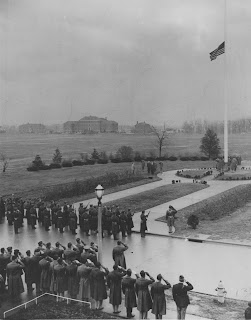
Brooks was killed running to his M3 Half-track hoping to man its .50 caliber machine gun. When the news of Pvt. Robert H. Brooks, the first battle casualty of the Armored Force, reached Fort Knox, the Commanding General, Jacob Devers, ordered that the main parade ground at the base from that day on be named after the young tanker.

In inviting Brooks’ parents to the naming ceremony, it was discovered that they were Black tenant farmers from rural Kentucky. At the time, the Army’s Armored Force was segregated.

When this was reported back to General Devers, he said, “It does not matter whether or not Robert was Black, what mattered was that he had given his life for his country.” At the dedication of Brooks Field on December 23, Major General Devers said “In death, there is no grade or rank. And in this greatest democracy the world has ever known, neither riches nor poverty, neither creed nor race, draws a line of demarcation in this hour of national crisis.”

Pvt. Brooks was not alone in his determination and dedication to service. His Company D and 192nd Tank Battalion held out in the Battle of Bataan with dwindling supplies, rampant disease, and little rest until they were surrendered by their commanders on April 9, 1942. Rescue did not come nor was it planned. What followed was the infamous Bataan Death March, capricious abuse, starvation, hellships, and slave labor in Japan. By war’s end, barely half of the men and women surrendered on Bataan had survived. Only 37 or the 66 men from Harrodsburg returned home.

So today, I ask you to remember the bravery of both Pvt. Brooks and General Devers who defied convention to do what was right to advance democracy and equality. I invite you to visit Brooks Field at Fort Knox in my district to pay your respects to them. And I ask you not to forget the brave men of the 192nd Tank Battalion who withstood fascism in battle and in captivity, half of whom did not return home.