Showing posts with label Ube Industries. Show all posts

Saturday, April 15, 2023

12th AMERICAN POW DELEGATION TO JAPAN

2023 POW FRIENDSHIP VISITATION PROGRAM

PARTICIPANT/POW CONCISE PROFILES  

FEBRUARY 11 TO 16,  2023

This past February, the Japanese  government again invited children of POWs of Japan to the country to work on reconciliation and their parent's ordeal with Imperial Japan's armed forces. This was the first trip that included a daughter of a female Army officer, a nurse on Corregidor. It is also the first trip that highlighted a POW camp where POW slave labor was for a company, Ube Industries, owned by the current Japanese Foreign Minister Yoshimasa Hayashi. His great grandfather founded the conglomerate.

They met with the U.S. Ambassador to Japan, Rahm Emanuel. They also visited with Ambassador Ichiro Fujisaki, president of the America-Japan Society, who helped initiate the program in 2009 while he was ambassador to the United States. Sadly, he was unwilling to host a program for his visitors with his members or at the Nakasone Peace Institute where he is president.

This may also be the last trip the Japanese feel necessary to host. Its multi-million dollar kakehashi program to bring Americans to Japan is focused on Japanese-Americans, high school students, and cultivating the next generation of American Japan experts. As American policymakers are now reluctant to mention that Japan was an enemy or an unrepentant perpetrator of war atrocities, it seems likely that this reconciliation program will disappear. 

The following children visited Japan. For fuller biographies of their POW parent, see this LINK.

Ms. Margaret A. GARCIA , 72, lives in Albuquerque, New Mexico. She is the daughter of CPL Evangelisto “Evans” R. Garcia (June 19, 1913 – January 29, 2011), a corporal in New Mexico’s 200th Coast Artillery. They were the first to fire on the invading Japanese on December 8, 1941. He fought in the Bataan Peninsula and endured the Bataan Death March. He was sent to Japan in 1943 to be a slave laborer in Mitsui’s Omuta coal mine outside Nagasaki. Today, the mine is a UNESCO World Industrial Heritage site.

Ms. Sandra Harding, 70, of Santa Fe, New Mexico, is the daughter of two U.S. Army officers who were prisoners of war of Japan surrendered in the Philippines: Lt. Earlyn Black Harding (September  8, 1918 – August 16, 2007) and Lt. Col. Harry J. Harding (March 22, 1919 – October 30, 1987). Lt. Black was an Army Nurse on Corregidor who was interned at Santo Tomas in Manila. Lt. Col. Harding was with the 63rd Infantry Regiment (Philippine Army) on Panay. He was sent to Japan and imprisoned in Kobe House POW Camp, Zentsuji, and Rokuroshi. Ms. Harding was an elementary school art teacher for the Santa Fe Public Schools and recently retired as a freelance graphic artist.

Mr. Thomas J. Hoskins, Jr., 75, lives in San Antonio, Texas. He is the son of Staff Sergeant Thomas J. Hoskins (April 6, 1918 – April 18, 1995) who was a member of the U.S. Army Signal Corps. His father operated one of the two working radar units in the Philippines when Japan attacked on December 8, 1941. As a POW, his father was forced to build an airfield on Palawan Island in the Philippines. He was taken to Japan to be a slave laborer in various Kawasaki area POW camps near Tokyo. After the war, his father continued to serve in the military until his retirement in 1959 as a Master Sergeant in the U.S. Air Force.

Ms. Linda McDavitt, 76, lives in Austin, Texas where she is President/CEO of the Genevieve and Ward Orsinger Foundation and Sail Training Commander of the Austin Yacht Club. She is the daughter of Capt. Jerome A. McDavitt (February 10, 1912-May 3, 1982) the 24th Field Artillery Regiment (Philippine Scouts). Surrendered on Corregidor, he was sent to Japan in 1944 where he was the POW commanding officer at the Hiroshima #6B - Omine POW camp that provided slave labor for a coal mine owned by Ube Industries. He was one of 89 Texas Aggies (graduates of Texas A&M) involved in the defense of Bataan and Corregidor.

Ms. Lorna Nielsen Murray, 64, lives in South Jordan, Utah. She is the daughter of PFC Eugene P. Nielsen, (January 23, 1916 - February 3, 2011) a member of the 59th Coast Artillery who fought on Corregidor. Nielsen was one of only 11 survivors of the 1944 Palawan Massacre of 139 American POWs. They were on Palawan Island in the Philippines to build an airfield for the Imperial Japanese Army. Today, this airfield is the foundation for the island’s Antonio Bautista Air Base. On November 22, 2023, Vice President Kamala Harris laid flowers at the memorial to the victims of this Japanese war crime. Ms. Murray is also a cousin to Lt. Col. Chase J. Nielsen, one of the famed “Tokyo Doolittle Raiders” and one of the eight who were captured by Japan. He was one of the four POWs who survived.

Dr. Gail Yoella Small, 68, lives in Reno, Nevada and is the daughter of Major George Small (February 28, 1908 – December 15, 2007) who was with the Chemical Warfare Service, 7th Chemical Company, Aviation, at Clark Field in the Philippines. After the Far East Air Force in early December 1941 was destroyed, he was assigned as an officer with the 31st Infantry Division, Company F of the 2nd Battalion that fought on Bataan. He survived the Bataan Death March, Camp O’Donnell, and the Cabanatuan POW Camp in the Philippines. In Japan, he was imprisoned at Osaka POW Camp 2-D UMEDA, Zentsuji, and Rokuroshi. 

Ms. Karen Brady Smith, 73, lives in Kent, Washington. She is the daughter of Major Jack E. Brady (February 26, 1921 – August 11, 2008) who was a member of the 228th Army Signal Company in the Philippines. He survived the Bataan Death March, Camp O’Donnell, and Cabanatuan POW Camp. He was on one of the first hellships, Tottori Maru, to Japan, enduring a 38-day journey via Formosa, Mako, and Korea to Japan. He was held at the Omori POW Camp in Tokyo, used as stevedore for Nippon Express and worked at an iron smelter in Iwate at Sendai #10-B for Tokyo Shibaura Denki K.K. (Tohoku Denki Seitetsu Kabushiki Kaisha)

Friday, December 01, 2017

Daughters and Widows of POWs in Japan

Steele (L) Pruitt (R)
In October 2017, by invitation of the Japanese government, two widows and four daughters of former POWs of Japan visited the sites of their loved one's enslavement. They visited a now closed Ube Industries coal mine, the location of Japan's "show" camp, and Dowa Industries' copper mine in Sendai. Below are brief profile of the POWs and the women who returned to Japan.

Ben Steele, who became a well-known artist in Montana, was the focus of, Tears in the Darkness: The Story of the Bataan Death March and its Aftermath. His widow and the widow Charles Pruitt visited the Ube Industries coal mine in Yamaguchi Prefecture where their husbands were slave laborers.

click to order
BENJAMIN CHARLES STEELE

Shirley Emerson Steel
e, 92, is the widow of Benjamin Charles Steele. They met while he was teaching at the high school in New London, Ohio and were married August 31, 1952. Active in the Billings First United Methodist Church, Mrs. Steele taught English at the local high school before devoting herself to raising their adopted son Sean. She is accompanied by her step-daughter Rosemarie Steele, 70, who recently retired after 32 years as Wheatland Country, Montana elected treasurer. She is active in the local Kiwanis Club and was one of the club’s first five women members. She is Mr. Steele’s older daughter from his first marriage.

Benjamin Charles Steele was born November 17, 1917 in the small Montana town of Roundup and grew up riding horses, roping cattle, and occasionally delivering supplies to the well-known western artist Will James. On September 9, 1940, he enlisted in the U.S. Army Air Corps at Fort Missoula, Montana. After basic training at March Field, California, he received instruction at Kirkland Field, Albuquerque, New Mexico to be an aircraft dispatcher and was assigned to the 7th Materiel Squadron, 19th Bombardment Group. He arrived in the Philippines aboard the USAT Willard A. Holbrook on October 23, 1941.

He was at Clark Field about 40 miles northwest of Metro Manila on December 8th when Imperial Japan began its invasion of the Philippines by bombing this air field and others. After the near total destruction of the American Far East Air Force by December 10th, Steele and 200 members of the 19th Bomb group were withdrawn to the Bataan Peninsula with men from the 27th Bomb Group to form the 2nd Provisional Infantry Regiment. They had had no training, and many did not even know how to load their WWI Springfield rifles. U.S. and Filipino forces on Bataan were surrendered on April 9, 1942. Steele, at Cabcaben Field near the tip of the Bataan Peninsula, began the Bataan Death March at one of its longest points. For six days he and 75,000 other sick, starving, and exhausted men made their way 65 miles north up to the train junction of San Fernando. From there, they were packed into unventilated boxcars for a 24-mile trip to Capas. The next three miles were by foot to Camp O'Donnell, an unfinished training camp for the Philippine Army. Trying to avoid the constant death at the Camp, Steele joined a group of 300 men selected for the Tayabas Road Detail. The work that was so brutal, and the conditions so harsh tha fewer than half the men survived. Near mortally sick from beri beri, dysentery, pneumonia, blood poisoning, and malaria, Steele was sent to Bilibid Prison on August 15th where he stayed for18 months. Although expected to die, he clung to life and kept his sanity by covertly sketching Montana scenes—cowboys, horses and barns—and the human degradation and cruelty surrounding him. He did so at great risk, as he could have been shot if his sketches were discovered. When able, he was sent to Cabanatuan to do be an agricultural slave labor.

On July 4, 1944, he was loaded aboard the freighter Sekiho Maru (Canadian Inventor), which came to be known as the Mati Mati Maru (Wait Wait Ship). On September 1, after many breakdowns, a typhoon, and a stop in Formosa, the surviving prisoners, their beards long, hair matted, and skin covered with ulcers and open sores, stumbled down the gangway at Moji, Japan. He was taken to Hiroshima # 6B - Omine (Sanyo) in Yamaguchi Prefecture (Prime Minister Shinzo Abe’s home prefecture) 75 miles from Hiroshima. He worked in a dangerous mine as a slave laborer for Ube Kosan's Sanyo Muen Kogyo Sho (Ube Industries' Sanyo Smokeless Coal Works, today’s Ube Industries Ltd., the great grandson of Akira Tawarada the first president (1942) of the consolidated Ube Industries, Yoshimasa Hayashi, is currently Japan’s Education Minister). Steele believed he felt the atomic blast at Hiroshima on August 6, 1945.

In mid-September 1945, he was evacuated to the hospital ship USS Consolation, taken to Okinawa and then flown to San Francisco by the 19th Bombardment Group C54 and assigned to Fort George Wright Hospital in Spokane, Washington, where he remained until he was discharged July 10, 1946. Steele painted scenes from his capture as he went through his long recovery, including trying to regain the 80 pounds he lost. “I had lots of problems to work through,” he said, “and the doctors thought the art was a good idea.”

After the war, Steele earned a diploma from the Cleveland Institute of Art in 1950, a B.S. in Education from Kent State University, and a M.A. in Art from Denver University. While teaching high school art in Ohio, he married his second wife, Shirley on August 31, 1952. He retired in 1982 from Eastern Montana State College (today’s Montana State University Billings) as head of the Art Department. He had many one-man shows of his art and his illustrations appear in over 20 books and several documentaries. His WWII POW collection is at the University of Montana and his sketchbooks are at the MacArthur Memorial Museum in Norfolk, Virginia. He is the focus of Tears in the Darkness: The Story of the Bataan Death March and Its Aftermath (2010) and the subject of a 2016 documentary by Jan Thompson, Survival Through Art.

He said he learned to forgive his Japanese captors because of his relationship with Harry Koyama, a Japanese-American art student. “He’s been a part of my life since I met him in college in the 1960s,” Koyama, a modern, western artist with a gallery in Billings, said about Steele. “That’s even more of a humbling experience to know that I had not just an effect, but a positive effect on his life.”

Steele passed away September 25, 2016. Hundreds attended his memorial service in the Montana Pavilion at MetraPark. He is buried in Sunset Memorial Gardens, Billings, Montana. On August 24th, 2017, the Ben Steele Middle School opened in Billings.

Philippines POW#: 本-1546
Japan POW#: 359

Congressman: Greg Gianforte (R-MT), https://gianforte.house.gov/


CHARLES L. PRUITT

Doris Jean Pruitt
, 88, is the widow of the late Charles Pruitt. Judith Ann Pruitt, 70, is their oldest of three children. She lives in Boston, Massachusetts and worked in property management in Boston for over 20 years and then for the Closet Factory in design/sales for 15 years. She is an active member of the American Defenders of Bataan and Corregidor Memorial Society and serves on their board. Currently, she is the organization’s Treasurer and Convention Chair.

Charles L. Pruitt, one of nine children, was born in Sweetwater, Tennessee on November 6, 1920. He joined the U.S. Navy on September 6, 1940 and received his recruit training in Norfolk, Virginia. His first duty was as a Yeoman aboard the USS Lexington (CV-2). In April 1941, he was transferred to the 16th Naval District at Cavite, Philippines where he was a carpenter’s mate assigned to the Naval Ammunition Depot, Cavite Navy Yard to train as a mine technician. The Navy Yard was bombed and destroyed on December 10, 1941 shortly after Imperial Japan’s invasion. In the immediate aftermath, he helped operate a crane on Sunset Beach, three miles from Cavite, unloading munitions and assisting in the mining of Subic Bay that is about 65 miles northwest of Cavite and Manila.

Like most of the U.S. Navy on the Philippines, he became an infantryman. This makeshift “Navy Infantry” consisted of 150 ground crewmen from Patrol Wing Ten, 80 sailors from the Cavite Naval Ammunition Depot, 130 sailors from USS Canopus (AS-9), 120 sailors from the base facilities at Cavite, Olongapo, and Mariveles, and 120 Marines from an antiaircraft battery. He fought in the Battle of the Points (January 22 to February 18, 1942) at Lapay-Longoskawayan repelling successfully part of a 2,000-strong landing Japanese force.

On February 23rd, most of “Navy battalion” was transferred to Corregidor, three miles from Bataan in Manila Bay. He was assigned beach defense with the 4th Marines under the command of Major Max Clark at Ramsey Ravine, one of the critical points in the defense of the fortress island. Corregidor fell May 6, 1942. The Japanese first moved their nearly 12,000 prisoners on the island to the exposed, rocky beach at the 92nd Garage. There, the POWs waited nearly three weeks (May 24th) in the tropical sun with little food, water or sanitation before they were put in small boats to Manila. After being forced to wade ashore, the POWs were marched through Manila in what has become known as the “March of Shame” to Bilibid Prison POW Camp. From there, by rail and by foot they made their way to Cabanatuan #3 prison camp. In late September 1942, Cabanatuan #3 was closed and the prisoners were relocated to Cabanatuan #1 to be organized for work details. Pruitt was sent to labor at Camp Murphy and Zablan Field. On August 27, 1944, he was among the 1,035 POWs boarded on the Mitsubishi-made “Hell ship” Noto Maru that made its way via Formosa, air raids and sub attacks to Moji, Japan (September 4th).

He was then among 50 men taken to Hiroshima # 6B - Omine (Sanyo) in Yamaguchi Prefecture (Prime Minister Shinzo Abe’s home prefecture) 75 miles from Hiroshima. He worked in a dangerous mine as a slave laborer for Ube Kosan's Sanyo Muen Kogyo Sho (Ube Industries' Sanyo Smokeless Coal Work, today’s Ube Industries Ltd., the of great grandson of Akira Tawarada the first president (1942) of the consolidated Ube Industries, Yoshimasa Hayashi, is currently Japan’s Education Minister). Pruitt was one of eight men at the camp who did not wait for liberation forces to arrive at his camp. They somehow made their way down to the south end of the island of Kyushu and met up with American forces. For unknown reasons, he was registered as “liberated at Fukuoka #9 Miyata” a mine in central Kyushu. He proceeded to hitch-hike on air transports from Japan all the way to San Francisco. He briefly stayed at Oak Knoll Naval Hospital took another military transport to Olathe, Kansas where he finished his trip back home to Tennessee via a Trailways bus to Memphis. He spent the next six months at the Naval Hospital in Millington, Tennessee.

After his return to Sweetwater, Tennessee, he married his sister’s friend, Jean DeButy, on October 28, 1946. Their first child, Judith Ann, was born August 5, 1947. He remained in the Navy for 20 years, and retired in 1960 as a Chief Warrant Officer. Pruitt, a talented woodworker, taught cabinet-making at Tennessee schools until 1981. In retirement, he served as Commander of the Smokey Mountain Chapter of American Ex-POW organization (AXPOW). He was also the National Commander of the American Defenders of Bataan and Corregidor for 1994-1995. Mr. Pruitt passed away December 4, 1998 and is buried at the Tennessee State Veterans Cemetery.

Philippines POW#: 1-12247
Japan POW#: 469

Congressman: Chuck Fleischmann (R-TN 3rd)

BURKHART, THOMAS F.

Caroline Burkhart,
70, is the daughter of the late Thomas F. Burkhart. She grew up as an Army “brat” throughout the United States and now lives in Baltimore, Maryland, where she pursued a career in real estate. She is an experienced researcher of the American POW experience with Imperial Japan and a former vice president of the American Defenders of Bataan and Corregidor Memorial Society.

Thomas F. Burkhart was born May 6, 1914 in Altoona, Pennsylvania. He joined the U.S. Army Air Corps in July 1937 and was assigned as a medical clerk to Hamilton Field, California. In June 1941, he was discharged from the Army Air Corps and commissioned a 2nd Lieutenant in the U.S. Army Reserve. He was immediately sent to the Philippines aboard the SS President Pierce. He arrived June 24th and was assigned to Fort McKinley outside Manila, the headquarters for the U.S. Army Forces in the Far East (USAFFE) Philippines Department. He became an officer with the Headquarters Company of the 45th Infantry, Philippine Scouts, an elite U.S. Army unit composed of American officers and Filipino enlisted men. After Imperial Japan’s December 8, 1941 invasion of the Philippines and USAFFE’s December 23rd activation of War Plan Orange-3 (WPO-3), his battalion helped defend the withdrawal of American forces on Luzon to the Bataan Peninsula. Barely a month after being promoted to 1st Lieutenant, on January 24, 1942, he earned a Silver Star for “Gallantry in Action” at the Battle of Abucay Hacienda (January 15-25, 1942) helping maintain the first battle position on Bataan.

Sick with malaria, Burkhart was in the open-air General Hospital #1 near the tip of Bataan when Major General Edward King surrendered the Bataan Peninsula to Japanese forces on April 9, 1942. At the end of the month, the patients were taken by truck up to San Fernando and there made to stand in packed boxcars for the 24-mile trip to Capas, Tarlac. As he told his family, “hell would be a refrigerator” compared with being in these poorly ventilated, rolling prisons that were like ovens under the sweltering tropical sun. As those who endured the Bataan Death March, he was forced to march the last three miles to Camp O’Donnell, a makeshift POW camp from an unfinished Philippine Army training camp. In early June, the Japanese fearing the deaths of all the prisoners from the horrific conditions of the Camp began to release their Filipino POWs and transfer the others to a new facility at Cabanatuan. It is estimated that 1,550 Americans and 22,000 Filipinos died at Camp O’Donnell, the overwhelming majority with the first eight weeks.

On November 6 1942, he was among 1,500 prisoners packed into the coal bunker of the unmarked “Hell ship” Nagato Maru. It took three tortuous weeks for the ship to make its way from the tropics to the cold of Northeast Asia. The ship stopped at Takeo, Formosa before arriving at the port of Moji on Kyushu, Japan. Burkhart nearly blind from malnutrition, was first taken to Osaka POW Camp #4-B Tanagawa. This camp provided POW slave labor for the Toshima Group (today’s Tobishima Corporation) to build a breakwater and submarine base. The camp was notable for having one of the highest death rates among the mainland POW camps. He was soon (January 15 1943), moved to the Hiroshima #1-B Zentsuji POW Camp on the island of Shikoku. Although Zentsuji, is often referred to as a “propaganda show camp,” conditions were harsh and the men were punished for any perceived offense often on a whim of the guard in charge. The enlisted men at the camp were slave stevedores for Nippon Express Co. (Nippon Tsuun) at Sakaide Rail Yards and the Port of Takamatsu. As an officer, Burkhart worked in the camp garden and tried to raise rabbits. On June 23, 1945, he and 334 officers were transferred to POW Camp 11-B Rokuroshi deep in the Japanese Alps near the industrial town of Fukui (destroyed by air raids July 1945). They were to do subsistence farming, even though they had arrived in the camp late in the growing season and no land had been cleared for cultivation. Because Rokuroshi had not been identified by the Japanese government as a POW camp, it was one of the last to be found (September 8, 1945). He was quickly evacuated to Manila on USS Tryon and then sent to San Francisco on the USS Storm King.

Burkhart remained in the Army and made a career with the Quartermaster Corps, retiring in 1957 as a Lt. Colonel in U.S. Army Reserve. Throughout his life he was plagued by health problems most likely caused by the illnesses and hardships of being a POW. For a number of years after retirement, he worked as a government contractor in the food service industry. In 1972, at 57, he passed away and is buried at Arlington National Cemetery.

Philippines POW#: 1-03739
Japan POW#: NA
Congressman: John P. Sarbanes (D-MD 3rd)

JOHN J. MCCORTS

Mary Jane McCorts Blaine,
62, is the daughter of the late John J. McCorts. She is a life-long resident of Harrisburg, Pennsylvania and works for the Pennsylvania State Employee Credit Union (PSECU). For the past 20 years, Ms. Blaine has been an active member of the American Defenders of Bataan and Corregidor Memorial Society.

John J. McCorts was born May 19, 1921 in Stillions, Arkansas, the older of two boys, and named for his maternal grandfather. After his parents’ divorce, his family moved to his maternal grandmother’s farm near El Dorado, Arkansas. At some point they moved to Abilene, Texas where he graduated from high school and enlisted in the U.S. Army one year later in 1940. He was trained to be a radio operator with the Signal Corps. Likely sent to Philippines sometime between June and October 1941, his first assignment was with the 228th Signal Operations Company that was constituted on September 2, 1941. It is unclear when in January 1942 or how he moved from Ft. McKinley to Corregidor Island in Manila Bay to work on signals intelligence in the Malinta Tunnel. On May 6, 1942, when Corregidor was surrendered by Major General Jonathan Wainwright, he was taken prisoner while repairing wire near the Tunnel. His family did not know if he was dead or alive until Christmas 1942 and only then through a newspaper article in the Boulder City, Nevada newspaper.

Like most of the 12,000 men on Corregidor, he was moved to the rocky beach at the 92nd Garage, After nearly three weeks (May 24th) in the tropical sun with little food, water or sanitation, they were put in small boats to Manila. The men were then made to wade ashore before being paraded six miles down Dewey Boulevard on a “Victory March” now called the “March of Shame” before the Filipino and foreign residents to the old Spanish-built prison of Bilibid. Many of the POWs were chained together with collar shackles and suffered the Japanese soldiers urinating on them. The following day they were moved by train and foot to the squalid Cabanatuan POW Camp.

McCorts was among the 300 POWs and 2,000 Imperial Japanese Army troops boarded on Lima Maru September 20, 1942 to Takao, Formosa. The men were taken to Taiwan POW Camp #2 – Taichu for two months. On November 15, 1942, he was sent to the Port of Moji in Japan aboard the “Hell ship” Dainichi Maru. From there, he was taken north to the Mitsubishi-owned shipyard and POW camp Tokyo #1-D Yokohama at Yokohama. He was a riveter inside ships under construction. The noise and constant beatings he received to his head caused permanent damage to his hearing.

At some point, he was transferred north to the Sendai #8B Kosaka POW Camp to be a slave laborer at a copper mine and smelter owned by Fujita-gumi Construction Company (today’s Dowa Holdings Co., Ltd.). There is now a museum in Kosaka reviewing the history of the local mine, which was one of Japan’s most productive as well as the origin of Dowa Holdings’ metal and mining business. The Kosaka Mine Office Museum and mine are pictured on Dowa’s website. There is no mention at the museum of the Allied POWs who slaved there.

He was liberated on September 11, 1945 and returned to the United States on October 15, 1945. He spent nearly a year at Letterman General Hospital in San Francisco, California and Birmingham General Hospital in Van Nuys, California. Bewildered by freedom and the job environment, he rejoined the Army’s Signal Corps. Over the years, he traveled most of the world as part of his service and sometimes on his own, including: Russia, Greece, Italy, Egypt, Korea, France, Germany, Singapore, and Viet Nam.

His Russia posting in the late 1940s, landed him in the midst of a 1953 investigation by Senator Joe McCarthy (R-WI) into possible espionage and un-American activities at the U.S. Army Signal Corps facility at Fort Monmouth in New Jersey. He was discharged and denied a promotion. McCarthy’s charges soon proved scurrilous and McCorts was reinstated. The experience, however, left him angry and bitter and prompted him to turn down a promotion to Master Sergeant. He remained on active duty until 1963 and retired from the Reserves in 1970. He used his GI benefits to pursue his college education at Temple University, where in 1972 he received a B.A. in Social Administration.

His first post-service job was as an electronic communications specialist with the Pennsylvania Department of Civil Defense. After graduation from Temple, he changed career paths and worked in the Pennsylvania State Department of Health and Welfare where he started as a case worker, then a field auditor, and retired as policy director.

In 1992, McCorts developed a rare cancer often found in people who had long-term, low-level exposure to copper cyanide as found in the Dowa Holdings’ mine. Although his cancer was in remission, he suffered from a series of strokes and other medical issues and passed away on February 10, 2001. He is buried in the Indiantown Gap National Cemetery, Annville, Pennsylvania.

Philippines POW#:
Japan POW#: 796

Congressman: Lou Barletta (R- PA 11th)

Sunday, November 06, 2016

Ben Steele In Memoriam


ADBC-MS President Jan Thompson 
gives an eulogy at the Steele memorial

Ben Steele - a Bataan Death March survivor whose art helped him maintain his sanity as a prisoner of war of Japan during WWII as well helped him forgive his captors - died in Montana on Sunday, September 25, 2015. He was 98. He had been in hospice care for more than a year.

It seemed like the entire state came out for his memorial service on October 4th at the Montana Pavilion at MetraPark. The 2,000 seat venue was full and the 90-minute service broadcast live. Montana's Governor Steve Bullock ordered flags across the state a half-staff for the day and issued a proclamation:
I hereby order all flags flown in the State of Montana to be flown at half-staff on Tuesday, October 4th, 2016, in memory of the life of Benjamin Charles Steele, WWII Veteran, Bataan Death March survivor, devoted educator, and artist. 
Ben Steele was a Montanan of immeasurable character who portrayed the courage of his generation with a sketchbook and a joyful laugh. He taught all of us never to give up on the importance of inspiring future generations after overcoming incredible adversity.
Steele was born on Nov. 17, 1917, in the small Montana town of Roundup and grew up riding horses, roping cattle and occasionally delivering supplies to the well-known western artist Will James. “His parents told him not to hang out much with Will James because he was a drinker, but Dad never said a bad word about him,” his daughter Julie Jorgenson told The Billings Gazette.

In October 1941, US Army Air Corps Private Steele arrived at Clark Field in the Philippines to join the air crews maintaining the war planes arriving from America. On December 8th, Japan began its invasion of the Philippines by bombing Clark and other US air bases. After the near total destruction of the American air force on the Philippine Islands, Steele and other airmen were evaluated on December 24th and sent to fight with the US Army Infantry on the Bataan Peninsula. He and all the troops on Bataan were surrendered on April 9, 1942.

Along with thousands of Filipino and American soldiers, he endured the 65-mile Bataan Death March under a scorching tropical sun up the Bataan peninsula to a make-shift POW camp at Camp O'Donnell in Capas. Along the way, the men were robbed, bayoneted, starved, beaten and killed. All suffered from four months of desperate fighting from malnutrition, exhaustion, dysentery, and malaria. Over 10,000 Filipinos and 600 Americans died on the March.

Ben Steele
The death rate escalated at the POW camp with about 20,000 Filipinos and 1,500 Americans dying there because of disease, starvation, neglect, and brutality. In June, to get out of the camp, Steele joined the Tayabas Road detail. This proved even more difficult than the March, especially since none of the soldiers knew when it would be over. For most, it would end in death. Out of the original 325 soldiers, Ben was one of only 50 who survived the work camp.

By August, Ben became so ill from beri beri, dysentery, pneumonia, blood poisoning, and malaria that he could no longer work. He was sent to Bilibid Prison for 18 months. Although expected to die, he clung to life and kept his sanity by covertly sketching Montana scenes--cowboys, horses and barns--and the human degradation and cruelty POWs were subjected to. He did so at great risk. Steele acknowledged he could have been shot if his sketches were discovered.

Canadian Inventor
On July 4, 1944,  he was put on board the freighter Canadian Inventor, which the prisoners called Mati Mati Maru. The POWs endured 62 days en route to Japan. The ship arrived at Moji, Japan on September 1. Most ships bringing POWs to Japan docked at Moji. He was sent the next day to be a slave laborer at a coal mine owned by Sanyo Muen Kogyosho, today's Ube Industries.

The POW camp linked to the mine was Hiroshima #6-B (Omine Machi). It was so close Hiroshima, that he heard the explosion of the atomic bomb dropped on that city on August 6, 1945. In 1996, to the Company's credit, they allowed a memorial to built near the mine the POWs who toiled there.

In mid-September 1945, he was evaluated to the hospital ship USS Consolation, taken to Okinawa and then was flown to San Francisco by the 19th Bombardment Group C54 and assigned to Fort George Wright Hospital in Spokane, Washington, where he remained until he was discharged on July 10, 1946. Steele painted scenes from his capture as he went through his long recovery, including trying to regain the 80 pounds he lost. “I had lots of problems to work through,” he said, “and the doctors thought the art was a good idea.”

In 1950, Ben graduated from the Cleveland Institute of Art. He earned a Bachelor of Science in Education degree from Kent State University two years later and a Master of the Arts degree from Denver University in 1955. He also pursued further graduate study at the University of Oregon, Illinois State University, and Montana State University. He served as post crafts director for the Department of Army at Fort Riley, Kansas in 1953 and as staff crafts director for the 3rd U.S. Army in 1956. In September 1959, he started teaching in the art department of Eastern Montana College, today's University of Montana, Billings, acting as director and eventually as head of the art department until June 1982. He retired as Professor of Art Emeritus.

He said he learned to forgive his Japanese captors because of his relationship with Harry Koyama, an art student of Japanese heritage. “He’s been a part of my life since I met him in college in the 1960s,” Koyama, a western artist with a gallery in Billings, said about Steele. “That’s even more of a humbling experience to know that I had not just an effect, but a positive effect on his life.”


click to order
Steele’s powerful images of his time in captivity are housed at the Montana Museum of Art and Culture at the University of Montana in Missoula. While many people knew Steele’s war stories and what he endured as a prison of war, “it’s his personality, his warm caring personality that made people love him,” his daughter says. “His students would come up to me and say, ‘Ben and I have a special bond.’ But he made everyone feel special.” Steele’s survival was chronicled in the 2009 New York Times best-seller Tears in the Darkness: The Story of the Bataan Death March and Its Aftermath by Michael and Elizabeth Norman.

A documentary of Steele’s life, Survival Through Art, narrated by Alec Baldwin and filmed by ADBC-MS President Jan Thompson has just been completed. In March 2016, ground was broken for Ben Steele Middle School in Billings. 

Wednesday, July 01, 2015

UNESCO and Japan's campaign to forget

Mitsui Miike Mine Omuta POW camp barracks
nominated World Heritage site
During the July 4th weekend, UNESCO World Heritage Committee members will meet in Bonn, Germany to approve the Government of Japan's nomination of 23 sites for designation as bearing "universal value" as world industrial heritage sites.

As the letter below shows, most of these sites have long histories of slave and forced labor combined with dangerous working conditions, labor strife, and seminal accidents. For the American POWs of Japan, a shocking number of the sites are at or are near POW camps that used Allied POW slave labor.

Unfortunately, the US government no longer has a seat at UNESCO. But possibly, Washington can speak to its Japanese ally to remind them of the debt they owe to American veterans for defending their freedom. 

American Defenders of Bataan and Corregidor Memorial Society

June 22, 2015*


Mr. Kishore Rao
Director
World Heritage Centre
7, place de fontenoy
75352 Paris
France

Dear Mr. Rao:

I am writing in regard to the Government of Japan’s nomination of the “Sites of Japan’s Meiji Industrial Revolution: Kyushu-Yamaguchi and Related Areas” for the UNESCO World Heritage List. As president of the American Defenders of Bataan and Corregidor Memorial Society (ADBC-MS), which represents surviving POWs of Japan, their families, descendants, and researchers, I have serious reservations about whether the application meets the UNESCO criteria of “universal value” and meaning.

The goal of the ADBC-MS is to preserve and to teach the history of the American POWs held captive by Imperial Japan during World War II. Japan’s use of Allied POW slave labor in its corporate metal and mineral mines is an essential part of POW history, and a central and long-term feature of the history of the nominated sites. From late Meiji onward, Japan used forced convict labor in its extractive industries and created “industrial prisons” to supply workers to factories and mills at private companies.

The Japanese World Heritage nomination focuses on the history of Japan’s mining and steel industries, but completely omits the history of POW labor. As such, it violates UNESCO’s mandate of ensuring that World Heritage sites have “Outstanding Universal Value.” The story of the thousands of foreign workers who maintained these Japanese industries remains untold.

We do not object to Japan highlighting its modern history, but the story is incomplete without a full and complete history of the use of slave labor. Forced and conscripted labor was as much a convention in Meiji Japan as it was during World War II.

Japan’s nomination features eight industrial “areas.” Five of these held 26 POW camps to provide slave labor to Japan’s industrial giants, such as Mitsui, Mitsubishi, Sumitomo, Aso Group, Ube Industries, Tokai Carbon, Nippon Coke & Engineering, Nippon Steel & Sumitomo Metal Corporation, Furukawa Company Group, and Denka.

The nomination does not mention the OVER 13,000 POW slave laborers who worked at or near the nominated sites. The POWs included 4,385 Dutch, 3357 British, 3,023 Americans, 1,207 Australians, 358 Canadians, 133 Indians, 5 New Zealanders, 22 Chinese, 9 Portuguese, 6 Norwegians, 2 Czechs, 2 South African, 2 Arabians, and 2 Malays.

Over all, at war’s end, there were close to 200 sites for POW internment throughout all of Japan—163 facilities to incarcerate POWs and about 33 facilities for civilian internees. There were 27 on the island of Kyushu where the majority of Japan’s nominated sites are located.

In addition, the key ports at Kitakyushu, then called Moji, and Nagasaki —both nominated sites—were the entry points for nearly 35,000 Allied POWs, of which approximately 11,000 were American. Over 7,000 American and Allied POWs perished traveling to Japan aboard the aptly called “Hell ships”, and 3,500 more perished in Japan, 25 percent within the first 30 days of arrival.

As shown at the UNESCO World Heritage site of Liverpool-Maritime Merchant City, there is a benefit to including a country’s darker history. The telling of the port’s role in the triangular transatlantic slave trade has helped the city attract a wider group of tourists while stimulating learning and international connections. For example, since establishment of its World Heritage status in 2004, Liverpool opened in 2007 the International Slavery Museum on the dock and in 2006 a Centre for the Study of International Slavery (CSIS) at the University of Liverpool. Identical memorials to the victims of slavery stand on the docks of Liverpool, Richmond, Virginia, and Cotonou, Benin, linking the shared memory among them.

In 2011, a Repatriation Memorial was unveiled at Liverpool’s Pier Head as a remembrance for the former POWs and civilian internees who returned from captivity in the Far East. My members would welcome appropriate memorials at the POW arrival ports of Moji and Nagasaki in Japan as well as Kaohsiung, Taiwan and Busan, South Korea.

Nationals from six of the 21 nations represented on today’s UNESCO World Heritage committee were POWs held on mainland Japan. These nations are: India, Malaysia, Jamaica, Finland, Poland, and Portugal. There were also thousands of Koreans who were used as conscripted labor during the war.

It is our hope that Japan can be persuaded to amend its application to tell the full history of their industrialization by including its history of POW labor. We believe this request is reasonable. It enriches the nomination by conveying the totality of the story, helping it transcend national boundaries, and highlighting its universal importance.

After all, the many visitors to the nominated World Heritage sites who will arrive at Fukuoka International Airport will land on runways originally leveled and constructed by British, American, and Dutch Prisoners of War.

Thank you for your time and attention. Please do not hesitate to contact me with any questions.

Sincerely yours,

Ms. Jan Thompson
President
Daughter of PhM2c Robert E. Thompson USN, Bilibid, Fukuoka 3B, & Mukden, POW# 2011

*This letter was amended June 29, 2015 to reflect a better calculation of the POW camps strengths and numbers at liberation, August 1945. With existing records, it is difficult to be exact.

Wednesday, October 17, 2012

Ten Days in October

FM Gemba with American former POWs of Japan
For the third time in as many years, seven nonagenarian veterans of World War II become "guests of Emperor." These men were tortured, starved, beaten, and forced to work in dangerous conditions by Imperial Japan as prisoners of war. Unlike their first trip to Japan, which was by Hell Ship or parachute, they traveled by a first class ticket on a Japanese airline.

For the third time, Japan's Foreign Minister faced the American POWs and apologized for his government for their suffering under Imperial Japan (photo above). The men and their caregivers are touring Japan and visiting the sites of their incarceration and slave labor. They slaved for well-know Japanese firms such as Hitachi, Mitsubishi, Nippon Express, Rinko, and Ube Industries.

Initiated in 2010, the visitation program for American former POWs of Japan is a model for Japanese government war apologies. There is a formal presentation of an apology and a concerted act of contrition. It is unfortunate, however, that the Japanese Government does not publicize this successful program and has not pushed the Japanese companies that were complicit in the torture and abuse of the POWs to also acknowledge and apologize. Indeed, the companies have been largely silent and some have refused to allow these elderly men to revisit the sites of their first stay in Japan.

Here are brief biographies of the men in Japan from October 12 to 21.

>Randall S. Edwards, 95, lives in Lakeland, Florida. Born in Wyoming, he grew up in Nebraska and enlisted in the U.S. Navy in 1935 after high school to see the world. He was sent to the Philippines in 1940 and assigned as a Radioman 1ST Class to the submarine tender, the USS Canopus, which had been ordered to stay in Manila Bay after the bombing of Pearl Harbor in December 1941. Bombed and strafed continually, the ship was finally scuttled in Mariveles Bay on April 8, 1942 with the crew escaping to the fortress island of Corregidor in the mouth of Manila Bay. On Corregidor, the crew served in beach defense with the Fourth Marines. He was a POW at Cabanatuan 3 and shipped to Mukden, China (today’s Shenyang) in October 1942 on Mitsubishi’s Hellship Tottori Maru via Formosa and Korea to Manchukuo (Manchuria). Edwards was a slave laborer at MKK (Manshu Kosaku Kikai, which some researchers believe was owned by Mitsubishi and known as Manchuria Mitsubishi Machine Tool Company, Ltd.). He worked on multiple machines from grinders to lathes, carefully sabotaging each task. Toward the end, he was made to haul pig iron to the company’s foundry. He believes that the multiple shots and blood tests that he received while at Mukden were part of human medical experiments conducted by the Imperial Army’s 731st Biological Warfare Unit. After the war, Edwards remained in the Navy where he received over 40 medals during his service and retired in 1955 as a Warrant Officer. From 1948-1950, he was with U.S. Occupation Forces in Yokosuka, Japan in charge of the Base’s radio station. He found there that the Japanese were “not all demons.” After the Navy, he received his BS in Electrical Engineering from the University of Florida, Gainesville and went to work as a research engineer on fusion energy at the Oak Ridge National Laboratory in Oak Ridge, Tennessee. After retiring in 1982, he became a National Service officer for American Defenders of Bataan and Corregidor and American Ex-Prisoners of War to help his fellow veterans with their VA claims. He enjoys golf and international travel with his wife Rose Mary.
POW# 104
Member of: DAV, American Defenders of Bataan & Corregidor, American Ex-Prisoners of War

>Robert W. Ehrhart, 89, lives in Carmichael, California. He grew up in Oakland, California and enlisted in the Marine Corps Reserve during high school. His unit was activated November 6, 1940 and sent to the Philippines in April 1941 to join the Marine Detachment at Cavite.  On May 1, the 1st Separate Marine Battalion, unique in that it trained to function either as infantry or antiaircraft artillery, was activated. Relocated fall 1941 to the Olongapo Navy Yard near Subic Bay, the unit was moved during December 1941 to Corregidor Island. On January 1, 1942 they were redesignated the Third Battalion, Fourth Marines and joined the Battle of Corregidor through surrender on May 6, 1942. Ehrhart was sent to the Cabanatuan POW Camp where he was on a burial detail, burying as many as forty men a day. He remembers that the “bodies were like skeletons and when you lifted them onto the window shutters, which were used for litters, their skin would peel back and stick to your hands.” To bolster his morale and that of his fellow POWs, he started to draw cartoons, risking severe punishment if discovered. He had a pencil, but paper was almost impossible to obtain. He bartered for whatever writing material anyone had with the rare Carnation Milk can label his greatest canvas. In September 1943, Ehrhart was transferred to Japan aboard the Hellship Taga Maru (aka Coral Maru). He was sent to Osaka 4-D Sakurajima were he was a slave laborer at Hitachi Zosen’s Sakurajima Shipyard (today’s Universal Shipping Corporation). He worked as a riveter helping build military ships and oil tankers. Today, the site of this POW camp is the Universal Studios Japan theme park. After the camp was bombed in May 1945, he was sent to Osaka 6-B, Akenobe, POW Camp where he was a slave laborer working as a stope driller in a copper mine for Mitsubishi Mining (today’s Mitsubishi Materials Corporation). When the POWs realized that the war had ended, they pieced together an American flag to fly on the camp flagpole, which they believe was the first postwar U.S. symbol in Japan. After recuperating in military hospitals from vitamin deficiency, malnutrition, and various tropic diseases, he was discharged April 29 1946. He then studied Mechanical Engineering at the University of California, Berkeley. After graduation, he worked for the Navy and eventually joined the State of California’s Department of Water Resources as a hydroelectric engineer. Since retiring in 1983, he has pursued his passions of travel and fine photography. The Veteran’s History Project of the U.S. Library of Congress holds a recording of his oral history.
POW# 221
Member of DAV, VFW, American Defenders of Bataan & Corregidor, American Ex-Prisoners of War

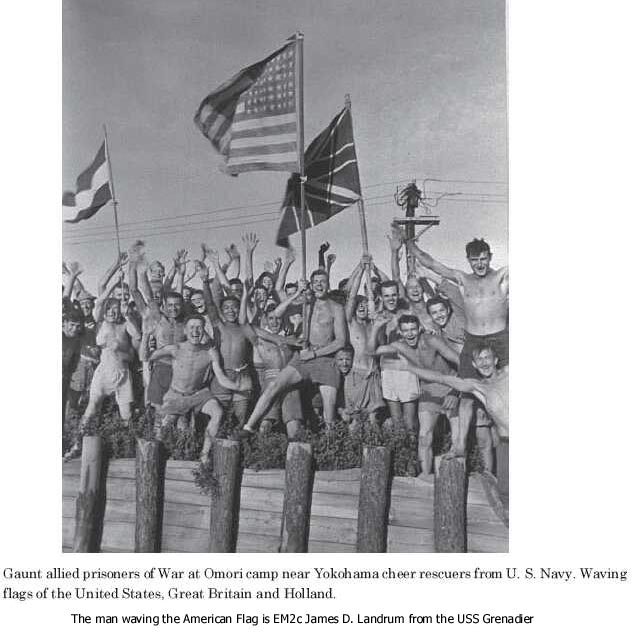
>David G. Farquhar, Jr., 90, resides among orange groves in Redlands, California where he has lived all his life. He joined the U.S. Army Air Force in 1942. He trained in Nebraska and was assigned as a Technical Sergeant to General Curtis LeMay’s 20th Air Force, 24th Squadron, 313th Bomb Wing, 6th bomb group, Crew #2404. He was sent with the 6th Bomb Group to Tinian in the Northern Marianas in January 1945. Farquhar participated in 18 missions over the Pacific and Mainland Japan. On May 23, 1945, he was a turret gunner when his B-29 was shot down over Tokyo by flak and fighter planes. He and his 11 crewmates all bailed out safely and were captured. They were taken to the infamous horse stalls outside of the Kempeitai (military police of the Imperial Army) Headquarters in Tokyo near the Emperor’s palace. They were not considered POWs but “special prisoners” who were war criminals. Beaten, starved, and tortured, they were denied clothes, basic hygiene, and medical treatment. On August 15th, the day Japan surrendered, he was transferred to a cell at Tokyo Base Camp #1 Omori where he was liberated August 28, 1945. Omori was the first POW camp liberated. After a series of hospital stays he was discharged in 1946 and returned to San Diego State College (today’s San Diego State University) for a BA in Engineering. He then obtained an MA in Education from the University of Redlands. From 1950 to 1993, Farquhar taught both junior high and high school mathematics and science. He has been married to Jacqueline for nearly 66 years. He currently tends his orange grove, serves on various boards, and participates in community activities.
POW# Not known to “special prisoners” 
Member of American Ex-Prisoners of War 

>Douglas Northam, 93, lives in Reno, Nevada. Born in Morris County, Texas, he grew up in nearby Naples, Texas. After graduating from high school in 1937, he enlisted in the Civilian Conservation Corps and in 1940 in the U.S. Navy. He was transferred to China in February of 1941 and assigned to the USS Oahu (PR-6), a Yangtze River Patrol boat ported in Shanghai. The USS Oahu, never designed for open sea operations, was sent to Manila Bay in November 1941, arriving two days before the Japanese attack on Pearl Harbor. The gunboat operated in and around Manila Bay and Cavite Navy Yard on inshore patrol and in support of U.S.-Filipino forces on Bataan until after its fall April 8, 1942 and then continued to operate about the island fortress of Corregidor until sunk by enemy gunfire May 5th. Northam was then assigned to an artillery group on Corregidor, which was surrendered on May 7th when Corregidor fell. As a POW of Japan he was sent to Bilibid POW Camp in Manila and then moved to Cabanatuan 1 and 2. In November 1942, he was sent to Japan aboard Mitsubishi’s Hellship the Nagato Maru. He worked for Nippon Express as a slave stevedore in the freight yards in and around the city of Osaka at Umeda Bunsho Camp in Osaka (Osaka 2-D UMEDA). In March 1945, after his POW camp was firebombed, he was transferred to Osaka POW Camp 5-B TSURUGA were he was a slave stevedore again for Nippon Express and Tsuruga Transportation Company. After the war, Northam utilized the GI Bill to study geology at the University of California, Berkley. He joined Shell Oil Company in 1951 as a laboratory technician and retired 1977 as research technician. He has been married to Hazel for 64 years. In retirement he was a volunteer at a local elementary school and the VA Hospital. His hobbies include gardening, horse racing, and cooking.
POW# 117
Member of DAV, American Defenders of Bataan & Corregidor, American Ex-Prisoners of War, AMVETS 

>John Leroy Mims, 90, lives in Aberdeen, North Carolina. Born in Ashburn, Georgia, he grew up in Florida and enlisted in the Army at age 16 in 1938, but was discharged a year later after it was discovered that he was underage. Still hungry and jobless, he re-enlisted February 15, 1941 and was assigned to Company B, 1st Battalion of the famous 31st Infantry Regiment sometimes referred to as the “American Foreign Legion.” In April 1941, he was sent to the Philippines aboard the USAT Republic and stationed at Cuartel de España in Manila. He fought in the Battle for Bataan and as a POW forced on the Bataan Death March. During the war, his Filipino fiancée Juanita worked as a secretary for a Japanese general and bravely aided the resistance by sending shortwave radio messages to Allied forces in the Pacific. As a POW, the Japanese repeatedly beat and tortured Mims . Although they were able to break his body, they could never come close to breaking his spirit. During his captivity, the Japanese broke his back, neck and both of his legs and shattered many of the bones in his face. The beatings briefly left him a paraplegic on two separate occasions and he retains a limp. Mims lost over 120 pounds as a POW dropping from 190 pounds to 67 pounds. Of the 1,600 soldiers in the 31st Infantry Regiment who surrendered, less than half survived Japanese captivity. In September 1944, he was sent to Japan on board Mitsubishi’s Nippon Yusen Kaisha (NYK) Hellship Sekiho Maru (Canadian Inventor [the Mati Mati Maru or slow slow ship]). Mims became a slave laborer mining coal for Ube Kosan’s Sanyo Muen Kogyo Sho (Ube Industries’ Sanyo Smokeless Coal Work, which is still known today as Ube Industries Ltd.) at Hiroshima #6B - Omine (Sanyo) POW Camp in Omine-machi, Yamaguchi Prefecture. After the war, Mims remained in the Army for the next 27 years, attaining the rank of Sergeant First Class. He returned to Japan from 1952-54 to be in charge of the Tokyo Quartermaster Depot. He retired in 1963 and involved himself in real estate, construction, and mining. He and Juanita were married 59 years until her death in 2004. They are parents of three biological and 22 adopted children. He remarried in 2009 to another beautiful Filipina, Nena Sabal. His hobbies include reading and recounting his history story as a POW of Japan, especially on how he survived the infamous Bataan Death March. The Veteran’s History Project of the U.S. Library of Congress holds a recording of his oral history.
POW# 429
Member of DAV, VFW, American Legion, Military Order of the Purple Heart, and National Order of the Trench Rats, American Defenders of Bataan & Corregidor

>John Real, 90, lives in Ventura, California. A California native he enlisted in the US Army Air Corps after graduating from high school in 1940. He was sent to the Philippines in April 1941 and assigned to aerial reconnaissance at Clark Field with the 2nd Observation Squadron, 27th Bombardment Group, V Bomber Command, 20th Air Force. Real and his unit manned an observation tower on top of Mt. Mariveles, Bataan during Japan’s invasion of the Philippines where he tracked Japanese ship movement around the Olongapo Navy Yard. He walked down the mountain to surrender on April 9, 1942 and was stripped of all his belongings before being forced on the Bataan Death March. At the start of the march, he and others were used as human shields by being forced to walk in front of seized American 155mm calibre field guns (Long Toms) that the Japanese were firing at Corregidor. He was a POW at both Camp O’Donnell and Cabanatuan 1. He avoided a certain death at O’Donnell by volunteering for a work detail on Bataan. In September 1943, he was sent to Moji, Japan aboard the Hellship Taga Maru (aka Coral Maru) via Formosa. At Tokyo 5-B POW Camp in Niigata he was a slave laborer unloading coal ships for Niigata Kairiku Unso, now part of the Rinko Corporation (however, POWs remember Rinko as their “employer”). After the war, Real received a BA in Business Administration from the University of California, Santa Barbara and a MA from the Thunderbird School of Global Management in Arizona, where he met his wife with whom he had three children and was married to for 49 years until she passed away in 2006. After graduation, he pursued a career in pharmaceutical sales with various companies, retiring with Berlex Labs, at the time a division of Schering AG. In retirement, he has been an active member of the Museum of Ventura County and the J. Paul Getty Museum at the Getty Villa in Malibu.
POW# 514 
Member of DAV, VFW, American Legion, American Ex-Prisoners of War, American Defenders of Bataan & Corregidor, AMVETS 

>George R. Summers, 90, lives in Riverside, California. Born in the Philippines, he grew up in California where he joined the Marine Corps Reserve in February 1941. Activated in June 1941, his unit was sent to Guam, an American territory, in September 1941. Japan invaded the island on December 8, 1941 and he was taken prisoner upon the surrender of the island on the 10th--the first American territory to fall. Summers was on the first transport of Allied POWs to Japan, the Argentina Maru with 420 American POWs from Guam to Tadotsu on the north coast of Shikoku. After arriving in Japan on January 16, 1942, the POWs were transported to Zentsuji (Hiroshima Branch #1), a POW camp about eight kilometers from Tadotsu. He spent six months there clearing a mountainside to plant apple trees. He was then transferred to Tanagawa Osaka Area POW Command #4B Camp. At Tanagawa, he helped to manually tear down a mountainside building a breakwater for a primitive dry-dock and submarine base. This camp was noted for its severe malnutrition and extreme death rate. Six months later, he was sent to Umeda Bunsho Camp in Osaka (Osaka 2-D UMEDA), Japan where he worked for Nippon Express as a slave stevedore. He was transferred to a total of six POW camps due to American bombings. His last camp was the Nagoya 10-B Fushiki Camp, where he worked as a stevedore slave unloading soybeans from Korea for Fushiki Kairiku Unso until Japan’s surrender. After his release, he was hospitalized for six months at the Long Beach Naval Hospital. Like many veterans, he then shifted between various odd jobs and classes. In 1947, he joined the U.S. Merchant Marine. From 1955 to 1968 he worked for General Telephone Company, which later became GTE and is today’s Verizon. After GTE, he served as a financial clerk for the City of Anaheim from 1968 to 1978. Married to Juanita Louise Summers since 1970, he has two children from his first marriage. In retirement, he has focused on real estate investment and his hobbies of collecting Koi fish and exotic birds.
POW# 347 
Member of DAV, American Ex-Prisoners of War, Military Order of the Purple Heart