Showing posts with label Churchill Winston. Show all posts

Saturday, May 14, 2016

Obama must memorialize more than Hiroshima

memorial to American POWs
who died in Hiroshima
On May 27th, U.S. President Barack Obama and Prime Minister Shinzo Abe will together visit together the Hiroshima Peace Memorial.

There has been much commentary on this, most to create a climate of acceptance of this historic visit. Few give the perspective of the American POW. Many assume it will be negative. This is not necessarily true.

Below is an op ed that appeared on May 11th in The Wall Street Journal Online by Dr. Lester Tenney. He tries to give some nuance to how a Pacific War veteran may view the visit.

For the POWs, who have so often have been abandoned by the White House, this is an opportunity to insist that they must be remembered.

To this end, a memorial needs to be erected at the Port of Moji on Kyushu that is part of a UNESCO World Heritage site; Japan’s new UNESCO World Industrial Heritage sites must note that American and Allied POWs were slave laborers at these sites; and that the POW visitation program must be turned into a permanent program of remembrance, reconciliation, and education.

On May 12th, National Security Advisor Susan Rice held a meeting with veterans organizations to review the President’s upcoming trip to Vietnam and Japan. The American Defenders of Bataan and Corregidor Memorial Society was not invited. Rice said the President’s decision to visit Hiroshima, Japan was “to honor the memory of all who lost their lives during World War II.” We shall see.

Remembering More Than Hiroshima
We must not forget the lives lost and trauma incurred by Allied forces during the Pacific War.

By LESTER TENNEY
Wall Street Journal, May 11, 2016 12:15 p.m. ET

A black man was the first American soldier to die in World War II. An unexploded bomb from a Mitsubishi “Betty” split U.S. Army Pvt. Robert Brooks in two on December 8, 1941, as he ran to the machine gun on his half-track at Clark Field in the Philippines. Like me, he was a member of the 192nd Tank Battalion preparing to fight the invading Imperial Japanese forces. It is fitting that our first black president will soon stand at Hiroshima, where the Pacific War began its end.

Pvt. Brooks’s sacrifice and those of thousands of American and Allied forces who fought and died for freedom in the Pacific must never be forgotten. What Hiroshima represents is more than the effects of a nuclear weapon. It is the culmination of a war started by Imperial Japan and conducted with gross inhumanity, a war in which more civilians died than combatants.

It would be wrong for the president to pivot away from this history and use his visit solely to discuss aspirations for a world without nuclear weapons. Hiroshima highlights mankind’s tragic ability to wreak terrible destruction, and this destruction was not caused exclusively by atomic bombs. Sand-filled bamboo sticks, bayonets, plague-inflected fleas, starvation and rape—methods of warfare used by Japan—are also destructive.

When President Harry Truman announced the bombing of Nagasaki, which ended the war, he recognized “the tragic significance of the atomic bomb.” However, he went on to explain “we have used it against those who attacked us without warning at Pearl Harbor, against those who have starved, beaten and executed American prisoners of war, against those who have abandoned all pretense of obeying international laws of warfare. We have used it in order to shorten the agony of war, in order to save the lives of thousands and thousands of young Americans.”

As a former American POW of Japan, I am particularly sensitive to these words. Truman was looking out for me and more than 27,000 other American POWs in Asia. Until then, we felt forgotten and ignored. The “Europe first” policy of Franklin Roosevelt and Winston Churchill abandoned us to fight without resupply or reinforcement on the Philippines at the start of World War II. We became POWs for more than three bitter years.

We endured four unforgiving months of tank warfare in the tropical heat on Bataan against an enemy with superior training, equipment and provisions. Surrendered by our commanders, nearly 80,000 of us American and Filipino troops were forced on the Bataan Death March. The surviving 68,000 arrived at Camp O’Donnell, a prison camp that saw up to 300 die daily.
The camp commandant ranted at us that we were lower than dogs and better off dead, as we would always be enemies of Japan. I must say that many times I had to agree.

After a period in the camp, many of us went by “hell ship” to Japan to become slave laborers. In my case, it was in a dilapidated Mitsui coal mine. My friend from Janesville, Wis., Capt. Fred Bruni, had a different experience. He and 150 men from the camp were sent to Palawan Island to build an airfield. Upon completion, all the men were set afire and machine-gunned by the Kempeitai.

We POWs have tried to preserve this history despite U.S. and Japanese government efforts to suppress it. Upon liberation, most of us were forced to sign gag orders not to discuss the horrors of our imprisonment. The U.S. government’s policy was to pacify Japan in part by curbing memories of its war atrocities. Central to the 1952 San Francisco Peace Treaty is an article foreclosing any further compensation of victims, thus again preventing the recall of Imperial Japan’s past crimes and abuses.

At home, an underfunded Veterans Administration refused to give us full disability and ignored or misunderstood the aftereffects of vitamin deficiency, tropical diseases and trauma. It took two acts of Congress before we received any compensation for our imprisonment and only at a rate of $1.50 per day for lost meals.

The U.S. government abandoned the Pacific War’s history. This has made efforts to hold Japanese companies accountable for their brutal use of POW slaves nearly impossible. It is taboo to associate high-speed rails, luxury automobiles or Washington’s metro cars with companies that once abused Americans. Among the nearly 60 well-known companies such as Mitsui, Mitsubishi, Sumitomo, Kawasaki and Nippon Sharyo, only the Mitsubishi Materials Company, which used POWs in four of its mines, has apologized.

In recent years the Japanese government has finally begun to make amends to American POWs. They offered an official apology in 2009. At the Obama administration’s urging, they established in 2010 a reconciliation program for former POWs to visit Japan. Unfortunately the program will end this year without any follow-up for descendants or the public.

But history is critical to how we understand ourselves. No one knew Pvt. Brooks’s race until the Army wanted to honor him. When news of his death reached Fort Knox, the chief of the armored force, Gen. Jacob Devers, decided that a parade ground should be named in his memory, because the first American tanker to die in World War II should not be forgotten.

When it was discovered that Pvt. Brooks’s parents were black tenant farmers from Sadieville, Ky., the general was asked if he wanted to reconsider. “No,” he answered, “it did not matter whether or not Robert was black, what mattered was that he had given his life for his country.” As Gen. Devers said at the Brooks Field dedication ceremony, “In death there is no grade or rank. And in this greatest democracy the world has ever known, neither riches nor poverty, neither creed nor race, draws a line of demarcation in this hour of national crisis.”

Mr. Obama wants to use his visit to Hiroshima to highlight the perils of nuclear war. But this is not the only lesson. Our service as veterans of the Pacific War needs to be remembered and not abandoned to some tumid oratory. The president’s visit to Hiroshima will be hollow, a gesture without motion, if the Pacific War’s full history is not maintained. Hiroshima does not and cannot exist outside the context of the Asia-Pacific War and all its dead.

Mr. Tenney, 95, was a member of the 192nd Tank Battalion, Company B that defended the Philippines in World War II. He lives in San Diego.

Monday, April 27, 2015

Shinzo Abe’s Ill-Timed Speech

The young Edward Jackfert
(VW Public Broadcasting)
Addressing the U.S. Congress on Hirohito’s birthday is an insult to Pacific Waveterans

 The Diplomat, April 27, 2015

By Edward Jackfert, 93, a POW of Japan captured on Mindanao, The Philippines as a member of the U.S. Army Air Corps. He was twice National Commander of the American Defenders of Bataan and Corregidor.

Japanese Prime Minister Shinzo Abe’s April 29 address to the U.S. Congress will come at the expense of America’s Pacific War veterans. As a former POW of Japan who endured a hellish three-and-a-half years of captivity and slave labor, I am astonished that Abe’s address falls on the birthday – a national holiday in Japan – of the man who initiated World War II, Emperor Hirohito. For me, it was a day of harsher beatings and lower bows. I am outraged that this high American honor was given to a Japanese leader who still evades his country’s war responsibilities. 

It has been difficult for me to watch the fading memory of Japan’s war atrocities accompanied by increasing Japanese denials of their heinous war record. A complacent U.S. Congress has been complicit. In 2011, no effort was made to remember the 70th Anniversary of Japan’s surprise attack on Pearl Harbor and the American entry into WWII. This omission and others regarding the war, I understand, were the result of new House rules ending commemorative resolutions.

But Congress was not totally opposed to celebratory resolutions that year. On December 19, 2011, it marked the 70th anniversary of Winston Churchill’s December 1941 speech before Congress. Churchill, barely two weeks after the bombing of Pearl Harbor, urged Americans to pursue the war first in Europe and not in Asia.

As someone who fought in the Philippines in the first battles of WWII, I have painful reminders of Churchill’s successful Europe-first lobbying. Most Pacific veterans from the early months of the war believe that his efforts ensured that we were abandoned. We were condemned to hopeless battles with obsolete weapons and no provisions ending in death or imprisonment in Japan’s notorious POW camps.

I think that most Americans view the bombing of Pearl Harbor as a more transformative event than a speech by a foreign dignitary – even one by Churchill. Ignoring the attack on Pearl Harbor was a slap in the face to Pacific War veterans.

Previous Japanese government officials have apologized for their country’s actions before and during WWII. Abe objects to those. He believes the war was just and walked out on the parliamentary vote in 1995 for the now-standard government apology. Today, he never uses the word “apology.” Instead, he is “deeply pained” by events of the past, yet never connects them to decisions made by Japanese leaders.

Speaking to Australia’s parliament last year, Abe was neither contrite nor clear. He merely mentioned “Sandakan” and sent his “condolences towards the many souls who lost their lives.” Never mentioned was that “Sandakan” was a series of death marches in 1945 on Borneo forced upon approximately 2,400 emaciated Australian and British POWs by the Japanese. [only 6 survived]

Most important, Abe failed to identify who was responsible for this war crime against Australians. It was simply something that “happened in the past.” As a survivor, myself, of Imperial Japan’s mindless brutality and fanatical leadership, I am not satisfied with disconnected “condolences” for “the evils and horrors of history.”

I want to know what Abe learned from the past, and what steps he plans for reconciliation with Japan’s former adversaries and victims. To the American POWs of Japan, this means acknowledging our inhumane imprisonment and brutal slave labor for Japan’s corporations. It means creating a program of remembrance and education on the war.

We Pacific War veterans ask most that what we fought for not be forgotten. This is what Congress must demand of Shinzo Abe.

Imperial Japan was a brutal regime that was merciless to the people put in its care. It astonishes me that Japan’s leaders now avoid offering an apology or acts of contrition. Yet, if the U.S. Congress cannot remember this history, it is unlikely that the Japanese will want to disturb that amnesia. And if Congress does not speak for America’s veterans, it is unlikely that Japan will feel compelled to remember them as well. Prime Minister Abe will simply indulge this ignorance.

Wednesday, January 28, 2015

The day we knew - Japan's war atrocities


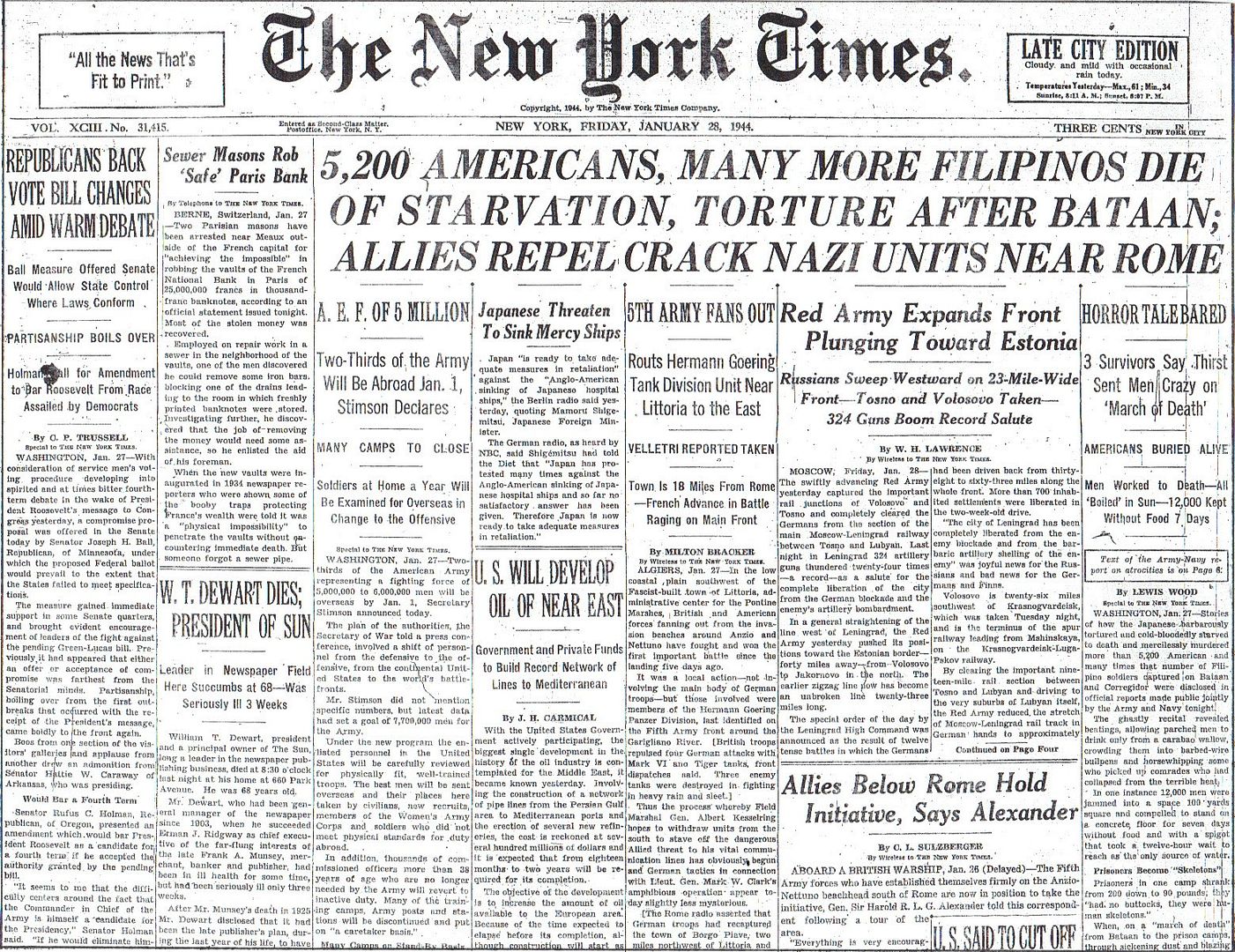
Seventy-one years ago today, the headlines across the United States screamed of the brutality of Imperial Japan. Prisoners, civilians, women, children had been tortured, starved, and slaughtered in the Philippines. The rumors of unimaginable savagery toward its captive peoples had all proved true.

On January 28, 1944, the world first learned about the Bataan Death March (April 1942) and the horrors endured by the American and Filipino POWs of Japan. Invading Japanese forces showed no mercy, allowing their prisoners to die by the thousands from savagery, starvation, and disease.

click to order
Newspapers and newsreels told the stories of three American escapees from a Japanese POW camp in the Philippines who had survived the Death March the Davao Prison Camp. Never before had the public been allowed to hear of the extent of Japanese atrocities and the inhumanity of their regime. Washington had kept the story from the public, fearing that the Japanese would use it as an excuse to end efforts to aid the POWs or worse.

Congressman and editors cursed Churchill and Roosevelt for advocating a Europe First strategy that put aside the war in Asia in favor of focusing on Hitler in the West. The result was the smashing of American air and sea power in Asia, the largest defeat in US military history, and the unfathomable deaths of thousands of Americans both military and civilian in the Pacific.

The truth aroused such fury in the American public that the government’s Europe First policy was imperiled. On January 29th at the Brooklyn Navy Yard, Margaret Truman, Missouri senator Harry Truman’s daughter, expressed the feelings of her fellow Americans when she said as she christened the battleship USS Missouri, “May this great ship be an avenger to the barbarians who wantonly slaughtered the heroes of Bataan.” *

click to order
More war bonds were sold in January and February 1944 than in any period of the war. The graphic description of the Death March and the POW camps was serialized by the Chicago Tribune and made into a book. The hero of the story, Texas native and US Army Air Corps William Dyess who organized the escape, unfortunately died December 1943 in a plane crash barely a month before the public release of his story.

The public learned that American and Filipino forces fought from an untenable position until formally surrendering to the Japanese on April 9. The Japanese immediately began to march some 76,000 prisoners (12,000 Americans, the remainder Filipinos) northward into captivity along a 65-mile route of death.

Japanese butchery, disease, exposure to the blazing sun, lack of food, and lack of water took the lives of approximately 5,200 Americans and Filipinos along the way. Many prisoners were bayoneted, shot, beheaded or just left to die on the side of the road. "A Japanese soldier took my canteen, gave the water to a horse, and threw the canteen away," reported one escapee. "The stronger were not permitted to help the weaker. We then would hear shots behind us." The Japanese forced the prisoners to sit for hours in the hot sun without water. "Many of us went crazy and several died."

The ordeal lasted five days for some and up to twelve days for others. Although the Japanese were unprepared for the large number of prisoners in their care, the root of the brutality lay in the Japanese attitude that a soldier should die before surrender. A warrior's surrender meant the forfeiture of all rights to treatment as a human being.

This was the "first murder" Captain William Dyess said he witnessed:
"The victim, an air force captain, was being searched by a three-star private. Standing by was a Jap commissioned officer, hand on sword hilt. These men were nothing like the toothy, bespectacled runts whose photographs are familiar to most newspaper readers. They were cruel of face, stalwart, and tall. 
'The private a little squirt, was going through the captain's pockets. All at once he stopped and sucked in his breath with a hissing sound. He had found some Jap yen.' 
'He held these out, ducking his head and sucking in his breath to attract notice. The big Jap looked at the money. Without a word he grabbed the captain by the shoulder and shoved him down to his knees. He pulled the sword out of the scabbard and raised it high over his head, holding it with both hands. The private skipped to one side.' 
'Before we could grasp what was happening, the black-faced giant had swung his sword. I remember how the sun flashed on it. There was a swish and a kind of chopping thud, like a cleaver going through beef'. 
'The captain's head seemed to jump off his 'shoulders. It hit the ground in front of him and went rolling crazily from side to side between the lines of prisoners.' 
'The body fell forward. I have seen wounds, but never such a gush of. blood as this. The heart continued to pump for a few seconds and at each beat there was another great spurt of blood. The white dust around our feet was turned into crimson mud. I saw the hands were opening and closing spasmodically. Then I looked away.' 
'When I looked again the big Jap had put up his sword and was strolling off. The runt who had found the yen was putting them into his pocket. He helped himself to the captain's possessions.'
You can read here THE DYESS STORY: The Eye-Witness Account of the DEATH MARCH FROM BATAAN and the Narrative of Experiences in Japanese Prison Camps and of Eventual Escape

Thursday, October 31, 2013

Insult to injury


On Wednesday, October 30th, Speaker of the House of Representatives John Boehner dedicated a bust of Winston Churchill in the rotunda ofthe Capitol. You can watch there ceremony above.

This is the result of a resolution he pushed through Congress in December 2011. Whereas Speaker Boehner did not allow any resolution to go forward to honor the 70th anniversary of Japan's surprise attack of Pearl Harbor nor did he issue his own statement of remembrance, he did honor Churchill’s Pearl Harbor December 26, 1941 speech to a Joint Session of Congress.

British Prime Minister Churchill was in the US to guarantee the Europe-first strategy that he had planned with President Franklin Roosevelt would be followed. The result was that thousands of American civilians and servicemen and women in the Pacific were abandoned to horrific fates. No reinforcements would come to the Marines of Wake Island, the tank brigades on Bataan, or the Coastal Artillery on Corregidor.

Boehner's tax-payer funded effort to honor Churchill was further an undisguised dig at President Barak Obama. The Speaker and many Republicans believe that the President returned a bust of Churchill in the Oval Office out of disrespect (code for not honoring the "white" Churchill). The truth is that there were two busts of Churchill in the West Wing; one was on loan from the British Government. This one was returned. No American hero was represented twice in the president's offices.

One can imagine that Churchill himself would have been taken aback by Boehner's unprincipled swipe at an American president. And for Americans, it is astounding that the Speaker should go so far to ignore citizens put in harms way, especially WWII veterans, for a racist fable about the President's character. 

Friday, December 07, 2012

Torpedoing Pearl Harbor Day

Churchill Mug
This essay by your editor first appeared 12/07/12 in The Hill, a newspaper and website focused on issues affecting Capitol Hill.


Last year, Congress stopped remembering Pearl Harbor. For nearly 50 years, the U.S. Congress had honored the survivors and fallen of Imperial Japan’s deadly attack through a resolution either asking the President to issue a proclamation designating December 7 as Pearl Harbor Day or issuing their own recognition of when the United States was pushed into World War II. This ended in 2011. America’s Greatest Generation was pushed aside to make a petty swipe at the White House about a surplus bust of former British Prime Minister Winston Churchill.

A House rules change in 2011 did away with commemorative resolutions. As a staffer from the House Speaker John Boehner’s office told me, a Pearl Harbor Remembrance Day resolution would be “frivolous.” The House Republican leadership of the 112th Congress had adopted new rules barring consideration of any measure that “expresses appreciation, commends, congratulates, celebrates, recognizes the accomplishments of, or celebrates the anniversary of, an entity, event, group, individual, institution, team or government program; or acknowledges or recognizes a period of time for such purposes” (Rule #28).


Speaker Boehner did not completely ignore December 1941 last year, however. That month served as the occasion to taunt the White House over a bust of Winston Churchill. He and many Republicans were upset that the President had returned this loaned presentation of Britain’s wartime prime minister to the British Embassy

.

On December 19, 2011, House Speaker Boehner allowed a resolution to pass that recognized the accomplishments of former Prime Minister Churchill. Boehner introduced H.Res. 497 commemorating the 70th anniversary of Churchill’s “The Masters of Our Fate” speech on December 26, 1941 before Congress, in which he urged Americans, barely two weeks after the bombing of Pearl Harbor to pursue the war first in Europe and not Asia. The resolution also requested the placement of a statue or bust of Sir Winston Churchill in the United States Capitol. 


No one regrets our efforts in Europe during the war, but Americans then fighting the first battles on the Philippines, Guam, Wake Island, and Java may have been somewhat circumspect about Churchill’s successful Europe-first lobbying. After Pearl Harbor, for four months through April 9, 1942, soldiers on Bataan tied up a better trained and equipped Japanese invasion force. On Wake Island, from December 8 to 22, 1941, less than 400 Marines held off a Japanese armada and amphibious assault. The soldiers, sailors, airmen, and Marines in the Pacific were abandoned and never resupplied. They were thus condemned to hopeless battles with obsolete weapons and no provisions ending in death or over three years of unmerciful imprisonment in Japan’s notorious POW camps.


Naturally, any political and military decisions in 1941 would have had good consequences for some Americans and bad results for others. But, 70 years later, a decision to commemorate a speech of a foreign head of state coupled with an explicit decision not to commemorate American veterans in one of the critical chapters of WWII is unfathomable.


Sadly, there is no longer a constituency to hold the House leadership responsible for ignoring WWII veterans or their history. The Speaker of the House, John Boehner (R-Ohio), who did not issue a personal Pearl Harbor Day statement in 2011, has the power to make exceptions to "Rule 28," but he has no incentive do so. This year the Pearl Harbor Survivors Association disbanded and other Pacific War veterans are considered too elderly to be an active political force.


In fairness, perhaps Speaker Boehner thought that Congress no longer needed to weigh on remembering Pearl Harbor. This was the president’s job. In 1994, Congress made permanent a tradition started in 1966 and passed Public Law 103-308) designating December 7th as "National Pearl Harbor Remembrance Day." It authorized and requested the President to: 1) issue an annual proclamation calling on U.S. citizens to observe the day with appropriate ceremonies and activities; and 2) urge all Federal agencies, interested organizations, groups, and individuals to fly the U.S. flag at half-staff in honor of those who gave their lives as a result of their service at Pearl Harbor. 


President Barak Obama, fulfilled his obligation 2011 by saying: “On National Pearl Harbor Remembrance Day, we honor the more than 3,500 Americans killed or wounded during that deadly attack and pay tribute to the heroes whose courage ensured our Nation would recover from this vicious blow. Their tenacity helped define the Greatest Generation and their valor fortified all who served during World War II. As a Nation, we look to December 7, 1941, to draw strength from the example set by these patriots and to honor all who have sacrificed for our freedoms.” He followed his words with a quiet visit on December 29th to the USS Arizona Memorial at Pearl Harbor in Hawaii.”


This year Congress is again silent on December 7. It is unfortunate that our veterans were ignored to make an irrelevant point about whether a foreign leader’s bust should on display in the Oval Office. Resolutions honoring WWII veterans transcend politics. They provide these men and women with a national gesture of eternal appreciation for their sacrifices and valor on Pearl Harbor day and the nearly four years thereafter fighting tyranny. They remind us of the greatness of American leadership. Failure to do so sends a troubling message to present and future veterans on how they too will be forgotten.