Showing posts with label WWII Memorial. Show all posts

Sunday, August 30, 2020

COMMEMORATING THE SURRENDER: TUNE IN


THE MIRACULOUS DELIVERANCE FROM AN EPIC TRAGEDY: THE END OF THE ASIA PACIFIC WAR WITH RICHARD B. FRANK. 8/31, 2:00pm (EDT), ZOOM EVENT. Sponsors: Friends of the National World War II Memorial. Speaker: Richard B. Frank, internationally recognized leading authority on the Asia-Pacific War, author.  PURCHASE BOOKS: https://amzn.to/2YaujsB; https://amzn.to/31WBo18 https://amzn.to/3j2KmB5

'UNCONDITIONAL SURRENDER' THE 75TH ANNIVERSARY OF V-J DAY WITH RICHARD B. FRANK, author of Tower of Skulls and Downfall. 9/1, 6:00pm (CDT), ZOOM EVENT. Sponsor: The Harry S. Truman Presidential Library and Museum.

THE ALLIED FORCES IN WORLD WAR II: HISTORY, CONSEQUENCES AND THE 21ST CENTURY WORLD ORDER. 9/2, 5:30-7:00pm (IST), WEBINAR. Sponsor: Observer Research Foundation (ORF), India. Speakers: Ajay Kumar Patnaik, Professor, Centre for Russian & Central Asian Studies, JNU; Sanjay Deshpande, Professor, Centre for Eurasian Studies, University of Mumbai; Sergei Fandeev, Director, Russian Centre for Science and Culture, Mumbai; Sriparna Pathak, Assistant Professor & Assistant Dean, School of International Affairs, OP Jindal Global University; Suresh Babu, former Ambassador of India to Armenia, Georgia & Mongolia.

TWILIGHT OF THE GODS: WAR IN THE WESTERN PACIFIC, 1944-1945. 9/2, 7:00pm (EDT), ZOOM EVENT. Sponsors: MacArthur Memorial and the Hampton Roads Naval Museum. Speaker: Ian Toll, author and historian. PURCHASE BOOK: https://amzn.to/3hywON4 (W. W. Norton & Company; Illustrated Edition (September 1, 2020), 944 pages)

PRISONERS OF THE EMPIRE: INSIDE JAPANESE POW CAMPS. 9/3, 8:00-9:00am (CDT). Radio Interview. Sponsor: The Morning Show KENOSHA-WGTD (91.1 FM). Speaker: author, Dr. Sarah Kovner, Columbia University. PURCHASE BOOK: https://amzn.to/34KQM3A (Harvard University Press (September 15, 2020), 336 pages)

Saturday, March 30, 2019

POWs voice their concerns to Congress


Time for the Gold Medal


STATEMENT FOR THE RECORD

to the

Senate Veterans' Affairs Committee and HouseVeterans' Affairs Committee Joint Hearing

 To Receive Legislative Presentations of Veterans Service Organizations


By


Jan Thompson


President
American Defenders of Bataan and Corregidor Memorial Society

12 March 2019


AMERICAN PRISONERS OF WAR OF JAPAN
CEMENTING A LEGACY

[excerpts]

Today, I want to speak to you about what it means to “Never Forget” our veterans.  The men and women who became POWs of Japan over 70 years ago fought the early desperate battles of WWII in the Pacific and suffered some of its worst consequences. Nearly 40 percent did not return home. Those who survived had the highest rate of post-conflict hospitalizations, deaths, and psychiatric disorders of any generation of veterans. Their families endured and inherited their trauma.

If this history is forgotten, so too will the sacrifices of today’s veterans. It is an obligation to honor our veterans and to remember appropriately their contribution to our country’s history.


Before the last American POW of Japan dies, we believe that the appropriate civic remembrance for them is a Congressional Gold Medal that recognizes their unique history of perseverance, valor, and patriotism.

Most important, we ask Congress to approve an accurate and inclusive Congressional gold medal for the American POWs of Japan. It is a long overdue symbol of our commitment to veterans of past generations that we will “never forget.”

⌘⌘⌘

What we ask Congress
We ask Congress to encourage the Government of Japan to hold to its promises and responsibilities by preserving, expanding, and enhancing its reconciliation program toward its former American prisoners. We want to see the trips to Japan continued.  We want Japan’s Ministry of Foreign Affairs to publicize the program, its participants, and its achievements.  We want to see a commitment to remembrance. We believe that both countries will be stronger the more we examine our shared history.

We ask Congress to encourage Japan to turn its POW visitation program into a permanent Fund supported by Japanese government and industry. This “Future Fund,” not subject to Ministry of Finance yearly review, would support research, documentation, reconciliation programs, and people-to-people exchanges regarding Japan’s history of forced and slave labor during WWII. Part of the Fund’s educational programming would be the creation of visual remembrances of this history through museums, memorials, exhibitions, film, and installations. Most important, the Fund would support projects among all the arts from poetry, literature, music, dance, and drama to painting, drawing, film, and sculpture to tell the story to the next generation.  

We ask Congress to ask and to instruct the U.S. State Department to continue to represent rigorously the interests of American veterans with Japan. It is only the U.S. government that can persuade Japan to continue the visitation program, to create a Future Fund, and to ensure that the Sites of Japan’s Meiji Industrial Revolution include the dark history of POW slave labor.

We ask Congress to press the Japanese government to create a memorial at the Port of Moji, where most of the “Hell ships” docked and unloaded their sick and dying human cargo. The dock already features memorials to the Japanese soldiers and horses that departed for war from this port. Nowhere in Moji’s historic district is there mention of the captive men and looted riches off-loaded onto its docks. This must change.

⌘⌘⌘

Over the past few years, there have been Congressional gold medals given to groups that included American POWs of Japan. Eight members of the Doolittle Raiders were POWs, at least one Nisei member of the Military Intelligence Service was a POW, and nearly all the officers of the Filipino troops who were awarded Congressional Gold Medals were American.

Unlike previous WWII Congressional Gold Medal award groups that honor specific service units or ethnicities, the American POWs of Japan are both men and women from many ethnic groups, religions, services, and regions. For example:

  • The 200th Coast Artillery (AA) on Bataan, the first to fire on the invading Japanese forces, was composed mainly of Hispanic Americans from New Mexico.
  • The first tanker to die in WWII was Private Robert Brooks, a black man with the 192nd Tank Battalion from Harrodsburg, Kentucky, who was killed on Nichols Field, Philippines.
  • Chinese-American, Eddie Fung, and Japanese-American, Frank Fujita, both fought on Java and were surrendered with the U.S. Army 2nd Battalion, 131st Field Artillery, 36th Division (Texas National Guard).
  • A statue before the St. Landry Catholic Church in Opelousas, Louisiana memorializes Army Air Corps Chaplain Father LaFleur who sacrificed his life while saving fellow POWs in the sinking of the hellship Shinyo Maru.
  • The military nurses captured in the Philippines were the first large group of American women in combat and, counted with the Army and Navy nurses surrendered on Guam, comprised the first group of American military women taken captive and imprisoned by an enemy.
  • Over 600 United States Merchant Marines, including one woman Mariner, became prisoners of Imperial Japan. Fifteen percent were killed by Japanese Imperial Navy officers during capture or died in Japanese POW camps.
  • The first American POWs of Japan were Marines stationed in China and the last were Navy and Army aviators shot down over Japan.
  • An Army Corps of Engineers Master Sergeant, Aaron Kliatchko, who died aboard a hellship is remembered as the “Rabbi of Cabanatuan” POW camp in the Philippines where he consoled Jew and gentile alike.

Seventy-eight years after the start of the War in the Pacific, it is time to recognize all those who fought the impossible and endured the unimaginable in the war against tyranny in the Pacific. Moreover, as I have described above, the Gold Medal would also recognize that we are the only American wartime group to have negotiated our own reconciliation with the enemy. 


Tuesday, May 30, 2017

Faces of WWII

click to purchase book

Ichiro Sudai trained to be a kamikaze. Roscoe Brown was a commander in the Tuskegee Airmen, the first African American military aviators. Uli John lost an arm serving in the German army but ultimately befriended former enemy soldiers as part of a network of veterans—"people who fought in the war and know what war really means." These are some of the faces and stories in the remarkable Veterans (144 pages), the outcome of a worldwide project by Sasha Maslov (Interview) to interview and photograph the last surviving combatants from World War II. 

Soldiers, support staff, and resistance fighters candidly discuss wartime experiences and their lifelong effects in this unforgettable, intimate record of the end of a cataclysmic chapter in world history and tribute to the members of an indomitable generation. Veterans is also a meditation on memory, human struggle, and the passage of time.

Monday, December 07, 2015

Pearl Harbor Rememberance Day - 74th Anniversary


NATIONAL PEARL HARBOR REMEMBRANCE DAY, 2015

- - - - - - -

BY THE PRESIDENT OF THE UNITED STATES OF AMERICA

A PROCLAMATION

Nearly seven and a half decades ago, as dawn broke over the island of Oahu, bombs broke through the sky as Japanese forces launched an unprovoked attack on our Nation -- absorbing America into a conflict that would change the course of human dignity and freedom. More than 2,400 precious lives and much of our Pacific Fleet were lost, yet the ensuing unification of our people proved mightier than the attack that aimed to weaken us. On National Pearl Harbor Remembrance Day, we pay tribute to the men, women, and children -- military and civilian -- who lost their lives on December 7, 1941, honor all who served in the wake of that infamous day, and recognize the sacrifices today's service members make to carry forward the inextinguishable torch of liberty for generations to come.

Reacting to the surprise attack, patriots from every corner of our country answered the call to serve and banded together in common cause. Sixteen million Americans left behind everything they knew and everyone they loved to fight for freedom far from home and liberate a continent from the grip of tyranny. Courageous individuals from all walks of life crossed oceans and stormed beaches, uplifting a generation and paving the way for our fiercest adversaries to become some of our closest allies. In the example of those who came forth in the months and years following the attack on Pearl Harbor, we see an enduring truth: that no challenge is too great when we stand as one people committed to the ideals which the stars and stripes symbolize.

Seventy-four years after the attack on Pearl Harbor, we endure as a Nation dedicated to affirming the inherent dignity of every person -- even in the face of unspeakable violence. As President Franklin D. Roosevelt said the day after the attack, "the American people in their righteous might will win through to absolute victory." On this day, let us honor the memory of all who gave their lives so that President Roosevelt's words could be realized, and let us resolve to uphold the legacy of our country, for which generations of brave men and women have fought and sacrificed.

The Congress, by Public Law 103-308, as amended, has designated December 7 of each year as "National Pearl Harbor Remembrance Day."

NOW, THEREFORE, I, BARACK OBAMA, President of the United States of America, do hereby proclaim December 7, 2015, as National Pearl Harbor Remembrance Day. I encourage all Americans to observe this solemn day of remembrance and to honor our military, past and present, with appropriate ceremonies and activities. I urge all Federal agencies and interested organizations, groups, and individuals to fly the flag of the United States at half-staff this December 7 in honor of those American patriots who died as a result of their service at Pearl Harbor.

IN WITNESS WHEREOF, I have hereunto set my hand this fourth day of December, in the year of our Lord two thousand fifteen, and of the Independence of the United States of America the two hundred and fortieth.

Sunday, June 21, 2015

“History is harsh” and Abe's speech to Congress

Former POW of Japan Lester Tenney sitting
behind Korean Comfort Woman
POW daughter Caroline Burkhart far right
“History is harsh”: Prime Minister Abe, the Joint Session of Congress, and World War II
By Professor Kerry Smith, Brown University

First appeared in JapanFocus, May 18, 2014

Thanks to a referral from my university’s government relations office [Brown Univerity] and an ability to head to Washington on short notice, I attended Prime Minister Abe’s April 29 speech before a Joint Session of Congress as a guest of Rhode Island Senator Sheldon Whitehouse.  This essay began as an attempt to convey a few impressions of the event from the perspective of the House gallery, but upon reflection, and after encountering the generally uncritical reception the speech received from the media in the U.S., it seemed useful to engage more directly with what Abe had said, and with the arguments I think he meant to convey. I am very grateful to the Senator and his staff for the opportunity and for their hospitality. I should stress, however, that the views expressed in this essay are entirely my own.

The first thing that Prime Minister Abe Shinzō did after taking the podium and greeting his audience at last week’s Joint Session of Congress was quote from the speech that his grandfather, Prime Minister Kishi Nobusuke, had delivered in that same chamber in June 1957.  Abe reminded listeners that Kishi “began his address by saying ‘It is because of our strong belief in democratic principles and ideals that Japan associates herself with the free nations of the world.’”[1]  That expression of fealty earned Kishi applause the first time it echoed through the House Chamber. Abe’s reward for recycling it was a rousing standing ovation.


The agenda for Abe’s recent trip to Washington has much in common with the goals of his grandfather’s visit in late June 1957. Kishi’s administration was concerned with managing the emerging frameworks for trade in East Asia, and with the limits on Japan’s access to American markets for some of its key exports, especially textiles.  China also loomed large, in part because Japan’s agreements with the U.S. precluded doing any significant business with the PRC, closing off opportunities for trade that might otherwise have benefited the Japanese economy.  Kishi’s visit was also an opportunity to remind U.S. policy makers and the public alike that Japan shared their commitment to democracy, and thus to resisting communism in all its forms, themes Kishi touched on more than once in his speech to Congress.[2]

That there are these commonalities in topics and tone in visits separated by almost fifty years is of course something that Abe’s speechwriters must have hoped policy makers and the public would pick up on, and be reminded of how long and how well Japan has aligned itself with America’s geopolitical goals.  Having Abe quote from the lyrics of Carole King’s 1971 hit "You've Got a Friend" was arguably another gesture in that same direction. The Prime Minister is of the same generation as many of those listening on the House Floor that morning, and no doubt more than a few recognized the song as having a place in their own histories, even if they had not before thought of it as part of the soundtrack of postwar U.S.-Japan relations.  Such an emphasis on continuity and past friendship meshes well with the push by both the Abe and Obama administrations to ratify the TPP, to align Japan’s expanding military capabilities even more closely with U.S. goals in the region, and to otherwise continue on their current trajectory towards what Abe, by the end of his speech, was describing as “an alliance of hope.”

One striking and somewhat ironic difference between the expectations that shaped Abe’s speech and the context of his grandfather’s is that Kishi didn’t have to talk about the war, much less apologize for any of Japan’s actions during it.   Kishi’s speech referenced the conflict only to thank the U.S. for its support in rebuilding Japan’s economy in its aftermath.  Kishi’s own personal experiences as a wartime cabinet member and potential defendant in the post-surrender war crimes trials were of little interest to the press or the public during his visit.  Invited to throw out the first ball at Yankee Stadium a few days after his speech in Washington, the fans in New York greeted the Prime Minister with a standing ovation, after which he delivered “a strong overhand pitch that went a little more than 25 feet into the glove of Yankee catcher Yogi Berra.”[3]

Fast forward to the present, where the expectations surrounding Abe’s visit and speech were very different.  It matters that this year brings the 70th anniversary of some of the deadliest of the wartime encounters between the Americans and the Japanese, of course, but it also matters that the Abe administration has worked hard over the years to offer the public ways of thinking about the war that are significantly out of step with how Japan’s neighbors, and many of its own historians, understand it.[4]

Abe’s performance before Congress built on those efforts in at least three ways.   First, having opposed earlier expressions of remorse for Japan’s actions during the war, and specifically having questioned both the veracity of the evidence linking the Japanese military to the comfort women system and thus the need to apologize to its victims, Abe has turned his decision to not repudiate the statements of regret crafted by prior administrations into a rhetorical device that occupies the space where an apology ought to be.  “Our actions,” Abe reminded Congress, “brought suffering to the peoples in Asian countries. We must not avert our eyes from that.”  “I will,” he continued, to applause from the Congressmen and Senators who had gathered to hear him speak, “uphold the views expressed by previous Prime Ministers in this regard.” [5] (This language is in line with previous statements by Abe prior to his Washington visit.)

Second, Abe’s speechwriters highlighted the Prime Minister’s efforts to honor those who sacrificed their lives for their country by having him reflect on his visit earlier that same day to the nearby National World War II Memorial.  Referring to the field of 4,048 gold stars on the wall that is among the Memorial’s most striking features, Abe reported that he had “gasped with surprise to hear that each star represents the lives of 100 fallen soldiers. I believe,” he went on, “those gold stars are a proud symbol of the sacrifices in defending freedom.” (A standing ovation followed.)  It was in the context of his visit to the Memorial, which Abe described as “a place of peace and calm that struck me as a sanctuary,” that he said:

History is harsh.  What is done cannot be undone.  With deep repentance in my heart, I stood there in silent prayer for   some time. My dear friends, on behalf of Japan and the Japanese people, I offer with profound respect my eternal condolences to the souls of all American people that were lost during World War II. ” (Another standing ovation.)[6]

Because this language limits the scope of Abe’s condolences to Americans, one of the things it also does is raise the question of whether he will eventually express similar sentiments towards the souls of Chinese or Korean soldiers and civilians lost in the war.  At the same time, it is hard not to hear at least some echoes of the Prime Minister’s many visits to Yasukuni Shrine in the way this part of his speech emphasizes the common impulse to honor the sacrifice and “lost hopes and lost futures” of young men and women “who otherwise would have lived happy lives.” In Japanese, his reference to the National World War II Memorial as a “sanctuary” reads as “神殿を思わせる、静謐な場所でした.” While 神殿 is sometimes used to name religious sites outside of Japan - the Temple Mount (神殿の丘), for example - I’d be surprised if readers coming across that term didn’t give some thought to the way it is more frequently deployed in Japan, which would be to refer to one of the sacred structures in a Shinto shrine, or more specifically still to one of the three Imperial Household sanctuaries on the Palace grounds. I’m not arguing that Abe was making an explicit comparison between his presence at the World War II Memorial and his actions at Yasukuni Shrine,  but it will be interesting to see whether this visit has to some extent inoculated the Prime Minister against official American critiques of future visits to Yasukuni, or at least complicated those critiques.

Abe’s final point about the war was at first blush also his least subtle.  Gesturing to the visitors gallery that rings the upper level of the House chamber, Abe invited the audience to acknowledge Lt. General Lawrence Snowden, who as a young Marine captain had been among the first to land on Ioto, or Iwo Jima, in February 1945.  Once the applause for Snowden had died down, Abe introduced the man standing next to the General in the gallery as

Diet Member Yoshitaka Shindō, who is a former member of my Cabinet.  His grandfather, General Tadamichi Kuribayashi, whose valor we remember even today, was the commander of the Japanese garrison during the Battle of Iwo Jima.  What should we call this, if not a miracle of history?  Enemies that had fought each other so fiercely have become friends bonded in spirit.
The handshake that Snowden and Shindō then shared prompted yet another standing ovation from Abe’s audience.

It is interesting that Abe understood history to be at once “harsh”, a way of thinking about the past that insisted that what was done could not be undone, but at the same time prone to miracles. In any case, the staged performance of this “miracle of history” was quite clever on several levels.  Of the many battles the American and Japanese forces waged against each other over the course of the war, only a handful have been as fixed in popular memory - in both countries - as the one for Iwo Jima. That horrific struggle is also special in that something like a shared narrative has developed around it, due in no small part to Clint Eastwood’s two films on the campaign, Flags of Our Fathers and Letters from Iwo Jima, both released in 2006.  The latter portrays General Kuribayashi (played by Ken Watanabe) as an honorable and humane man, who together with the soldiers under his command struggles to do his duty against impossible odds. Very few of the Japanese defenders survived the battle.  General Kuribayashi was not one of them. That there were few if any civilians left on Iwo Jima by the time the fighting commenced presumably makes it much easier - for both Americans and Japanese - to view the island’s defenders and those who would take it from them as worthy of respect, and perhaps admiration. It also matters that although the Americans were victorious in the end, the total number of their dead and wounded exceeded the final tally on the other side, which in the blundered logic of the day was seen by some in the Japanese leadership as a positive outcome.

Bringing Kuribayashi’s grandson together with Lt. General Snowden did useful work for the Prime Minister.  Who could bear witness to such an example of reconciliation in practice and not be moved? The optics of their friendly handshake offered tangible evidence of the Abe administration’s willingness to confront the nation’s wartime past, even as it reminded those who saw it of how close the U.S. and Japan had become in the seventy years since the end of the war.  It therefore also smoothed the way for Abe to get on with the business of promoting the TPP and a stronger military relationship with the U.S. in his speech, and for him to eventually introduce the theme of a “proactive contribution to peace based on the principle of international cooperation” as the “new banner” under which Japan would pursue these goals.

I suspect that audiences in Japan and elsewhere in East Asia might have been paying attention to some of the other messages that this piece of Abe’s performance conveyed. I was struck less by the implications of the handshake for U.S.-Japan relations, for example, than by Shindō’s participation in it.  It isn’t that  Shindō's connection to Kuribayashi came as a surprise, since he has spoken on many occasions about his grandfather, or that he is somehow opposed to reconciliation, since he is a regular and enthusiastic participant in joint memorial services on Ioto.[7] What complicates our understanding of Shindō’s role in this part of Abe’s visit are all the ways he has been active over the years as an advocate of a deeply revisionist agenda for how Japan’s wartime history should be remembered, and taught.  Shindō is well known for his frequent and problematic visits to Yasukuni Shrine, a practice he continued during his tenure as Abe’s Minister of Internal Affairs and Communications.  The Chinese, South Korean and Taiwanese governments have regularly denounced these visits, but Shindō’s decision not to go to Yasukuni this April, as has been his practice in recent years, almost certainly has more to do with Abe’s impending visit to Washington than with concerns over how Japan’s neighbors would react.[8] As an active proponent of Japan’s claims to disputed islands in the South China Sea and the Sea of Japan, Shindō is also well known to policy makers and the public in the region for reasons other than Yasukuni. In August 2011, after announcing plans to travel to the South Korean island of Ulleung-do on a fact-finding mission related to the ongoing Dokdo/Takeshima territorial dispute, Shindō and several fellow legislators were ultimately denied entry to South Korea. That incident did not go unnoticed by the Japanese or Korean media.

The final observation to make about what it means that Abe brought Shindō with him to Washington and wrote him into his speech is that it is hard not to see it as signaling an attitude toward the comfort women issue that is at odds with the Prime Minister’s careful efforts in the months leading up to the trip to avoid suggesting in public that his position differs in any way from that of his predecessors on the key questions of whether coercion occurred, and what if anything the Japanese government might owe to survivors of those practices.  In a March 26th interview with the Washington Post's David Ignatius and then again at Harvard a few days before he arrived in Washington, Abe had spoken of his sorrow over the suffering of those women who had been victims of human trafficking, and as he did in his speech, reiterated the point that his views were no different from those expressed by previous Prime Ministers.[9]

Such language was presumably designed to avoid the widespread criticism that a clearly articulated change in the government’s position would have provoked, to say nothing of the complications it would have posed for Abe’s dealings with the Obama administration.  But casting Shindō in a key role as a symbol for postwar reconciliation - however pleasantly sentimental that might have been for an American audience - can also be read as evidence of what the Abe administration really thinks about all this.  Shindō has a history going back many years as an outspoken critic of efforts to connect the Japanese military to the coercion of young women into the comfort women system. (His views on the topic are documented on his website.) In a recent Channel Sakura broadcast, for example, Shindō responds at length to the June 2012 unveiling of a memorial to the comfort women in New York’s Nassau County.[10]  The text inscribed on the memorial referring to the “more than 200,000 women and girls who were abducted for the use of sexual slavery by the armed forces of the Imperial Government of Japan,” Shindō challenges as entirely without a basis in fact, and as an insult to the nation and the Japanese people alike.  Later that same year, and just before Abe became Prime Minister (again),  Shindō signed on as an “Assentor” when the Society for the Dissemination of Historical Fact placed a prominent advertisement in the New Jersey Star Ledger denying that the Japanese military had been involved in coercion, and arguing that the women “embedded with the Japanese army” were “working under a system of licensed prostitution” in which they were well treated and well paid.[11] Shindō was one of eight other future members of Abe’s cabinet whose names appeared on the ad.

Or nine if you include Abe, who was also on the list.

Also in the House visitors gallery that morning, as the guest of Representative Mike Honda, was Yong Soo Lee, who at the age of 16 had been forced to serve the Japanese military as a comfort woman.  She had no comment on the Prime Minister’s speech.


Kerry Smith is an Associate Professor in the Department of History, Brown University, where he teaches courses on modern Japan, East Asia, and the atomic age.  His publications include A Time of Crisis: Japan, the Great Depression, and Rural Revitalization (2001),  “The Shōwa Hall: Memorializing Japan’s War at Home,” The Public Historian, 24:4 (Fall 2002): 35-64,  and “Earthquake Prediction in Occupied Japan,” Historical Social Research 40, no. 2 (2015): 105–33. He is at work on a book about disasters, science and the history of expertise in 20th and 21st century Japan.


[1] 114 Cong. Rec. H2504 (daily edition April 29, 2015).  That phrase appears three paragraphs into Kishi’s speech.
[2] Prime Minister Kishi spoke before both Houses of Congress, just not at the same time. Kishi gave the same speech twice - first in the Senate Chamber and then a few hours later in the House.  85 Cong. Rec 9777 and 9865, 1957.
[3] “Kishi is Yankee Rooter, Hurls Game’s First Ball,” Washington Post and Times Herald,  June 24, 1957, p. A4.
[4] See, for example, Morris-Suzuki, Tessa. “Addressing Japan’s ‘Comfort Women’ Issue from an Academic Standpoint.” The Asia-Pacific Journal 12, issue 9, no. 1. (2014).
[5] 114 Cong. Rec H2505 (daily edition April 29, 2015.
[6] The first two sentences of that quote are rendered as one in the Japanese version of the speech: “ 歴史とは実に取り返しのつかない、苛烈なものです.” See the Prime Minister’s website http://www.kantei.go.jp/jp/97_abe/statement/2015/0429enzetsu.html for the full text in Japanese.
[7] Shindo’s official website ( (http://www.shindo.gr.jp) includes video clips of his visits to the island, as well as links to published reflections on his grandfather and the battle.
[8] “Yasukuni Frequent Flyer Enrages China, South Korea,” Japan Times, April 12,  2014.
[9] “David Ignatius’s full interview with Japanese Prime Minister Shinzo Abe,” Washington Post, online, March 26, 2015. http://wapo.st/1GwHbKO, accessed May 7, 2015.
[10] Also accessible via Shindō’s website,  a Youtube version of the broadcast is available here: https://youtu.be/JiXAcdX5SeU.
[11] “Yes, we remember the facts,” Star-Ledger, 4 November 2012.

Thursday, April 30, 2015

Statement of the ADBC-Memorial Society on PM Abe's Speech to Congress

Freedom Wall at National WWII Memorial


Washington, DC
April 29, 2015

There is something deeply disturbing about offering sympathy to the victims of a war that Japan started rather than acknowledging responsibility and offering national remorse.


Although we respect the Prime Minister Abe’s silent repentance and prayer at the National WWII Memorial, we wish he had not been silent when viewing the stars that represent the helpless American Prisoners of War who died because of the abuse and neglect of Imperial Japan.

We agree with the Prime Minister that history is "harsh," but we offer the caution that history is ultimately harsher on those who deny it.

Sunday, April 05, 2015

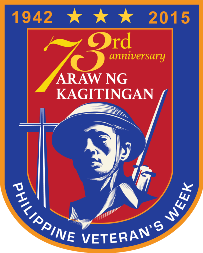
73rd anniversary of the Fall of Bataan April 9, 2015


Today, March 5th, the start of Philippine Veterans Week.

The Philippines and Filipinos throughout the US will observe the 73rd anniversary of the Fall of Bataan this coming Thursday, April 9th.

The day, also referred to as “Araw ng Kagitingan” (Day of Valor) is a legal holiday nationwide as stipulated in Republic Act 3022 which President Carlos P. Garcia signed in 1961. Read the full text of RA 3022 in this link.

The law calls on all Filipinos particularly their public officials to observe a one-minute silence at 4:30 o’clock in the afternoon of April 9 and to hold appropriate rites in honor of the veterans of the Fall of Bataan in particular and World War II in general.

The Fall of Bataan happened in April 9, 1942, when Filipino and American fighters isolated for months in Bataan surrendered to the Japanese Imperial Army under General Masaharu Homma.

This came after Major General Edward P. King of the United States Armed Forces in the Far East (USAFFE) came to the conclusion that further attempts to stop the Japanese from advancing would be useless. Most of the survivors of the Japanese offensive were then forced to march from Mariveles, Bataan all the way to San Fernando, Pampanga before traveling in tiny box cars via train to Camp O’Donnell in Tarlac.

The 65-BATAAN DEATH MARCH killed approximately 8,000 Filipino and 600 American troops.  At Camp O'Donnell thousands died. During the first 4 months 300 POWs died a day.

In Washington, a memorial will be held on April 9th at the World War II Memorial on the Mall and Embassy of the Philippines.

SCHEDULE PART I – WREATH LAYING CEREMONY
VENUE: WWII MEMORIAL, National Mall 
TIME: 4:45 – 5:30 PM

PARTICIPANTS

* VFW Washington Department Color Guard (Color Guard Commander – Jay Cabacar)
* Taps to be performed by James Cruzada Alleva
* Philippine Embassy Personnel
* FIL-AM Community of Metro DC
* Other Guests

SEQUENCE

* 4:45 – 5:15 PM : Assembly
* 5:15 – 5:30 PM : Wreath Laying Ceremony
HON. PATRICK CHUASOTO Chargé d’ Affaire, Philippine Embassy
* 5:30 PM : End of Ceremony
* 5:30 – 6:00 PM – DEPARTURE & PROCEED TO ROMULO HALL, PHILIPPINE EMBASSY

PART II – COMMEMORATION PROGRAM

VENUE: ROMULO HALL, PHILIPPINE EMBASSY 
TIME: 6:30 – 8:30 PM

* Philippine & US National Anthem (James Cruzada Alleva- Trumpet)
* Invocation – (WW2 Veteran)
* Recognition of WW2 Veterans and families present
* Welcome Remarks & Introduction of the Speaker - MGen Delfin N. Lorenzana AFP(Ret)
* Remarks: HON. PATRICK CHUASOTO
Chargé d’ Affaire, Philippine Embassy
Dinner/Refreshment
* Video/Film Clips Showing:
*Death March Recollection – by a veteran
*26th Annual Bataan Memorial March (3/22/2015)

Contact:
Office of Veterans Affairs
Embassy of the Philippines
Tel: 202-467-9427; 202-467-9410

Sunday, July 21, 2013

Guam's Liberation Day


July 21 is Guam's liberation day.

Marine Landing first hour
In 1944, after hours of Naval bombardment, American Marines and Infantry soldiers stormed the beaches. Marine Major General Roy S. Geiger, commanding general of III Amphibious Corps urged them forward saying "You have been honored. The eyes of the nation watch you as you go into battle to liberate this former American bastion from the enemy. The honor which has been bestowed on you is a signal one. May the glorious traditions of the Marine Corps' esprit de corps spur you to victory. You have been honored."

The Battle for Guam, lasting 21 days, was as nasty and brutal as any had been in the Pacific. The Imperial Japanese forces put up a tenacious resistance exacting heavy casualties. Japanese stragglers fought for months after the defeat and the last one was not found until 1972.

Soon, from airfields on Guam, as well as those on Tinian, B-29s were bombing the Japanese home islands. Hard fighting was yet to be experienced by Marine divisions on Peleliu, Iwo Jima, and Okinawa. But whether they knew it or not, the end of the war was less than a year away.

The War in the Pacific National Historical Park is a memorial to the citizens and liberators of Guam. It was established in 1978 to commemorate the bravery and sacrifice of those participating in the campaigns of the Pacific Theater of World War II and to conserve and interpret outstanding natural, scenic, and historic values and objects of the island of Guam. The National Park Service's website on Guam is an excellent historical resource including first person accounts and photos.

Part of Japan's terrible cost on Guam were 10,971 battlefield casualties, and more than 8,500 Japanese were killed or captured on Guam between August 1944 and the end of war in August 1945. In the 21 days of the Guam campaign ending 10 August, American Marine units of the III Amphibious Corps reported 1,190 men killed in action, 377 dead of wounds, and 5,308 wounded. The 77th Division's casualties were 177 soldiers killed and 662 wounded.

According to Captured: The Forgotten Men of Guam, an account of the POWs from Guam, there were 414 civilian and military, men and women POWs (five Navy nurses and a civilian wife and infant). Somehow, despite desperate conditions and dismal leadership only three percent perished. They were all taken to Japan aboard the Argentina Maru in January 1942 and first held at the Zentsuji POW Camp on Shikoku. There they did agricultural and stevedore labor. Some reportedly were used for human experimentation.

Today, of the more than 22,000 people who lived in Guam through World War II, less than 1,000 are still alive to share their memories. One constant, is the respect the people of Guam hold for their liberators, the US Marine Corps. The above video is from this past weekend's memorial ceremony.

Friday, November 09, 2012

Remembering Bataan & Corregidor

In late April of this year, five former POWs of Japan who fought on Bataan and Corregidor visited Washington, DC to commemorate these historic battles. Congressmen Mike Honda (D-CA), Brian Bilbray (R-CA), and Bill Huizenga (R-MI) were the only members of Congress to greet these veterans.

However, these members of America's greatest generation made a big impression on the people they did meet at the National Guard Association, the Heritage Foundation, the State Department, and the World War II memorial. As you will see in this video, young people are eager to meet and learn from them.


We have extensive video footage of the visit to Washington former by these former POWs of Japan, which we would like to turn into a a short documentary. Your contributions to help make this happen are much needed.