Sunday, April 05, 2015

And what of the fate of the torturers


Award-winning newsman Bob Simon died this past National Foundation Day, Japan's holiday to remember its Empire and the establishment of the Imperial family. One of his most inspiring stories for 60 Minutes was on Louis Zamperini. It won an Emmy.

For the segment, Simon went to Japan to track down Mitsuhiro WATANABE the torturer of Zamperini and hundreds of others who passed through the Omori and Naoetsu POW camps where Watanabe was a psychotic guard.

Simon found him. The interview is above. Zamperini had wanted to meet Watanabe and Simon want to film the encounter. Watanabe, an unrepentant former Imperial Army captain and now insurance salesman, refused.

Watanabe had escaped arrest by going into hiding during the American Occupation of Japan. He escaped prosecution when Washington suspended the arrest warrants of suspected war criminals after the San Francisco Peace Treaty went into effect on April 1, 1952.  With this, Watanabe was free to emerge from hiding and become a typical Japanese salaryman--an insurance salesman to be exact.

click to order
Watanabe severely beat and psychologically tortured Zamperini and was reviled among the other POWs, American and Allied. Yet, frankly and sadly, Watanabe was not the exception. Imperial Japan's fascist state had forged beasts from simple peasants and school boys.

Legendary war historian Max Hastings wrote in Retribution: The Battle for Japan, 1944-45 about the shocking Japanese treatment of POWs that has horrified and “fascinated” Westerners ever since. He noted that the POW’s “liberators were stunned by the stories they heard: of starvation and rampant disease; of men worked to death in their thousands, tortured or beheaded for small infractions of discipline.” He said that “It seemed incomprehensible that a nation with pretensions to civilisation could have defied every principle of humanity and the supposed rules of war.”

Thursday, March 19, 2015

American POWs speak truth to Japan and the Speaker of the US House of Representatives

Statement for the Record

to the

Senate Veterans' Affairs Committee and House Veterans' Affairs Committee Joint Hearing

 To Receive Legislative Presentations of 

Veterans Service Organizations


By


Ms. Jan Thompson


President, American Defenders of Bataan and Corregidor Memorial Society
[Daughter of PhM2 Robert E. Thompson USN, USS Canopus, 
Corregidor, Bilibid & Mukden, POW# 2011]

18 March 2015


American Prisoners of War of Japan
Honoring the Memory of World War II 
Veterans of the Pacific

Chairmen Isakson and Miller, Ranking Members Blumenthal and Brown, Members of the Senate and House Veterans Affairs Committees, thank you for allowing us to present the unique concerns of veterans of World War II’s Pacific Theater to Congress. The American Defenders of Bataan and Corregidor Memorial Society (ADBC-MS) represents surviving POWs of Japan, their families, and descendants. Our goal is to preserve their history and communicate the enduring spirit of the American POW experience in the Pacific to future generations.

We applaud the efforts of all the veterans’ service organizations to fight for adequate medical care and disability benefits. Moreover, the incidence and intensity of post-traumatic stress for American POWs of Japan is believed to be the greatest of any World War II veteran and possibly of any American war. These veterans had to survive the sordid POW camps, unimaginable and capricious torture, “hell ships” to Japan or its colonies, and years of brutal imprisonment and slave labor.  Upon returning from the Pacific War, they found a government reluctant to recognize and treat the mental and physical effects that were consequences of the deprivations suffered while POWs of Japan.

At the time, PTSD was not yet a medical category and VA doctors limited the POWs’ access to disability benefits by dismissing the after-effects of years of abuse, disease, and malnutrition. That should not happen to any veteran, and thus, we strongly support the legislative goals of our fellow veterans service organizations to ensure medical and mental health care, as well as to expedite disability claims, to provide rehabilitation, and to establish job-training programs for all American veterans. The American POWs of Japan and their families know intimately the difficulty of re-incorporation into civil society with little support.

Our task today, however, is to address another issue of respect and acceptance of returning service men and women. This is to ensure that they are not forgotten. For the American POWs of Japan this means that their unique history and the lessons of their experience with Imperial Japan is preserved. This is an urgent task. In the United States this history is being forgotten, and in Japan it is being revised.

Remembrance, Reconciliation, and Preservation

The ADBC-MS was dismayed in 2012 when none of the 70th anniversaries of historic battles during the beginning of World War II were officially recognized.  Astonishingly, December 7, 1941, “a date that will live in infamy,” has not been recognized with a Congressional resolution for many years. This year, the 70th Anniversaries of the daring “Great Raid” that liberated Cabanatuan POW camp in the Philippines and of the Battle for Manila that freed thousands of American civilian internees and POWs were not acknowledged.

We hope that future Congresses will remember the events that started American involvement in World War II with resolutions memorializing the simultaneous attacks on Pearl Harbor and the Philippines Islands. And we hope that future Congresses will honor those POWs who were massacred by Imperial Japanese forces as American forces advanced to liberate territories once lost. These include the 98 Americans on Wake Island who were bound and machine-gunned to death on October 7, 1943 and the 139 on Palawan Island who were drenched in gasoline and set afire.

The former POWs of Japan leave many legacies and lessons. Among the most important is how they coped with the postwar traumas of inhumane imprisonment. They fought two battles. One was for recognition of their “battle fatigue” and the other for justice and remembrance. The former is now championed by all veterans’ service organizations. We ask Congress for support and to help our veterans in their unique quest for justice and remembrance.

In an interview published 23 January 2014 in The Asahi Shimbun, Japan’s second largest newspaper, U.S. Ambassador to Japan Caroline Kennedy said:

I want to take a moment to talk about history and reconciliation. This fall, there was an event that previously might have been thought unimaginable. A group of Americans who suffered as Japanese prisoners of war during the Second World War returned here at the invitation of the Japanese government. Participating took enormous amounts of courage for all those involved….It is not easy, but citizens in all countries should encourage and support leaders who reach across history to build a peaceful future. It took courage on the part of the participants to come back to Japan and learn how Japan has changed.

As background to the Ambassador’s words, in 2009 the Government of Japan, through its then-Ambassador to the U.S. Ichiro FUJISAKI, and again in 2010 through its then-Foreign Minister Katsuya OKADA, officially apologized to the American POWs of Japan. These Cabinet-approved apologies first established as a Cabinet Decision on February 6, 2009 were unprecedented. Never before had a Japanese Government apologized for a specific war crime nor had it done so directly to the victims. The Japanese Government further initiated the “Japan/POW Friendship Program” of trips for American former POWs to visit Japan and return to the places of their imprisonment and slave labor. Thus far, there have been five trips, one each in the fall of 2010, 2011, 2012, 2013 and 2014.

The benefits of this long-awaited act of contrition have been immeasurable for former POWs and their families.  The Program, as Ambassador Kennedy has pointed out, is a great success, but we are concerned about its future. We are concerned that Japanese Prime Minister, Shinzo ABE, may revise Japan’s war apologies and end the POW/Japan Friendship Program. We are concerned that Japan has limited each trip to only seven former POWs. We currently have 26 men, all over 90-years old, eager to participate and waiting to hear when or if there will be another journey to Japan. Because of their advanced ages, many of these veterans may miss the opportunity.

We recall that in 1995 the Japanese government established the Peace, Friendship, and Exchange Initiative that included a multi-million dollar program of reconciliation and exchange with former POWs from all allied nations except the United States. From 1995 to 2009, the Japanese Government invited 904 ex-POWs from the United Kingdom, 507 from the Netherlands and 59 from Australia. The budgets allocated for those trips totaled over $16 million. To date, only 31 American former POWs have been invited and the yearly budgets have ranged only from $130,000 to $230,000. One cannot help but get the impression that some in Japan count on time and advancing years to limit the costs and impact of the program. We view this as shortsighted.

Success should encourage more action

The success of this visitation program should encourage Japan to do more. The Program should not end with the ability of the nonagenarian POWs to visit Japan or with their deaths. A POW’s captivity has multi-generational effects on families. The wives, children, and siblings of those who died suffered irreparable loss. The families of those who survived suffered from the long-term physical and mental health problems caused by the ex-POW's years of cruel captivity.  Widows, brothers, sisters, children, and other descendants have all been profoundly affected by the POW experience of their relative and they too should be eligible for future programs.

We ask Congress to encourage the Government of Japan to preserve, expand, and enhance its reconciliation program toward its American former prisoners. We want to see the trips to Japan continued and extended to include descendants and researchers. We want the visitation program drawn into a permanent program of research, documentation, reconciliation, and a people-to-people exchange that is not subject to the Japanese government’s yearly budget review. We want Japan’s Ministry of Foreign Affairs to publicize the program and its achievements. 

We want this program to include funds to create visual reminders of history through museums and monuments.  We want national memorials to the POWs who slaved and died on Japanese soil and territories as well as aboard the “hell ships.” We want to see a Japanese government-funded memorial at the Port of Moji where most of the hell ships docked and unloaded their sick and dying “cargo.”

We also want the many companies that brutally used POWs as slave labor and who now profit in the American market, to join with their government by acknowledging their use of forced labor and by offering their own acts of reconciliation. Over 60 Japanese companies, such as Mitsui, Mitsubishi, Sumitomo, Hitachi, Toshiba, Kawasaki, Nippon Steel, Nippon Express, Nippon Sharyo, Ube Industries, Showa Denko, Aso Group, and Yawata Steel maintained war production by cruel exploitation of American and Allied POWs.

Prime Minister Shinzo ABE and his address to Congress

Prime Minister Shinzo ABE, who we understand may soon address a joint meeting of Congress, has a unique opportunity to acknowledge Japan’s historical responsibilities. His past statements rejecting the verdicts of Tokyo War Crimes Tribunal that serves as the foundation of the 1951 San Francisco Peace Treaty with Japan trouble us. We want Congress to only extend the invitation to Prime Minister Abe to speak at the podium of Roosevelt and Churchill if they are assured that he will acknowledge that Japan’s defeat released the country from the venom of fascism and the inhuman goals of a criminal regime.

By doing so, the Japanese prime minister’s speech to Congress can be a historic one of reconciliation of which the first step is acknowledgement. Tied to this, we feel, should be that he extends and enhances the POW visitation program as we have outlined. He can engender trust with his American allies by honoring their country’s veterans. Here he can signal to Japan’s other wartime victims that meaningful reconciliation, as Ambassador Kennedy pointed out, is possible. The POW/Japan Friendship Program is one that confronts the past while preserving the dignities of both Americans and Japanese.

It is our hope in addressing this hearing that we can encourage Congress to work with the Obama Administration and the State Department to persuade Japan to hold to its promises and responsibilities. Japan needs to be encouraged to do more.  And it is our hope that members of Congress will encourage the many Japanese corporations that operate in their districts to acknowledge the history of the American POWs who slaved for them.

The American POWs of Japan and their families have paid a high price for the freedoms we cherish. What they ask in return for their sacrifices and service is for their government, even after 70 years, is to keep its moral obligation to them. They do not want their history ignored or exploited. They do not ask for further compensation. What they want most is to have their government stand by them to ensure they will be remembered, that our allies respect them, and their American history preserved.

Thank you for this opportunity to address your committees.

[Ms. Thompson is a documentary filmmaker. Her recent work is Never the Same: the POW Experience]

Sunday, March 01, 2015

Remembering the USS Houston CA-30


March 1, 1942

Arlington National Cemetery, Section 12
Memorial to the crew of the U.S.S. Houston-CA-30 & H.M.A.S. Perth
Over this week there will be a series of memorial events in Indonesia and Houston, Texas commemorating valiant battle of the Sundra Strait and the sinking of the USS-Houston CA-30. On Saturday, March 7th at 2:00pm in Sam Houston Park there will be a remembrance service at the USS-Houston Memorial.


click to order
On February 28, 1942, the day after the Battle of the Java Sea, the destroyers HMAS Perth (Australian Navy) and USS Houston CA-30 (U.S. Navy) steamed into Banten Bay. They ran into a Battle Fleet of the Imperial Japanese Navy. The two cruisers may have sunk one Japanese transport and forced three others to beach. However, a Japanese destroyer squadron blocked the Sunda Strait, their means of retreat. Unable to withdraw, Perth was repeatedly hit with gun and torpedo fire and sank about about 12:30 AM local time on March 1. Houston, losing power after a torpedo hit, managed to damaged three destroyers and sink a minesweeper. Finally dead in the water, with her captain dead, she began to sink. Japanese sailors proceeded to machine-gun the decks and the men in the sea until the ship capsized and sank shortly after the Perth went down.

Of the crew of 1,061, only 368 survived including 24 of the 74-man USMC detachment aboard. The crew became prisoners of the Japanese for the remainder of the war. Most of the remaining officers were sent to Japan to be slave laborers. The rest ended up toiling on Thai-Burma Death Railway. Seventy-nine men died of torture, disease and starvation while prisoners.


The wreck of the USS Houston lies in the Sunda Strait and has over the years been damaged by scavengers and treasure hunters. The US and Indonesian Navies are developing plans to project this hallowed war grave.  Ship of Ghosts: The Story of the USS Houston, FDR's Legendary Lost Cruiser, and the Epic Saga of her Survivors by James D. Hornfischer (2006) is considered a definitive history of the ship. 

Thursday, February 05, 2015

US National Archives shares records behind UNBROKEN

National Archives Meets Hollywood: Shares Records Behind UNBROKEN!

Free screening, document display, and article highlight National Archives’ connection

Washington, DC

Special free screening of UNBROKEN
Tuesday, February 10, at 7 PM, William G. McGowan Theater

Join us for a free screening of the film UNBROKEN (2014; 137 minutes; trailer), based on the 2010 book by Laura Hillenbrand, UNBROKEN: A World War II Story of Survival Resilience and Redemption. The film, a World War II action drama, was produced and directed by Angelina Jolie and stars Jack O'Connell, Takamasa Ishihara, and Domhnall Gleeson. Presented in partnership with NBCUniversal and in conjunction with the UNBROKEN Featured Document display, February 5 through March 4, 2015.

Register online or call 202-357-6814. Theater doors will open 45 minutes prior to start time. Walk-ins without reservations will be admitted 15 minutes prior to start time, depending on available seats. Attendees should use the Special Event entrance on Constitution Avenue and 7th Street, NW.

UNBROKEN Featured Document Display*
February 5 through March 4, 2015, National Archives East Rotunda Gallery

The National Archives welcomes UNBROKEN with a special display of Olympian Louis "Louie" Zamperini’s wartime service records and his Purple Heart, which he gave to UNBROKEN author Laura Hillenbrand. The display is free and open to the public at the National Archives Museum in Washington, DC, on Constitution Avenue at 9th Street, NW.

On May 27, 1943, Army Air Force bombardier Louis “Louie” Zamperini’s B-24 airplane crashed into the Pacific Ocean. Louie survived 47 days at sea, only to be taken as a prisoner of war by the Japanese. His fate unknown, Louie was declared dead a year and a day after his plane went down. His family received a condolence letter from President Franklin Roosevelt and a Purple Heart medal for “wounds that resulted in his death.” Against all odds, Zamperini survived and was liberated at the end of the war. The National Archives Museum’s “Featured Documents” exhibit is made possible in part by the National Archives Foundation.

Display highlights include:
-Letter from President Franklin D. Roosevelt to the Zamperini Family after Louis was mistakenly declared deceased, May 28, 1944.* National Archives at St. Louis
-Certificate awarding the Purple Heart medal to Louis Silvie Zamperini after he was mistakenly declared deceased, October 12, 1944.* National Archives at St. Louis
-Purple Heart medal awarded to Louis Silvie Zamperini, ca. 1944. Courtesy of Laura Hillenbrand, author "Unbroken: A World War II Story of Survival, Resilience, and Redemption," who received it as a gift from Louis Zamperini.
Online resources: Zamperini’s Paper Trail at the National Archives
The National Archives holds hundreds of millions of records created or received by the U.S. Government during World War II, including the original records of hero Louis Zamperini. See:
Air Crew Report on the disappearance of the Green Hornet, Zamperini's B-24 plane.
Smithsonian.com “Deep Dive” on the Air Crew Report that includes an interview with archivist Eric VanSlander.
National Archives blog post “Louis Zamperini: The Story of a True American Hero.”

The East Rotunda Gallery and William G. McGowan Theater are located in the National Archives Museum in Washington, DC. Metro accessible on Yellow or Green lines, Archives/Navy Memorial station. To verify the date and times of the programs, call the National Archives Public Programs Line at: 202-357-5000, or view the Calendar of Events online.

* Please note: a July 12, 1973, fire at the National Personnel Records Center in St. Louis, MO, destroyed approximately 16-18 million Official Military Personnel Files (OMPF) of Army and Air Force service members, including Zamperini’s file. In reconstructing his service record, official copies of these original records were incorporated into Zamperini’s OMPF by the National Archives.

Saturday, January 31, 2015

70th Anniversary of the Great Raid

On January 30, 1945, three days after Soviet troops liberated their first Nazi death camp, Auschwitz-Birkenau, American Rangers and Filipino guerrillas rescued American and Allied POWs from the first of many Japanese concentration camps on the Philippines.

The Great Raid—as the liberation of Cabanatuan was called-was urgent and heroic. General Douglas MacArthur approved the raid ahead of his advance on Manila and the full liberation of the Philippines after an intersected cable revealed a “kill all” order by Japan for all prisoners.

entrance to Palawan Massacre 
Proof that the Japanese were serious about this order was confirmed in early January by reports of the December 14th
Palawan Massacre. On Palawan Island in the Philippines, Japanese forces anticipating an American invasion pushed 150 American POWs into an air raid shelter, doused them with gasoline, set them afire, and then machine gunned, bayoneted and clubbed to the screaming men to death. Miraculously, eleven escaped to tell their story. Last Man Out: Glenn McDole, USMC, Survivor of the Palawan Massacre in World War II is one of these inspiring accounts of survival and perseverance.
One hundred and twenty-three are now buried at Jefferson Barracks National Cemetery in St. Louis, Missouri.

Nearly 3,000 American POWs had died in Cabanatuan. Further thousands had been transported to Japan for slave labor from the camp. Remaining were the sick and dying.

DVD click to order
Immortalized in the movie, The Great Raid, a group of more than 100 Army Rangers, Alamo Scouts and Filipino guerrillas traveled 30 miles behind Japanese lines to reach the camp on Bataan, Philippines. Along the route, other guerrillas in the villages muzzled dogs and put chickens in cages lest they alert the Japanese.

The nighttime raid, under the cover of darkness and a distraction by a P-61 Black Widow, surprised the Japanese forces in and around the camp. Hundreds of Japanese troops were killed in the 30-minute coordinated attack; the Americans suffered minimal casualties. The POWs were escorted back to American lines, often with Rangers carrying two emaciated men on their backs. In the end, the rescuers rounded up nearly 60 caribou carts to transport the survivors. The rescue allowed the prisoners to tell of the death march and prison camp atrocities, which sparked a new rush of resolve for the war against Japan when it was made public in March 1945.
click to order


The raid was considered successful—489 POWs were liberated, along with 33 civilians. The total included 492 Americans, 23 British , three Dutch, two Norwegians, one Canadian, and one Filipino. The rescue, along with the liberation of Camp O'Donnell the same day, allowed the prisoners to tell of the Bataan and Corregidor atrocities.

The Great Raid was soon followed by additional successful liberations, such as the raid by the 1st Cavalry Flying Column of Santo Tomas Civilian Internment Camp on February 3, raid of Bilibid Prison on February 4, and the 11th Airborne's raid at Los Baños on February 23. 

A poorly worded and inaccurate joint resolution by Congress directed then-President Ronald Reagan to issue a proclamation designating April 12, 1982 as "American Salute to Cabanatuan Prisoner of War Memorial Day".

Wednesday, January 28, 2015

The day we knew - Japan's war atrocities


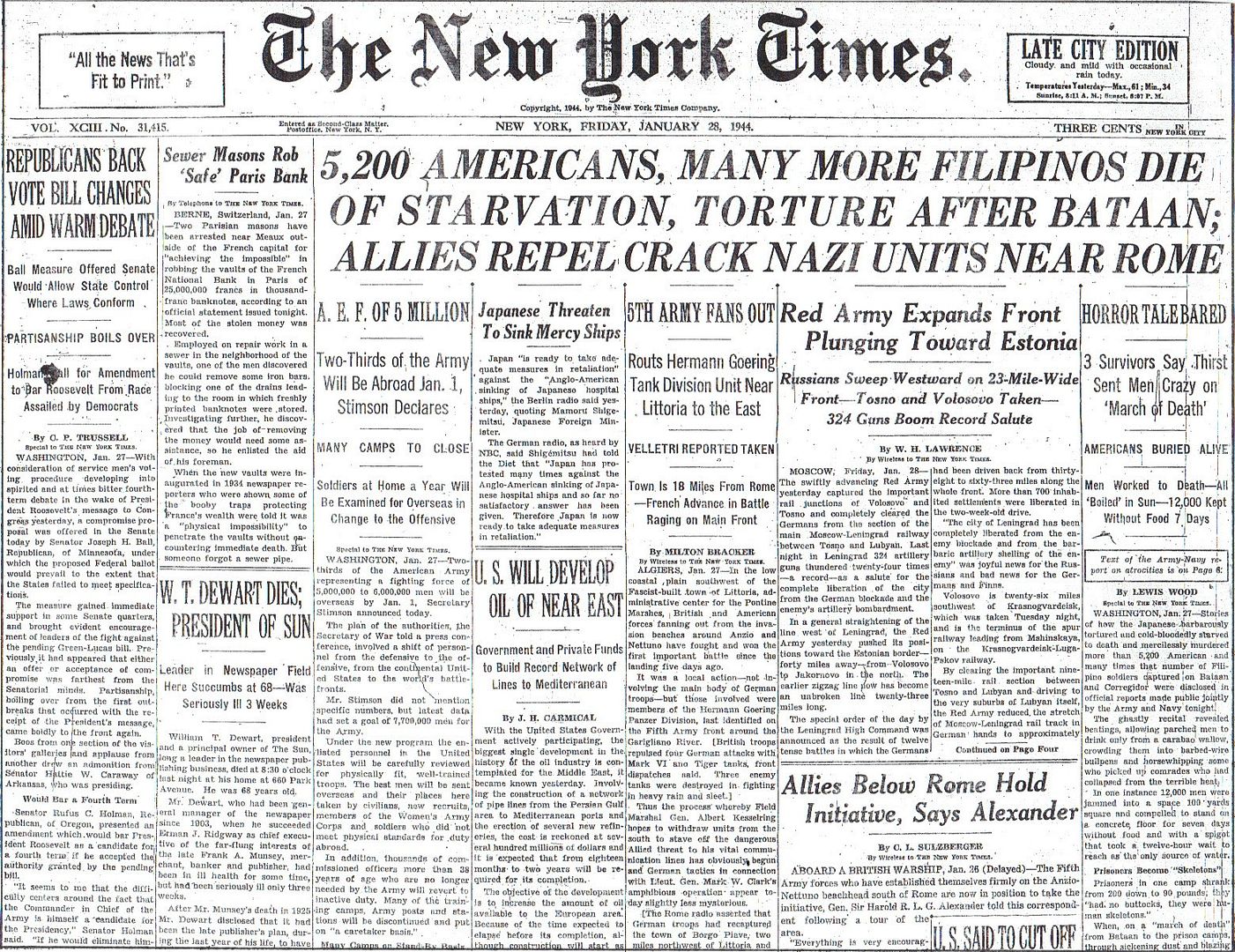
Seventy-one years ago today, the headlines across the United States screamed of the brutality of Imperial Japan. Prisoners, civilians, women, children had been tortured, starved, and slaughtered in the Philippines. The rumors of unimaginable savagery toward its captive peoples had all proved true.

On January 28, 1944, the world first learned about the Bataan Death March (April 1942) and the horrors endured by the American and Filipino POWs of Japan. Invading Japanese forces showed no mercy, allowing their prisoners to die by the thousands from savagery, starvation, and disease.

click to order
Newspapers and newsreels told the stories of three American escapees from a Japanese POW camp in the Philippines who had survived the Death March the Davao Prison Camp. Never before had the public been allowed to hear of the extent of Japanese atrocities and the inhumanity of their regime. Washington had kept the story from the public, fearing that the Japanese would use it as an excuse to end efforts to aid the POWs or worse.

Congressman and editors cursed Churchill and Roosevelt for advocating a Europe First strategy that put aside the war in Asia in favor of focusing on Hitler in the West. The result was the smashing of American air and sea power in Asia, the largest defeat in US military history, and the unfathomable deaths of thousands of Americans both military and civilian in the Pacific.

The truth aroused such fury in the American public that the government’s Europe First policy was imperiled. On January 29th at the Brooklyn Navy Yard, Margaret Truman, Missouri senator Harry Truman’s daughter, expressed the feelings of her fellow Americans when she said as she christened the battleship USS Missouri, “May this great ship be an avenger to the barbarians who wantonly slaughtered the heroes of Bataan.” *

click to order
More war bonds were sold in January and February 1944 than in any period of the war. The graphic description of the Death March and the POW camps was serialized by the Chicago Tribune and made into a book. The hero of the story, Texas native and US Army Air Corps William Dyess who organized the escape, unfortunately died December 1943 in a plane crash barely a month before the public release of his story.

The public learned that American and Filipino forces fought from an untenable position until formally surrendering to the Japanese on April 9. The Japanese immediately began to march some 76,000 prisoners (12,000 Americans, the remainder Filipinos) northward into captivity along a 65-mile route of death.

Japanese butchery, disease, exposure to the blazing sun, lack of food, and lack of water took the lives of approximately 5,200 Americans and Filipinos along the way. Many prisoners were bayoneted, shot, beheaded or just left to die on the side of the road. "A Japanese soldier took my canteen, gave the water to a horse, and threw the canteen away," reported one escapee. "The stronger were not permitted to help the weaker. We then would hear shots behind us." The Japanese forced the prisoners to sit for hours in the hot sun without water. "Many of us went crazy and several died."

The ordeal lasted five days for some and up to twelve days for others. Although the Japanese were unprepared for the large number of prisoners in their care, the root of the brutality lay in the Japanese attitude that a soldier should die before surrender. A warrior's surrender meant the forfeiture of all rights to treatment as a human being.

This was the "first murder" Captain William Dyess said he witnessed:
"The victim, an air force captain, was being searched by a three-star private. Standing by was a Jap commissioned officer, hand on sword hilt. These men were nothing like the toothy, bespectacled runts whose photographs are familiar to most newspaper readers. They were cruel of face, stalwart, and tall. 
'The private a little squirt, was going through the captain's pockets. All at once he stopped and sucked in his breath with a hissing sound. He had found some Jap yen.' 
'He held these out, ducking his head and sucking in his breath to attract notice. The big Jap looked at the money. Without a word he grabbed the captain by the shoulder and shoved him down to his knees. He pulled the sword out of the scabbard and raised it high over his head, holding it with both hands. The private skipped to one side.' 
'Before we could grasp what was happening, the black-faced giant had swung his sword. I remember how the sun flashed on it. There was a swish and a kind of chopping thud, like a cleaver going through beef'. 
'The captain's head seemed to jump off his 'shoulders. It hit the ground in front of him and went rolling crazily from side to side between the lines of prisoners.' 
'The body fell forward. I have seen wounds, but never such a gush of. blood as this. The heart continued to pump for a few seconds and at each beat there was another great spurt of blood. The white dust around our feet was turned into crimson mud. I saw the hands were opening and closing spasmodically. Then I looked away.' 
'When I looked again the big Jap had put up his sword and was strolling off. The runt who had found the yen was putting them into his pocket. He helped himself to the captain's possessions.'
You can read here THE DYESS STORY: The Eye-Witness Account of the DEATH MARCH FROM BATAAN and the Narrative of Experiences in Japanese Prison Camps and of Eventual Escape

Tuesday, January 27, 2015

Tom Uren an Australian hero: In Memoriam

Tom Uren, a man of letters: POW, MP, AC

January 27, 2015

''I'VE been hit with open hands, closed fists, pieces of wood, iron bars and bamboo about two inches in diameter,'' Tom Uren says.


He was hardly more than a boy then- a prisoner-of-war and slave of the Japanese in his early 20s on the Burma-Thai railway.

But Tom Uren would take many more hits as his long, often controversial life wore on, and he rolled with them all and refused to lie down.

Today, aged 91, with most of his opponents fallen away - and a lot of them forgiven by him, including the Japanese - he will receive the highest honour his nation can bestow on a civilian: Companion in the General Division of the Order of Australia.

Others to be so honoured today include former Howard government foreign affairs minister Alexander Downer, astrophysicist and joint Nobel prize winner Professor Brian Schmidt of the Australian National University's Mount Stromlo Observatory, and the director of the Australian Centre for Christianity and Culture in Canberra, the Reverend Professor James Mitchell Haire.
Australia mourns the passing of the Honourable Tom Uren AC. He was a prisoner of war, a parliamentarian, a minister, a deputy leader of his party and served our country throughout his adult life.He was an aspiring boxer and outstanding athlete who joined the army at the age of 20 and deployed to Timor.He spent his 21st birthday – and the following three – as a prisoner of war. He suffered the brutality of the Burma-Thai Railway and he witnessed from afar the atomic bomb on Nagasaki.Despite these experiences, he rejected hatred. -- Prime Minister Tony Abbott
Mr Uren's award states it is for ''eminent service to the community, particularly through contributions to the welfare of veterans, improved medical education in Vietnam and the preservation of sites of heritage and environmental significance".

All true, but it's an inadequate summation of the life of the Balmain-born man who, impoverished, left school at 13 years and seven months.

He fought for the heavyweight boxing championship of Australia at 19 (and lost), marched into the hell of the Burma-Thai railway at 21, served the Labor Party as member for the Sydney electorate of Reid for 32 years, became his party's deputy leader and a cabinet minister in the Whitlam government and later found himself consigned to the junior ministry for four years in the Hawke government.

As a whip-thin prisoner shipped from Thailand to Japan to labour in a copper smelter, he watched the sky discolour when the Fat Man atomic bomb was dropped on Nagasaki. [He was at Omuta, Fukuoka 17 as a slave laborer for Mitsui Mining.]

It stopped the war and freed him, but he became one of Australia's leading anti-nuclear campaigners. The Japanese, he insists, were as much victims of militarism and fascism as anyone else.

Long a man of the Left, Mr Uren's early excursions into the peace movement were so passionate that ASIO believed he was taking his instructions from the Soviets. When newspapers published the libel, he sued and eventually won enough for two holiday homes, which he took delight in calling the ''Fairfax Retreat '' in the bush and the ''Packer Lodge'' on the New South Wales south coast.

His insistence in marching against the Vietnam War earned him several stretches in jails, including Sydney's Long Bay and Brisbane's Boggo Road. Mr Uren was appalled by the dehumanising effect of the old jails, and used his influence to get at least one of his fellow prisoners a job in Canberra.

''So many people are crook on their fellows, but I just look for the love in people,'' he says.

Often Mr Uren found himself talking, he says ''to two-and-a-half dogs". He was one of the early proponents of self-determination for the East Timorese, but no one seemed interested. He simply kept at it until it became mainstream.

The defining period of his life was the Burma-Thai railway. Taken prisoner on Timor aged 20, he marched into his first prison camp on the railway aged 21.

Always a big, strong man, he became known for his willingness to put his body between furious Japanese guards and his comrades, figuring he could take the beating that might kill a mate weakened by hunger, disease and slaving.

It was the influence of the camp commander, Lieutenant-Colonel Edward ''Weary'' Dunlop, that stayed with him. Colonel Dunlop, a surgeon, taxed fellow officers to build a small bank to buy medical supplies and food, saving the lives of many hundreds of men, and he ensured that the strong looked after the weak, the young looked after the old and the relatively healthy cared for the sick.

It was, Mr Uren says, collectivism - a principle he adopted for life and which during the Cold War found him branded a communist, though he never was.

He never forgot his fellow POW survivors, and fought a battle over 23 years to grant them extra benefits, arguing that they died younger and suffered greater illness than other returned servicemen. In 2011, Prime Minister Julia Gillard announced that all remaining POWs would receive an extra $500 a fortnight.

Of the 22,000 Australian prisoners of the Japanese, only some 400 are alive now, but Mr Uren said Ms Gillard's action displayed compassion and justice, which he valued above all else.

And his elevation to Companion of the Order of Australia?


''I just want to thank my fellow Australians for their support, their warmth and their love in my evergreen years,'' he says.

Reprinted from The Sydney Morning Herald by Tony Wright